by Thomas R. Wells
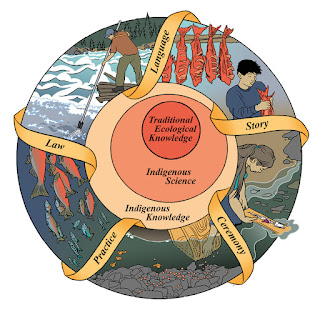
The idea that ‘indigenous’ knowledge counts as knowledge in a sense comparable to real i.e. scientific knowledge is absurd but widely held. It appears to be a pernicious product of the combination of the patronising politics of pity and anti-Westernism that characterises the modern political left (dumb, but still preferable to the politics of cruelty that characterises the modern political right!).
My point is simple: knowledge is knowledge. Where it comes from doesn’t matter to its epistemic status. What matters is whether it deserves to be believed. The scientific revolution has provided a general approach – systematic inquiry – together with specialist methodologies appropriate to different domains (such as mathematical modeling, taxonomy, statistical analysis, and experimental manipulation and measurement). It is irrelevant that this approach first appeared in North-Western Europe and that many of the domain specific techniques were first developed and refined by white men from the ‘west’. What is relevant is that modern science allows a degree of confidence in factual and theoretical claims that has never been warranted before, and made this capability equally available to everyone around the world as the new standard for objective knowledge, i.e. knowledge that is reliably true no matter from what perspective you look at it.
If indigenous peoples have observational data and successful technologies to contribute to this kind of systematic inquiry into what makes an ecosystem resilient, or what plants might contain molecules with pain-relieving properties, or the history of climactic events, then that should be welcomed. But the test of whether these are an actual contribution must come from whether they survive scientific scrutiny, not the authenticity of their indigenous origins.


 Jeanne Moutoussamy-Ashe. Mine Dancers, Alexandra Township, South Africa, 1977.


 CW: As the title suggests, there will be discussion of death and dying and some mention of suicide in this post.
 Remember how Dave interacted with HAL 9000 in 2001: A Space Odyssey? Equanimity and calm politeness, echoing HAL’s own measured tone. It’s tempting to wonder whether Arthur C. Clarke and Stanley Kubrick were implying that prolonged interaction with an AI system influenced Dave’s communication style and even, perhaps, his overall demeanor. Even when Dave is pulling HAL’s circuits, after the entire crew has been murdered by HAL, he does so with relative aplomb.