by Mindy Clegg
Since the start of the second Trump term, people have noticed the destructive nature of this regime, even those who at one time dismissed him as an actual threat to the country (looking at you David Brooks). Those of us who avoided the Flavor Aid understood the great harm that another Trump presidency would visit upon us. Like the deportations and tariffs, this was foreseeable. Last time I touched on the attacks on the nation-state and international institutions that have shaped our world since the end of the second world war. Universities are also under attack by Trump and other autocrats, modeling their approach to academia on Victor Orban’s authoritarian takeover on Hungarian universities.
This is less an attempt to completely take universities apart and more an attempt to redirect them back to what some see as their original mission: empowering the elite classes to shape our society for their own benefit. In other words, Trump and his cronies seek to undo the democratic work of the last century, where education started to be seen as a universal good and necessity. In doing so, they attack an important foundation of modern society which they themselves benefited. But this is not new with Trump as there have been years of attacks by the far right. If higher education does need reform, what they propose is not that. It is, in fact, an attempt to gut democratic institutions, an important social leveler of the past 70 years.
Academia is a set of institutions (universities, colleges, technical schools, publishers, journals, and so on) that deserve both criticism and praise for its role in modern society. On one hand, the expansion of universities—along with unionized blue color work—have been an effective engine of social mobility in the global north since the end of the second world war. This was true in both the first and second world, with some countries making college essentially free. In the US, college became more affordable thanks in part to programs like the GI Bill and Pell Grants. Starting in the 1940s, this helped more working and middle class young people access college in greater numbers with the biggest beneficiaries being the Baby Boomers. As more people went to college, the need for more faculty sky-rocketed and public universities grew in size. Access to a college education contributed to upward mobility and the expansion of the postwar American economy. Read more »



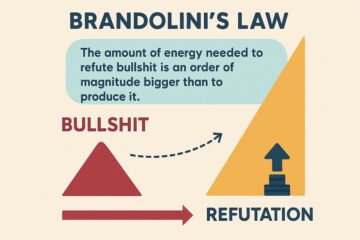 As atrocious, appalling, and abhorrent as Trump’s countless spirit-sapping outrages are, I’d like to move a little beyond adumbrating them and instead suggest a few ideas that make them even more pernicious than they first seem. Underlying the outrages are his cruelty, narcissism and ignorance, made worse by the fact that he listens to no one other than his worst enablers. On rare occasions, these are the commentators on Fox News who are generally indistinguishable from the sycophants in his cabinet, A Parliament of Whores,” to use the title of P.J. O’Rourke’s hilarious book. (No offense intended toward sex workers.) Stalin is reputed to have said that a single death is a tragedy, a million deaths is a statistic. Paraphrasing it, I note that a single mistake, insult, or consciously false statement by a politician is, of course, a serious offense, but 25,000 of them is a statistic. Continuing with a variant of another comment often attributed to Stalin, I can imagine Trump asking, “How many divisions do CNN and the NY Times have.”



 Sughra Raza. Seeing is Believing. Vahrner See, Südtirol, October 2013.
 It’s a ritual now. Every Sunday morning I go into my garage and use marker pens and sticky tape to make a new sign. Then from noon to one I stand on a street corner near the Safeway, shoulder to shoulder with two or three hundred other would-be troublemakers, waving my latest slogan at passing cars.
 I first started reading Jon Fosse’s Septology in a bookstore. I read the first page and found myself unable to stop, like a person running on a treadmill at high speed. Finally I jumped off and caught my breath. Fosse’s book, which is a collection of seven novels published as a single volume, is one sentence long. I knew this when I picked it up, but it wasn’t as I expected. I had envisioned something like Proust or Henry James, a sentence with thousands and thousands of subordinate clauses, each one nested in the one before it, creating a sort of dizzying vortex that challenges the reader to keep track of things, but when examined closely, is found to be grammatically perfect. Fosse isn’t like that. The sentence is, if we want to be pedantic about it, one long comma splice. It could easily be split up into thousands of sentences simply by replacing the commas with periods. What this means is the book is not difficult to read—it’s actually rather easy, and once you get warmed up, just like on a long run, you settle into the pace and rhythm of the words, and you begin to move at a steady speed, your breathing and reading equilibrated.