by Barry Goldman
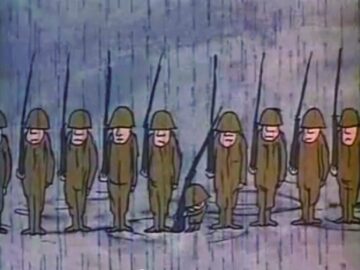
The brilliant and recently departed Jules Feiffer drew a cartoon many years ago called Munro. It was later made into an Academy Award-winning animated short. You can watch it here.
Munro was only four years old, but somehow he got drafted into the army. He went to see his sergeant and said, “I’m only four.” The sergeant said:
It is the official policy of the army not to draft men of four. Ergo you cannot be four.
We see this form of reasoning in many contexts. It is the official policy of the United States that we do not torture prisoners of war. Therefore, waterboarding, which has been used to torture prisoners since the 14th century, cannot be torture.
Alternatively, the prisoners captured after 9/11, detained at Guantanamo, and waterboarded regularly cannot be “prisoners of war.” Instead, they are “alien enemy combatants” to whom the protections of the Geneva Convention do not apply.
This kind of reasoning can be difficult and complex and may require many years of rigorous training. Only a highly-trained and rigorous thinker like John Yoo, now the Emanuel S. Heller Professor of Law at UC Berkeley, could produce a document like Military Interrogation of Alien Unlawful Combatants Held Outside the United States. Try to read it and you will see.
My point is: This is what lawyers do. As the Devil’s Dictionary put it:
LAWYER, n. One skilled in circumvention of the law.
But there is a larger point that is both more important and less discussed. Even if there were a clear and unambiguous law, duly approved by Congress and signed by the president that said “Torturing prisoners is perfectly fine,” it would not be fine. If anything is wrong, torture is wrong. It doesn’t matter what Mr. Yoo or Congress or the President says. An atrocity enacted into law does not cease to be an atrocity. Read more »







 Jeanne Moutoussamy-Ashe. Mine Dancers, Alexandra Township, South Africa, 1977.


 CW: As the title suggests, there will be discussion of death and dying and some mention of suicide in this post.
 Remember how Dave interacted with HAL 9000 in 2001: A Space Odyssey? Equanimity and calm politeness, echoing HAL’s own measured tone. It’s tempting to wonder whether Arthur C. Clarke and Stanley Kubrick were implying that prolonged interaction with an AI system influenced Dave’s communication style and even, perhaps, his overall demeanor. Even when Dave is pulling HAL’s circuits, after the entire crew has been murdered by HAL, he does so with relative aplomb.