
by Adele A. Wilby
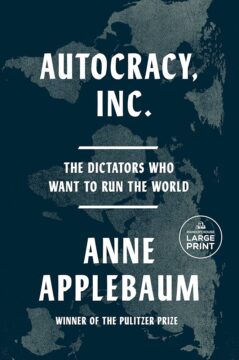 Renowned and respected for her scholarship, her history of authorship of many books on dictatorship and her political experience, is it any wonder that Anne Applebaum’s new book Autocracy, Inc. The Dictators Who Want to Run the World has been so critically received; she is an expert on her subject. This slim volume provides us with an incisive exposition and analysis of how autocrats function in the world today, securing their own personal power and wealth, and in Applebaum’s view, posing a threat to democracies.
For Applebaum, autocratic regimes clearly pose a threat to democracies, but about which states is she referring? The number of autocrats is, according to her, extensive and includes communists, monarchists, nationalists and theocrats. On Applebaum’s ‘list’ of autocracies are, predictably, Russia, China, Iran, North Korea – the well-known adversaries of the West – amongst many others. ‘Softer autocracies and hybrid democracies, sometimes called illiberal democracies’ such as Turkey, Singapore and India also come under her purview. It appears that autocracies and ‘softer autocracies’ outnumber the democracies in the world today and most of the world’s population lives under such regimes, and that is the problem for Applebaum.
We learn from Applebaum that the ‘art’ of autocracy in the modern world is very much up to speed, taking advantage of a globalised world, involving sophisticated networks of ‘financial structures, a complex of security services – military, paramilitary, police – and technological experts who provide surveillance, propaganda and disinformation’. The apparatus deployed by autocrats to achieve their political and financial objectives are probably used by most states across the globe; it is the purpose for which they are used that irks Applebaum. In her view a ‘ruthless, single-minded determination to preserve their personal wealth and power’ drives the autocrats in the world today. Read more »


 Every time I read or watch anything about the election I hear some variant of the phrase “margin of error.” My mathematically attuned ears perk up, but usually it’s just a slightly pretentious way of saying the election is very close or else that it’s not very close. Schmargin of error might be a better name for metaphorical uses of the phrase.
 Philosophical reflection on artificial intelligence (AI) has been a feature of the early days of cybernetics, with Alan Turing’s famous proposals on the notion of intelligence in the 1950s rearming old philosophical debates on the man-system or man-machine and the possibly mechanistic nature of cognition. However, AI raises questions on spheres of philosophy with the contemporary advent of connectionist artificial intelligence based on deep learning through artificial neural networks and the prodigies of generative foundation models. One of the most prominent examples is the philosophy of mind, which seeks to reflect on the benefits and limits of a computational approach to mind and consciousness. Other spheres of affected philosophies are ethics, which is confronted with original questions on agency and responsibility; political philosophy, which is obliged to think afresh about augmented action and algorithmic governance; the philosophy of language; the notion of aesthetics, which has to take an interest in artistic productions emerging from the latent spaces of AIs and where its traditional categories malfunction; and metaphysics, which has to think afresh about the supposed human exception or the question of finitude.
 The opening credits of Affliction (1997) feature small, rectangular images that fill only half the screen. You wonder if something is wrong with the aspect ratio, or if the settings have been changed on your television. A succession of images is placed before the viewer: a farmhouse in a snowy field, a trailer with a police cruiser parked in front, the main street of a small, sleepy town, the schoolhouse, the town hall. The last image is a dark, rural road, with a mountain in the distance. Finally the edges of the image expand, fill the screen, and a voice begins to narrate:



 Egypt
Egypt Germany



 In her provocative, genre-defying book,
 There is a