
by Mindy Clegg

Many scholars of the hard sciences have recently descended into an understandable panic over the anti-intellectual actions of the current destructive regime in the White House. The Trump administration has begun to dismantle the federal funding system that benefited academia since the Cold War. Many critics see this as an unprecedented and aggressive intervention by the state into academia in order to curtail academic freedom, a standard expectation of the modern university system. The establishment of facts about the world via testable and repeatable hypothesis helped shape western society for centuries now.
Over the course of the 20th century, scientific research incubated in academia became a key driver of many changes (good and bad) in our society. Academia became the linchpin of a network of public-private partnerships that led to these improvements, especially during the Cold War. Without university-level research it seems unlikely that we’d have our regime of vaccinations that has saved millions of lives. Nor would we have the modern computing industry. From the point of view of many academic scientists, it took only a single, massively destructive administration to send the whole network into a death spiral. How could the work of building a system of knowledge over 150 or so years come tumbling down over a handful of years? The reality is that the process of undermining the academy is not just a byproduct of the Trump era. It did not begin with this current attack on science. Rather, the center and far right have long targeted the the humanities and social (or soft) sciences.
In recent years, education has been shifting towards centering STEM fields which stands for science, technology, engineering, and mathematics. Sometimes this includes the social sciences and humanities but that’s hotly debated. The term gained traction in 1990s. Placing STEM at the center of education became a rallying cry among those wanting to keep a university education inline with a changing economy after the Cold War. Put differently, they sought to refocus sciences to better serve the needs of capital in the neoliberal economy. By that time, the computing industry was growing and computer science departments were expanding to accommodate the need. Other fields such as engineering and other technologies got a boost as well. Read more »



 Nick Brandt. Zaina, Laila and Haroub, Jordan, 2024. From The Echo of Our Voices – The Day May Break.





 Philip Graham: The home page of your new and expanded author’s website,
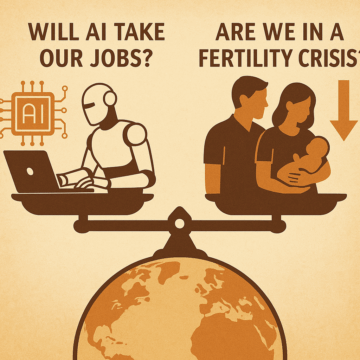 The question of the day on everyone’s minds is whether AI is a boom or a bust. But if we lift our eyes ever so slightly from the question of the day and look at the bigger picture, two bigger questions come into view.
 In Arabic, the word