
Victory at Charlie’s Place: A Democracy More Like ‘High Noon’ than de Tocqueville

by Daniel Gauss

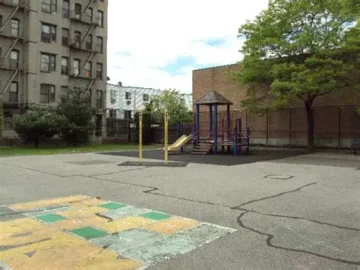
Charlie’s Place, courtesy of the New York City Parks and Recreation Department’s web site.

This story goes back to a time when Williamsburg was just starting to become the hipster promised land and just before 9/11. It can be classified as an obscure but, hopefully, interesting part of previously untold Brooklyn history, history which still resonates as gentrification continues its relentless march across the city. It’s basically about how I accidentally triggered a small, neighborhood political crisis by doing something no one expected: trying to clean up a neglected city park that had the same name as my old dog.

In 2000 I was looking for an inexpensive apartment to finish graduate school at Columbia. Contrary to any stereotypes, not every student who goes to Columbia has a trust fund, especially at Teachers College, where the student body was and still is more racially and economically diverse than at Columbia’s main campus. Yes, 120th street is still one of the widest streets in academia.

Colleges of education often draw students with a strong sense of social commitment and a desire to be of service. Diversity, thus, emerges less from institutional efforts and more from self-selection: people who choose this course of life tend to bring a wider range of backgrounds and experiences with them.

Each time I needed to move it was so difficult because I was living on such a small amount of money, from a little community center where I worked. So, I inadvertently became the type of person who becomes part of the first stage of the gentrification of a neighborhood. Like many struggling students, teachers, artists, and social‑service workers, I was just looking for a place I could afford.

I eventually found it on Ellery Street, near the Marcy Houses and the JMZ subway line – an area referenced in lyrics by Jay‑Z, who once lived around there. Geographically it was between Williamsburg, Bushwick and Bed-Stuy. Some well-heeled wag I knew at Columbia once sardonically quipped that the neighborhood formed a kind of “fertile crescent of economic deprivation.” Times have changed; that type of wag probably lives there now. Read more »
Sunday, March 16, 2025

A Look in the Mirror

MORE LOOPY LOONIES BY ANDREA SCRIMA

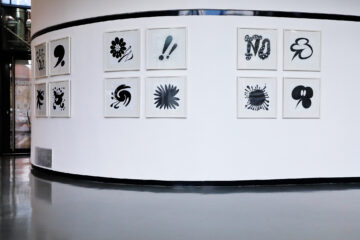
For the past ten years, Andrea Scrima has been working on a group of drawings entitled LOOPY LOONIES. The result is a visual vocabulary of splats, speech bubbles, animated letters, and other anthropomorphized figures that take contemporary comic and cartoon images and the violence imbedded in them as their point of departure. Against the backdrop of world political events of the past several years—war, pandemic, the ever-widening divisions in society—the drawings spell out words such as NO (an expression of dissent), EWWW (an expression of disgust), OWWW (an expression of pain), or EEEK (an expression of fear). The morally critical aspects of Scrima’s literary work take a new turn in her art and vice versa: a loss of words is countered first with visual and then with linguistic means. Out of this encounter, a series of texts ensue that explore topics such as the abuse of language, the difference between compassion and empathy, and the nature of moral contempt and disgust. 

Part I of this project can be seen and read HERE

Part II of this project can be seen and read HERE

Images from the exhibition LOOPY LOONIES at Kunsthaus Graz, Austria, can be seen HERE

 
Andrea Scrima, LOOPY LOONIES. Series of drawings 35 x 35 each, graphite on paper; edition of postcards with text excerpts. Exhibition view: Kunsthaus Graz, Austria, June 2024.

7. EEEK

Michel de Montaigne’s famous statement—“The thing I fear most is fear”—remains, nearly five hundred years later, thoroughly modern. We think of fear as an illusion, a mental trap of some kind, and believe that conquering it is essential to our personal well-being. Yet in evolutionary terms, fear is an instinctive response grounded in empirical observation and experience. Like pain, its function is self-preservation: it alerts us to the threat of very real dangers, whether immediate or imminent.

Fear can also be experienced as an indistinct existential malaise, deriving from the knowledge that misfortune inevitably happens, that we will one day die, and that prior to our death we may enter a state so weak and vulnerable that we can no longer ward off pain and misery. We think of this more generalized fear as anxiety: we can’t shake the sense that bad things—the vagueness of which render them all the more frightening—are about to befall us. The world is an inherently insecure and precarious place; according to Thomas Hobbes, “there is no such thing as perpetual Tranquillity of mind, while we live here; because life it selfe is but Motion, and can never be without Desire, nor without Fear” (Leviathan, VI). Day by day, we are confronted with circumstances that justify a response involving some degree of entirely realistic and reasonable dread and apprehension, yet anxiety is classified as a psychological disorder requiring professional therapeutic treatment. Read more »