by Dilip D’Souza
The autumn equinox – well, autumn in the northern hemisphere – came and went a few weeks ago. I spent it, as I mentioned in my last column here, at the Hanle Dark Sky Reserve (HDSR) in north India. Four nights with some 40 other amateur astronomers, in the open at 14,000 feet, temperatures hovering just below freezing, photographing the splendid night sky.
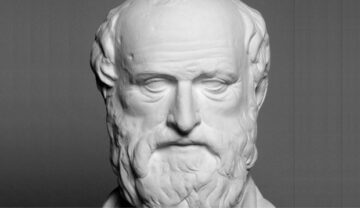
But on that equinox in particular, I was a fascinated spectator as a young PhD student in Physics from the Indian Institute of Science Education and Research (IISER), Pune, Sourabh, channeled his inner Eratosthenes. Maybe mine too.
That’s Eratosthenes the ancient Greek mathematician. But he was many other things too – a historian, an astronomer, a librarian, a musician and, perhaps most relevant to Sourabh on equinox day in Hanle, a geographer. To read about him is to think, this was a Renaissance Man before we knew the term. And at our homestay in Hanle, Sourabh set out to replicate this ancient Renaissance Man’s most famous experiment.
Which is … well, let’s see how Sourabh went about it.
September 22, the equinox: a bright, sunny day in Hanle. Shirtsleeve temperatures by mid-morning even though it had been near zero at night. Cloudless brilliant blue sky augurs well for more stargazing tonight, our last night here. But right now the sun dazzles, casting sharp shadows.
In one corner of the homestay’s yard is a pole stuck in the ground, about 3 feet tall. When we walk over, it is actually a length of grey PVC pipe and it isn’t clear why it stands here. Unless … maybe it’s meant for Eratosthenes-style experiments? It certainly fits the bill. It casts a shadow and it makes a near-right angle with the ground. In fact, the ground right around it is a small expanse of flat concrete, which will shortly prove its convenience. Read more »
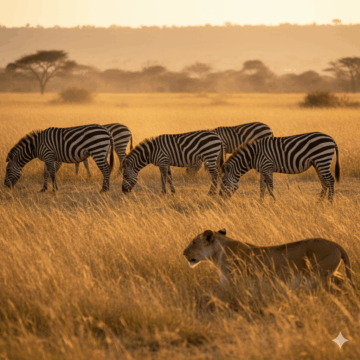 To be alive is to maintain a coherent structure in a variable environment. Entropy favors the dispersal of energy, like heat diffusing into the surroundings. Cells, like fridges, resist this drift only by expending energy. At the base of the food chain, energy is harvested from the sun; at the next layer, it is consumed and transferred, and so begins the game of predation. Yet predation need not always be aggressive or zero-sum. Mutualistic interactions abound. Species collaborate when it conserves energy. For example, whistling-thorn trees in Kenya trade food and shelter to ants for protection. Ants patrol the tree, fending off herbivores from insects to elephants. When an organism cannot provide a resource or service without risking its own survival, opportunities for cooperative exchange are limited. Beyond the cooperative, predation emerges in its more familiar, competitive form. At every level, the imperative is the same: accumulate enough energy to maintain and reproduce. How this energy is obtained, conserved, or defended produces the rich diversity of strategies observed in nature.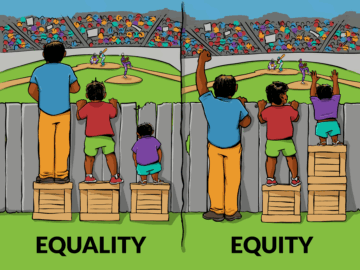
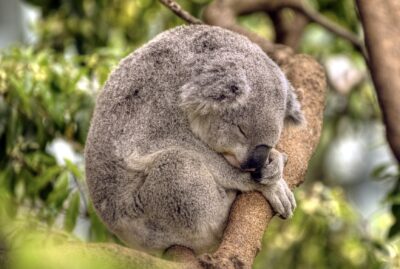
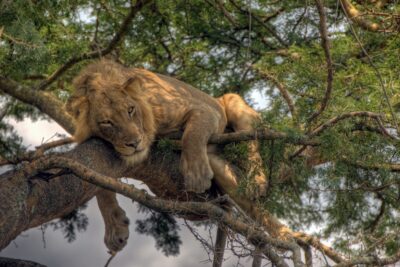 We humans think we’re so smart. But a
 Giant Tarantulas
 by Steve Szilagyi
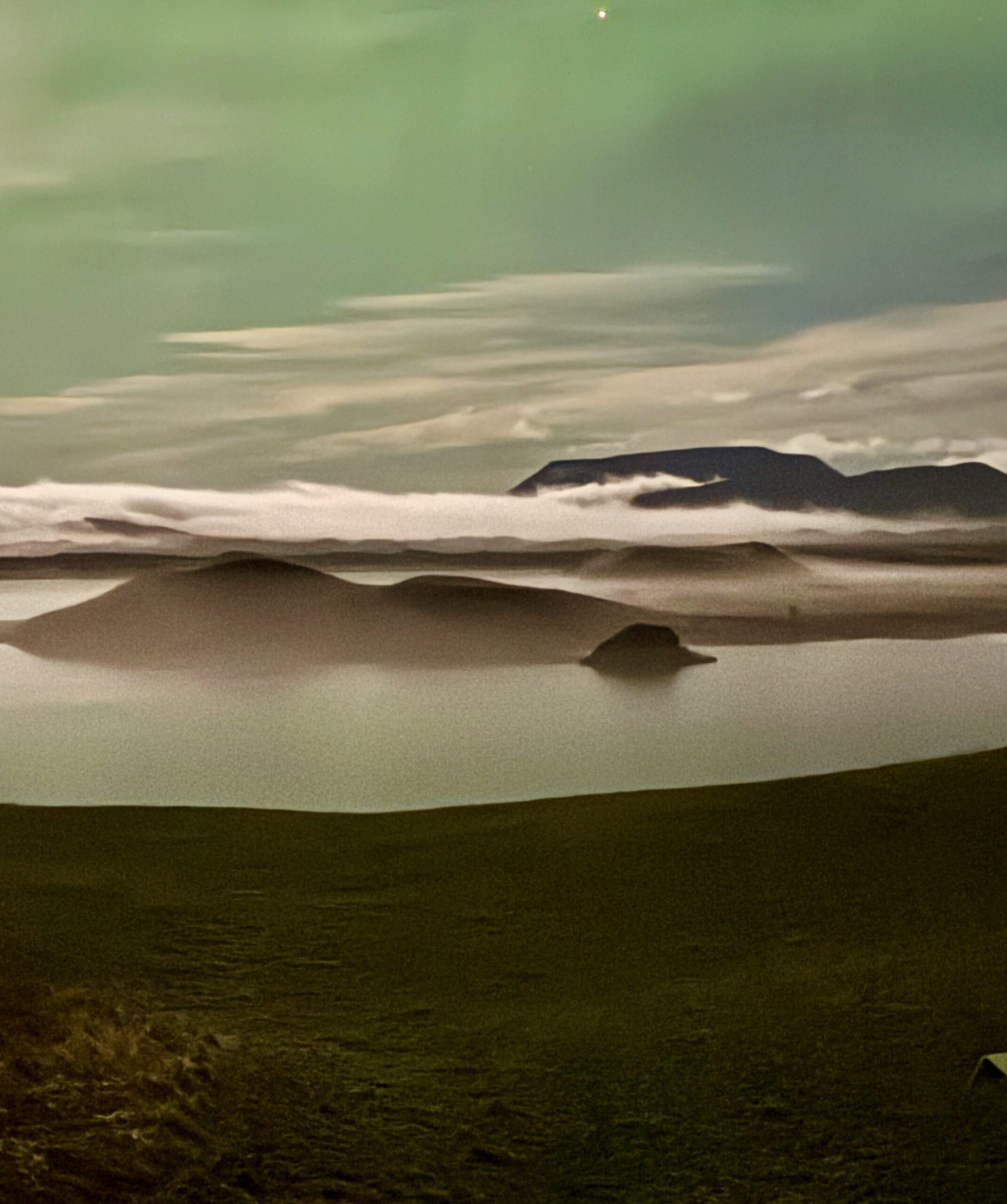 Jaffer Kolb. Lake Mývatn, October 13th, 12:08 am.




 A recent news story about the fate of Ernest Shackleton’s ship