by Jim Hanas
 Any sufficiently advanced technology might be indistinguishable from magic, as Arthur C. Clarke said, but even small advances–if well-placed–can seem miraculous. I remember the first time I took an Uber, after years of fumbling in the backs of yellow cabs with balled up bills and misplaced credit cards. The driver stopped at my destination. “What happens now?” I asked. His answer surprised and delighted me. “You get out,” he said.
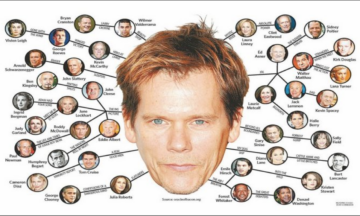
Thirty years ago a website appeared that, in the early days of “the graphical portion of the Internet”–as the New York Times then faithfully called the World Wide Web upon first occurrence–seemed like such a miracle. I am speaking, of course, of the Oracle of Bacon, the site inspired by the parlor game “Six Degrees of Kevin Bacon.” The story of the Oracle, which is maintained to this day, is–in many ways–the history of the consumer Internet in brief. It features a meme, virality, consumer delight, and unintended consequences–but more on those later.
The Oracle is based on a game invented by college students in 1994. An early message board thread titled “Kevin Bacon is the Center of the Universe” challenged readers to find the shortest path between Kevin Bacon and other actors via chains of movies they had appeared in together. The post reported that the game’s initial prompt had “received 80 responses in just over a week” (!) at the University of Virginia, though it was three students at Albright College in Pennsylvania that codified the game–and its benchmark–under the name “Six Degrees of Kevin Bacon,” after the 1993 movie based on the John Guare play of the same name. A book followed in 1996, and–were it not for the contemporaneous explosion of the World Wide Web–the story might have ended there. Read more »
 Several years ago I was the moderator of a bar association debate between John Eastman, then dean of Chapman University School of Law, and a dean of another law school. The topic was the Constitution and religion. At one point Eastman argued that the promotion of religious teachings in public school classrooms was backed by the US Constitution. In doing so he appealed to the audience: didn’t they all have the Ten Commandments posted in their classrooms when growing up? Most looked puzzled or shook their heads. No one nodded or said yes. Eastman appeared to have failed to convince anyone of his novel take on the Constitution.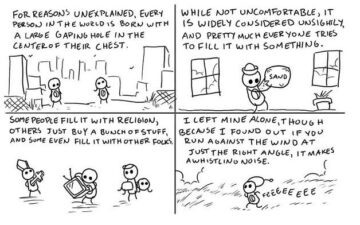
 The question of whether AI is capable of having conscious experiences is not an abstract philosophical debate. It has real consequences and getting the wrong answer is dangerous. If AI is conscious then we will experience substantial pressure to confer human and individual rights on AI entities, especially if they report experiencing pain or suffering. If AI is not conscious and thus cannot experience pain and suffering, that pressure will be relieved at least up to a point.


 Jacob Lawrence. Migration Series (Panel 52).
 We do not need philosophers to tell us that human beings matter. Various versions of that conviction is already at work everywhere we look. A sense that people are worthwhile shapes our law, which punishes cruelty and demands equal treatment. It animates our medicine, which labors to preserve lives that might seem, by some external measure, not worth the cost. It structures our families, where we care for the very young and the very old without calculating returns. It haunts our politics, where arguments about justice presuppose that citizens possess a standing that power must respect. But what does it mean to say human beings are worthwhile? And why might it be worthwhile to ask what me mean when we say we matter?
 Not long ago I wrote for 3 Quarks Daily
  Anyway, I’ve been following