by Mike Bendzela
It sometimes wrenches my own credulity when I think about it: The sweeping and violent imaginings of a Southern fake war adventurer, college as well as high school drop-out, and binge-drinking, adulterous sometime-screenwriter, whose pissed-off wife once bonked him on the head with a croquet mallet, became encysted, like a wasp’s gall, in the head of a naive, Midwestern closet case as he was meandering through college for five years trying to find a major that suited him. While admittedly selective, this description is true, which I think is hilarious but which my partner, upon my reading it to him, thinks is “not very positive.” William Faulkner could never be accused of being positive, and that was his strength: He could stare down human malignity like no other, all the while maintaining a detached, unblinking vision that refused to look away. As one of his characters, Cash Bundren, says: “It’s like there was a fellow in every man that’s done a-past the sanity or insanity, that watches the sane and the insane doings of that man with the same horror and the same astonishment.”
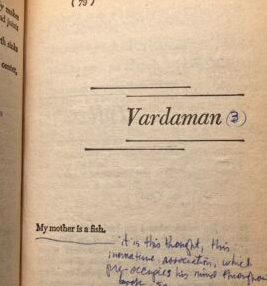
I had to burrow my way through several sciences (geology, botany), arts (painting and drawing), performing listlessly in all of them, before finding myself in the early 1980s in a course called Early Twentieth-Century American Fiction, taught by a tall, passionate Black woman named Anna Robinson (about whom I can find nothing on the Internet), and thinking I should change my major to American Lit. She promptly shoved the novel As I Lay Dying under our noses. I bridled. What the hell is this? I fumed. Why do we get one character’s point of view on one page and another’s on the next? I seethed. Who are these people? Why do they talk so funny? Why do they think so funny? They do not even agree about what is going on. Over forty years later, I can still hear Professor Robinson quoting Addie Bundren’s line about her listless marriage from the middle of the novel — after she has died! — “And so I took Anse.” The time sequence is out of joint. Characters narrate scenes in which they are not present. What the hell, indeed. It was like hearing Thelonious Monk for the first time. Read more »
 We humans think we’re so smart. But a
 Giant Tarantulas

 by Steve Szilagyi
 Jaffer Kolb. Lake Mývatn, October 13th, 12:08 am.




 A recent news story about the fate of Ernest Shackleton’s ship