
AI before AI: Prehistory of Artificial Minds

by Muhammad Aurangzeb Ahmad
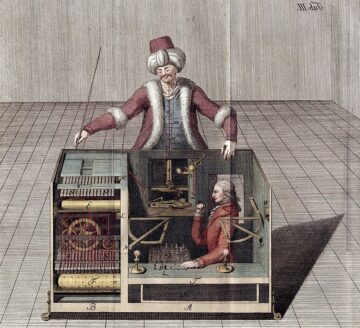
Source: The Turk: The Life and Times of the Famous Eighteenth-Century Chess-Playing Machine. New York: Walker. via Wikipedia

Artificial intelligence is generally conceptualized as a new technology which goes back only decades. In the popular imagination, at best we stretch it back to the Dartmouth Conference in 1956 or perhaps the birth of the Artificial Neurons a decade prior. Yet the impulse to imagine, build, and even worry over artificial minds has a long history. Long before they could build one, civilizations across the world built automata, thought about machines that could mimicked intelligence, and thought about the philosophical consequences of artificial thought. One can even think of AI as an old technology. That does not mean that we deny its current novelty but rather we recognize its deep roots in global history. One of the earliest speculations on machines that act like people. In Homer’s Iliad, the god Hephaestus fashions golden attendants who walk, speak, and assist him at his forge. Heron of Alexandria, working in the first century CE, designed elaborate automata that were far ahead of their time: self-moving theaters, coin-operated dispensers, and hydraulic birds.

Aristotle even speculated that if tools could work by themselves, masters would have no need of slaves. In the medieval Islamic world, the Musa brothers’ Book of Ingenious Devices (9th century) described the first programmable machines. Two centuries later, al-Jazari built water clocks, mechanical musicians, and even a programmed automaton boat, where pegs on a rotating drum controlled the rhythm of drummers and flautists.  In ancient China we observe one of the oldest legends of mechanical beings, the Liezi (3rd century BCE) recounts how the artificer Yan Shi presented a King with a humanoid automaton capable of singing and moving.  Later, in the 11th century, Su Song built an enormous astronomical clock tower with mechanical figurines that chimed the hours. In Japan, karakuri ningyo, intricate mechanical dolls of the 17th–19th centuries, were able to perform tea-serving, archery, and stage dramas. In short, the phenomenon of precursors of AI are observed globally. Read more »
Monday, August 22, 2016

Modeling Artificial and Real Societies

by Muhammad Aurangzeb Ahmad

SchellingmodelScience Fiction literature is fraught with examples of what-ifs of history which speculate on how the would have looked like if certain events had happened a different way e.g., if the Confederates had won the American Civil War, if the Western Roman Empire had not fallen, if Islam had made inroads in the imperial household in China etc. At best these are speculations that we can entertain to shed light on our own world but imagine if there was a way to gauge how societies react under certain environmental constraints, social structures and stress. Simulation is often described as the Third Paradigm in Science and the field of Social Simulation seeks to model social phenomenon that cannot otherwise be studied because of practical and ethical constraints. Isaac Asimov envisions the science of predicting future with the psychohistory in the foundation series of science fiction novels.

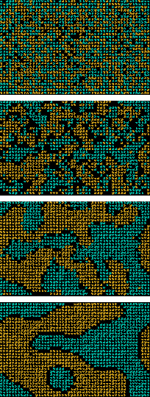
The history of social simulation can be traced back to the idea of Cellular Automata by Stainlaw Ulam and John von Neumann: A cellular automata is a system of cell objects that can interact with its neighbors given a set of rules. The most famous example of this phenomenon being Conway’s Game of Life, which is a very simple simulation, that generates self-organizing patterns, which one could not really have predicted by just knowing the rules. To illustrate the concept of Social Simulation consider Schilling’s model of how racial segregation happens. Consider a two dimensional grid where each cell represents an individual. The cells are divided into two groups represented by different colors. Initially the cells are randomly seeded in the grid representing an integrated neighborhood. The cells however have preference with respect to what percentage of cells that are their neighbors should belong to the same group (color). The simulation is run for a large number of steps. At each step a person (cell) checks if the number of such neighbors is less than a pre-defined threshold then the person can move by a single cell. If the number of such neighbors meets the threshold then the person (cell) remains at its current position. Even with such a simple setup we observe that the integrated neighborhood slowly becomes segregated so that after some iterations the neighborhood is completed segregated. The evolution of the simulation can be observed in Figure 1. The main lesson to be learned here is that even without overt racism and just having a preference about one’s neighbors can lead to a segregated neighborhood.

Read more »