
Common Evolution and Common Good

by Kevin Lively

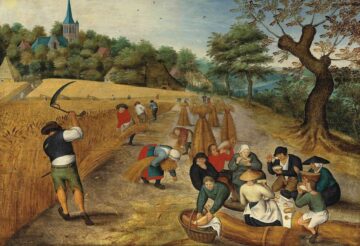
Pieter Brueghel the Younger “Summer: The Harvesters”, 1623.

One often used metric by which the ‘complexity’ of societies is judged, is the level of logistic sophistication with which they self-propagate. While the engineering and logistical nuances of how modern society sustains itself are the fodder for endless analysis; equally complex is the almost-unconscious cultural framework within which this takes place.

One primary foundation of our cultural framework is how we perceive and construct The Commons; that is, lands or resources whose usufruct are held in some degree of common ownership. Historical examples include who may, and may not, take fish from the streams and oceans; who may, and may not, take firewood and game from the forest; who may, and may not, access pastureland for grazing animals, and so on.

For a modern city dweller, these examples are functionally abstractions. More pertinent would be, for example, the quality of air and water, access to public libraries, public transportation and medical care, or food banks and homeless shelters. These are of course common-pool resources as everyone has both rights to their access and responsibilities for their upkeep. The structure of our societies is such that when you’re wealthy, availability of The Commons is of negligible benefit. However, when your private command over resources is limited, i.e. you’re broke, the “cultural-infrastructure” determining which level of access to which resources is permissible, may set the entire course of your life. More than that, the ramifications of socially mediated access of individuals to natural resources, multiplied out across entire societies, can drive the evolution of entire cultures. Read more »

We Smashed Up the World: On Noam Chomsky

by Marie Snyder

Noam Chomsky was rumoured to have left us almost a month ago, but he always told us not to trust the media! 
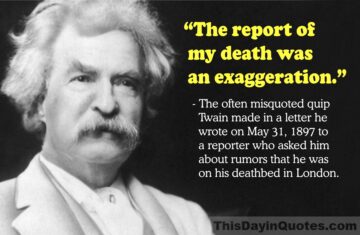
It appears he’s still alive at time of writing, and recovering at home from a stroke. Both The New Statesman and Jacoben published obituaries. Yanis Varoufakis claims his article about his friend was inadvertently published as an obituary (despite referencing Chomsky’s passing in it). That article has since disappeared. In shows that even the best of us can be duped. Vivek Chibber’s piece morphed into a tribute in which he said, 

“Noam hasn’t just pointed to injustice where he saw it, no matter how remote–he has felt it . . . as an affront to his own sensibility. . . . He doesn’t just have educated opinions on a bewildering array of topics and geographical regions–he has real expertise. This is what has made him such a towering figure.”

Absolutely. 

The benefit of mistakes like this (and there have been a lot of them) is getting to see what people really think of you! 

Chomsky is a different person than you or me — well, than me for sure. He has a wealth of knowledge and an astute analysis of events pretty much from the beginning of time to now all in his head and instantaneously available to him, but he’s also very down to earth, of the people. Most importantly, he gives us a framework of the world that’s necessary to understand in order to help us fight the good fight. 

Out of the multitude of writings he’s produced in his 95 years, I think one of the most comprehensive places for the uninitiated to start is with Understanding Power: The Indispensable Chomsky, a collection of talks given between 1989 and 1999. Below, I’ve summarized the ideas down to ten common threads often seen elsewhere in his work, abridged without all the evidence – you have to read the full 400-paged book for that. (Page numbers are from the 2002 paperback edition.) Read more »