
by Mary Hrovat
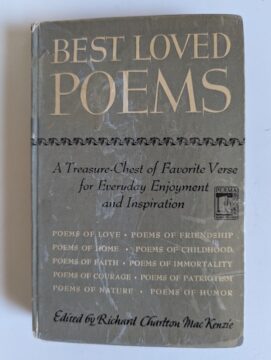 When I was growing up, my mother and I would sometimes read or recite poetry to each other. Ours was not a poetic household, and my father would occasionally complain: “If poets have something to say, why don’t they just say it?” But we thought they did say it, albeit indirectly sometimes, and we continued with our Longfellow, a bit more quietly.
My mother had a collection of Longfellow’s works (he was probably her favorite poet). Another book we frequently read from was an anthology called Best Loved Poems: A Treasure-Chest of Favorite Verse for Everyday Enjoyment and Inspiration (edited by Richard Charlton MacKenzie, copyright 1946). Everyday enjoyment, that’s what we were after.
Mom was opposed to what she called moping, and she especially loved Longfellow’s “A Psalm of Life” (“Let us then be up and doing / With a heart for any fate”) and “The Rainy Day” (“Be still, sad heart! and cease repining; / Behind the clouds is the sun still shining.”). We also found Excelsior very satisfying to read aloud. It was one of the poems that taught me that you don’t need to understand everything about a poem to get the message or to enjoy it. I suspect this was also one of the poems my father found most annoying, because you really want to belt out the repeated word Excelsior, and perhaps raise a fist skyward as you do.
We often read other poems written in a similar spirit of inspiration—for example, “Invictus,” by William Ernest Henley and “Say Not the Struggle Naught Availeth,” by Arthur Hugh Clough. I was comforted by Clough’s words of encouragement to the doubtful and worried; even as a child I was often apprehensive. I can’t remember how I felt about “Invictus,” except that, like “Excelsior,” it was satisfying to recite with great gusto. “In the fell clutch of circumstance / I have not winced nor cried aloud,” we exclaimed. The language seems all out of proportion to the life we lived, but I liked the archaic phrasing (who talks about the fell clutch of anything these days?). Looking back, I see that my struggles became more difficult when I tried to meet them with silent, tearless stoicism. Perhaps I was trying to borrow bravado. Read more »







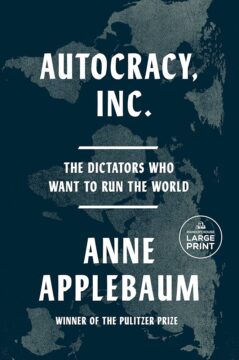 Renowned and respected for her scholarship, her history of authorship of many books on dictatorship and her political experience, is it any wonder that Anne Applebaum’s new book Autocracy, Inc. The Dictators Who Want to Run the World has been so critically received; she is an expert on her subject. This slim volume provides us with an incisive exposition and analysis of how autocrats function in the world today, securing their own personal power and wealth, and in Applebaum’s view, posing a threat to democracies.

 Every time I read or watch anything about the election I hear some variant of the phrase “margin of error.” My mathematically attuned ears perk up, but usually it’s just a slightly pretentious way of saying the election is very close or else that it’s not very close. Schmargin of error might be a better name for metaphorical uses of the phrase.
 Philosophical reflection on artificial intelligence (AI) has been a feature of the early days of cybernetics, with Alan Turing’s famous proposals on the notion of intelligence in the 1950s rearming old philosophical debates on the man-system or man-machine and the possibly mechanistic nature of cognition. However, AI raises questions on spheres of philosophy with the contemporary advent of connectionist artificial intelligence based on deep learning through artificial neural networks and the prodigies of generative foundation models. One of the most prominent examples is the philosophy of mind, which seeks to reflect on the benefits and limits of a computational approach to mind and consciousness. Other spheres of affected philosophies are ethics, which is confronted with original questions on agency and responsibility; political philosophy, which is obliged to think afresh about augmented action and algorithmic governance; the philosophy of language; the notion of aesthetics, which has to take an interest in artistic productions emerging from the latent spaces of AIs and where its traditional categories malfunction; and metaphysics, which has to think afresh about the supposed human exception or the question of finitude.
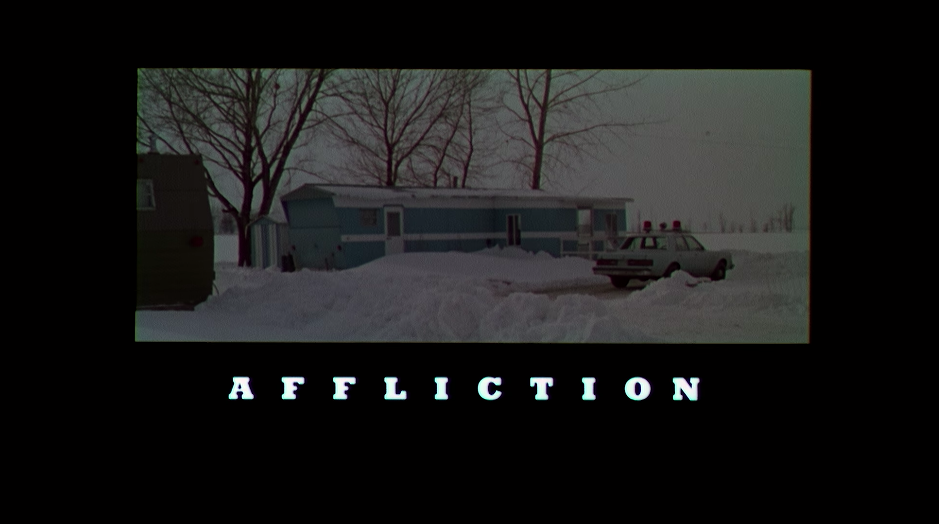 The opening credits of Affliction (1997) feature small, rectangular images that fill only half the screen. You wonder if something is wrong with the aspect ratio, or if the settings have been changed on your television. A succession of images is placed before the viewer: a farmhouse in a snowy field, a trailer with a police cruiser parked in front, the main street of a small, sleepy town, the schoolhouse, the town hall. The last image is a dark, rural road, with a mountain in the distance. Finally the edges of the image expand, fill the screen, and a voice begins to narrate:


 Egypt
Egypt Germany