by Steve Szilagyi
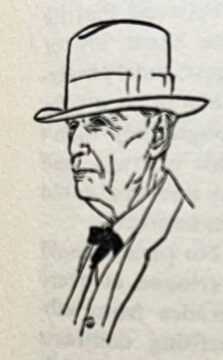
Edgar Watson (E.W.) Howe (1853–1937) was a small-town newspaperman who became nationally known for his plainspoken wit, tart epigrams, and relentless skepticism. “I must make everything so simple that people will see the truth,” he once said. His sayings—blunt, dry, and often astringent—were the fruit of decades spent editorializing in the Atchison (Kansas) Daily Globe and later in his one-man magazine, E.W. Howe’s Monthly.
How famous was he? Howe’s Daily Globe had subscribers not only across the U.S. but in thirty countries. His columns were praised by the likes of Heywood Broun and Mark Van Doren—who called them “the best in the language.” H.L. Mencken became a devoted admirer. At the 1915 San Francisco Exposition, his sayings were spelled out in electric lights. A 1927 testimonial dinner in New York drew a crowd of luminaries: Bernard Baruch, Ring Lardner, Walter Winchell, Rube Goldberg, and John Philip Sousa.
Though Howe also wrote novels, memoirs, and travel books, his enduring reputation rests on the sharpness of his aphorisms. These were collected in volumes like Country Town Sayings, Ventures in Common Sense, and Sinners Sermons. A few examples:
- A man will do more for his stubbornness than for his religion or his country.
- A loafer never works except when there’s a fire; then he will carry out more furniture than anybody.
- When men are not regretting that life is so short, they are doing something to kill time.
- No wonder teacher knows so much—she has the book.
- The most natural man in a play is the villain.
- If the women had money, how well they could get along without the men.
His personal story was every bit as compelling as his quips. Howe was the son of a hellfire Methodist preacher who forbade toys, candy, or any whiff of fun. The defining calamity of his youth came when he was eleven: his father abandoned the family and ran off with a woman from church. Howe became a tramp printer, working odd jobs and roaming the West. Read more »


 If you had to design the perfect neighbor to the United States, it would be hard to do better than Canada. Canadians speak the same language, subscribe to the ideals of democracy and human rights, have been good trading partners, and almost always support us on the international stage. Watching our foolish president try to destroy that relationship has been embarrassing and maddening. In case you’ve entirely tuned out the news—and I wouldn’t blame you if you have—Trump has threatened to make Canada the 51st state and took to calling Prime Minister Trudeau, Governor Trudeau.





 How are we to live, to work, when the house we live in is being dismantled? When, day by day, we learn that programs and initiatives, organizations and institutions that have defined and, in some cases, enriched our lives, or provided livelihoods to our communities, are being axed by the dozen? Can one, should one, sit at the desk and write while the beams of one’s home are crashing to the floor? Or more accurately: while the place is being plundered? There have been moments of late when I’ve feared that anything other than political power is frivolous, or worse, useless. In those moments, I myself feel frivolous and useless. And worse than that is the fear that art itself is useless. Not to mention the humanities, which right now in this country is everywhere holding its chin just above the water line to avoid death by drowning. It can take some time to remember that these things are worth our while, not because they’ll save us today, but because they’ll save us tomorrow.
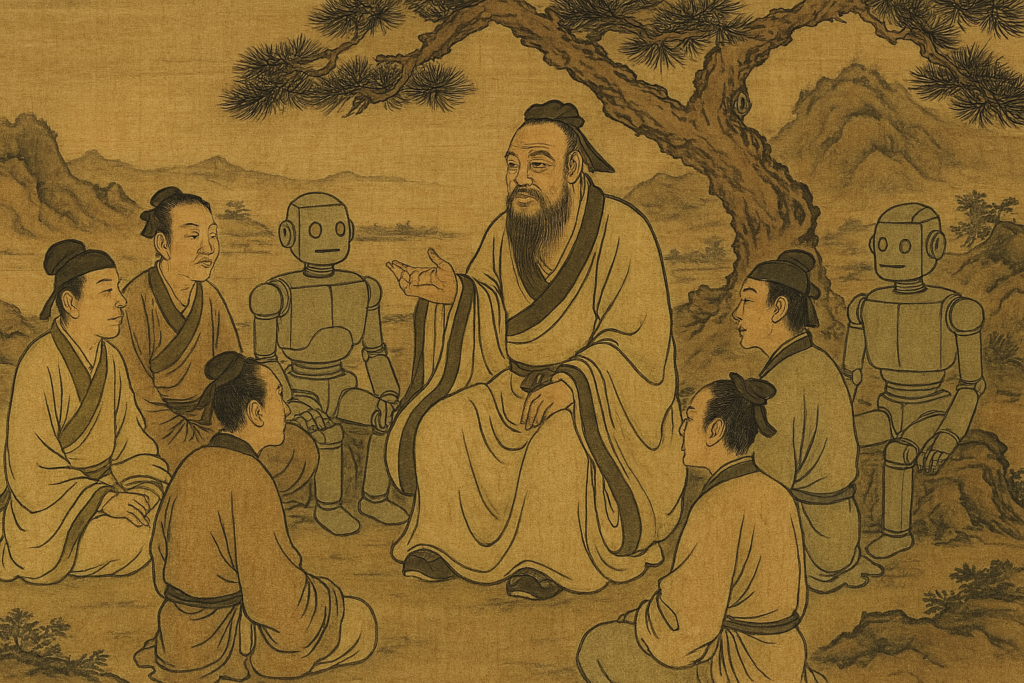

 I love public transportation.
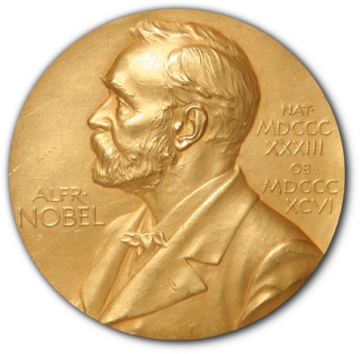 The list of Nobel laureates in physics, chemistry, and medicine includes men and women, Jews, Christians, Muslims, Hindus, Buddhists, and atheists, gay men, lesbians, and cis-scientists, people from Europe, Asia, Africa, North America, South America, and Australia. So, is the ultimate example of meritocracy also the epitome of Diversity, Equity, and Inclusion?