
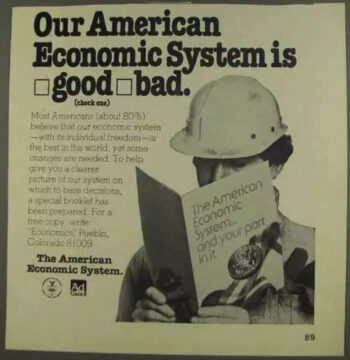
The Ideological Assault on Society

by Kevin Lively

Helpful information leaflets distributed by the Ad Council in their 1976 campaign to educate the average American.

“-isms” are dangerous things. Weighty ideologies with wide sweeping narratives packed into a neat little bundle, whose slogans are repeated ad-nauseam until the word itself becomes the message and any empirical weight the narrative may have had recedes into the background. Capitalism, Marxism, Constitutional Originalism, Fascism, Liberalism, Socialism, Anarchism, Statism or Nihilism. Thinking in such terms, or worse self-identifying with them, is often the death knell of actual thought. Much more ominously: action in defense of the ideology gains a higher moral prerogative than the consequences of the action itself. The only reasonable course in drawing inspiration from such streams of thought is to choose to consciously grapple with the inherent messiness of the fact that no fixed system of beliefs will ever offer permanent solutions in a human society living on an exponential technological slope. Looking at population growth from a Malthusian perspective, an English lord who died almost a hundred years before the discovery of penicillin, seems almost as daft as criticizing labor relations in China for being Communist, where it doesn’t seem like the workers have much control over the means of production.

A striking aspect of very strong “-ism” people is how they tend to consciously or unconsciously mirror their supposed ideological rivals. For example, one of the best sources of quantitative Marxist analysis on wealth and power in society is the leading business newspaper the Financial Times (FT); with the caveat that all the values are reversed. This point is repeatedly brought up by the hosts of the alternative media outlet Novara Media who alternate between self-identifying as either Socialist or Communist, yet whose diverse roster of guests on their Downstream podcast from across the political spectrum almost all concur that FT is the world’s leading source of news. For college students, maybe these “-isms” are not so dangerous, unless they happen to hold green-cards and their “-isms” run afoul of the present US administration. The real danger to society at large is when people wielding inordinate amounts of power and influence and who, crucially, are unaccountable to the public, are true believers in one “-ism” or another. Read more »

Monday, January 13, 2025

Hard Times and The Forgotten Man: Remembering the 1930s

by Mark Harvey

Let America be the dream the dreamers dreamed—
Let it be that great strong land of love
Where never kings connive nor tyrants scheme
That any man be crushed by one above.
—Langston Hughes

Dust Bowl, Oklahoma

The years from 1930 to 1945 were some of the most trying times in American history. Our forebears suffered close to ten years of The Great Depression and then, with next to no pause, were thrust into five years of World War II. It’s no wonder that so many men and women of that generation who survived those struggles came away with a quiet stoicism and other-worldly courage. I have a nostalgia for a time I never saw because I knew many of the people who were shaped by those times, and I miss them.

George Orwell said, “Each generation imagines itself to be more intelligent than the one that went before it, and wiser than the one that comes after it.” That’s one affliction I don’t suffer from. I consider the generation that weathered The Great Depression and World War II to be, for the most part, a cut above any generation since. I don’t think it was necessarily their innate character, but rather their mettle shaped by the age.

Having read a number of letters written to the White House during The Great Depression (from a wonderful collection in Down and Out in the Great Depression: Letters from the Forgotten Man by Robert S. McElvaine), I know that the times led to much bitterness and suffering. How could it not? But a tender humility and reserve also runs through much of the correspondence. Many of the writers address the president or first lady as if they were intimate family who might somehow wrangle them a job or free them from their desperate situation. One thirty-one-year-old woman expecting a baby writes,

Dear Mrs. Roosevelt: I know you are overburdened with requests for help and if my plea cannot be recognized, I’ll understand it is because you have so many others, all of them worthy…. We thought surely our dreams of a family could come true. Then the work ended and like “The best laid plans of mice and men” our hopes were crushed again.

A widow with a fourteen-year-old son writes to Eleanor Roosevelt asking if she has a spare coat to get through the winter and even offers to pay for postage if the first lady will send her one. A woman with seven children and just sixty-five cents to her name writes to Franklin Roosevelt asking for help to feed children too proud to beg for lunch.

In reading these letters, it’s clear that many of the writers truly believed Eleanor or Franklin would actually send them a winter coat or give them a job. Read more »