by Martin Butler
Behind many debates in contemporary culture lie two opposed perspectives on the human world. One argues that ordinary life consists largely of ‘social constructs’ in a sense ‘made up’ by human beings. They have no fixed reality beyond the human cultures and institutions in which they exist. Obvious examples are marriage, money and national borders. Others are more controversial: gender, standards of beauty, ethnicity, patriarchy, religious belief, adolescence, and so on. On the other side of the argument is the view that at least some of these concepts have a factual reality, whether based in biology, human nature, genetics, human evolution or some other deeper reality, an essential nature which is not merely the product of human culture. The term ‘essentialism’ is often used to describe this approach.

Social constructivism is a theory that has its home within the social sciences, it is not meant as a philosophical theory on a par with idealism, for example, which provides a global account of the nature of reality. Presumably describing something as a social construction contrasts it with what is not constructed. Few would want to argue that the atomic mass of carbon is a social construction. So social constructivism is a theory that sits within a broadly naturalistic account of reality. Despite appearances it has this much in common with at least the more scientific (usually biological) forms of essentialism. The debate, then, is presented as being about where to place the divide between the natural and the specifically human. We might say that money is uncontroversially a social construction and the atomic mass of carbon is uncontroversially not a human construction. The controversy exists in the middle ground.

I think this opposition distorts the issue. The language of ‘constructions’ obscures the fact that the human world is composed for the most part of normative practices. Normative practices are about what we do and say as we interact with each other and the world around us. A simple example is how we greet each other, something which shows considerable cultural variation. Crucially there is an appropriate and inappropriate way to greet someone, depending on relationship and context, and this is what makes such a practice normative. A construction of any sort suggests a static entity in the way that a chair is a physical construction, but it is these practices that matter and there is no sense in which they are static, nor do they ‘construct’ entities.
More importantly, the language of ‘constructions’ suggests artificiality in some sense, as if these constructions lack the reality of the natural world. Surely this is an empty comparison. To claim that national borders or marriage are only ‘constructions’ suggests a level of deception in cultures that treat these things seriously. To look reality squarely in the face, it is implied, is to recognise that they are not ‘real’. However, we may represent borders as lines on a map and regard these lines as in some sense fictional, but in no way does this get to the core of what a national border actually is. Read more »
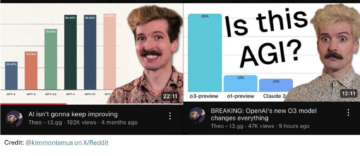 Oops. During most of 2024, all the talk was of deep learning hitting a wall. There were secret rumors coming out of OpenAI and Anthropic that their
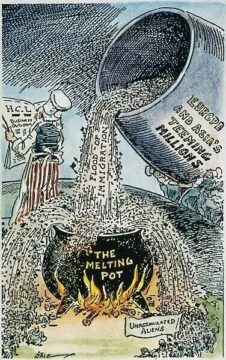
 My great-grandparents were among the 12 million immigrants who passed through Ellis Island and equally a part of the wave of 20 million immigrants who entered the United States between 1880 and 1920. America’s fast-growing economy needed more manpower than its existing population had available, and the poorer classes of Europe were the beneficiaries including four million Italians (largely southern) and two million Jews.
 An empire, threatened on its flank, vents spleen


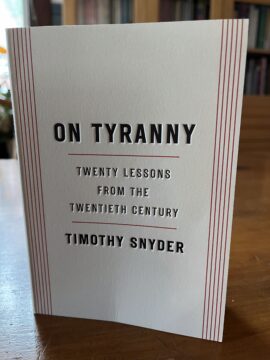
 Some people use religion to get their life together. Good for them. I’m all for it. Although I myself am an atheist, I don’t think it much matters how someone gets their life together so long as they do.
 On the one hand, nothing has changed since August 2020, when I wrote
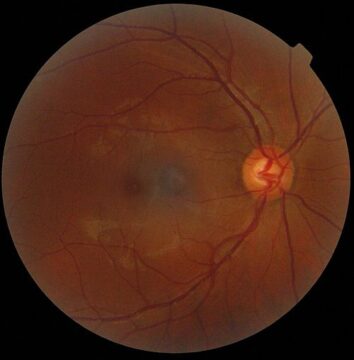 Anatomically, it’s the optic disc – the spot on each retina where neurons with news from all the light-sensitive rods and cones of the retina converge into the optic nerves. The optic disc itself,

 Sughra Raza. Rorschach Landscape, Guilin, China, January 2020.