
by Jochen Szangolies
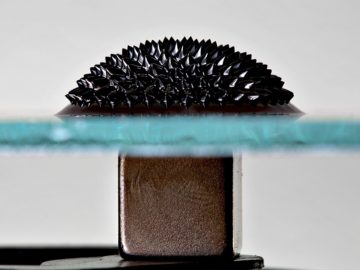
The ubiquity of a phenomenon sometimes causes its mystery to grow stale. Consider the strange lines along which a magnet orients iron filings in its vicinity: what we take in stride would, if experienced afresh, seem like the purest magic. Indeed, humble iron is probably the closest we get to genuine sci-fi ‘unobtainium’. Not only can the right treatment increase its durability by a multiple, enabling technologies unthinkable without it, but if you take a rod of iron, and hit it hard with a hammer, it suddenly acquires the ability to attract other bits of iron—as if the imparted force is transformed and stored in a mysterious field surrounding it. Moreover, if you then take that empowered core, and pass it through loops of very thinly wrought iron, you find that you can suddenly draw tiny bolts of lightning from the wire—or use the energy to power a light, or a motor, or, indeed, our civilization.
So, what is it that imbues iron with these near-magical capabilities? What yields it the power to attract or repel? Or, in the immortal words of the Insane Clown Posse, fucking magnets, how do they work?
Pace Violent J and Shaggy 2 Dope, the answer to this question is well known—in that particular sense of ‘well known’ that physicists use when they mean ‘don’t worry about it, the math says it works’. But even among physicists, the answer isn’t usually spelled out all that clearly—which is a bit of a shame: as we will see, it’s a cardinal example of how quantum mechanics, far from being just a ‘theory of the small’, is directly responsible for many everyday phenomena. Ultimately, the key to the question ‘why do magnets attract things’ lies in the phenomenon of quantum interference—though we’ll have to plot a bit of a roundabout course to get there. Read more »



 In the first round of this year’s NBA playoffs, Austin Reaves, an undrafted and little-known guard who plays for the Los Angeles Lakers, held the ball outside the three-point line. With under two minutes remaining, the score stood at 118-112 in the Lakers’ favor against the Memphis Grizzlies. Lebron James waited for the ball to his right. Instead of deferring to the star player, Reaves ignored James, drove into the lane, and hit a floating shot for his fifth field goal of the fourth quarter. He then turned around

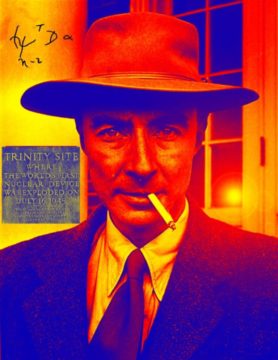


 Aqui Thami. Resisters, 2018.
 I can’t sing. Or so I always thought. A notorious karaoke warbler, I would sometimes pick a country tune, preferably Hank Williams, so that when my voice cracked, I could pretend I was yodeling. Then one night, I stepped up to the bar’s microphone and sang a Gordon Lightfoot song.

 My father’s mother—Annie Newman, my grandmother or Bubbi—was born Hannah Dubin in a shtetl in what is now Ukraine a few years before the Great War. One of her earliest recollections—in addition to the image of her own grandmother hiding in a baby carriage to escape marauding Cossacks—was of being able to see troop movements from the roof of her house, presumably during the Russian Imperial Army’s advance against Austria-Hungary, an engagement that occurred in Galicia, farther to the west, in 1914. Much later, in the aftermath of the nuclear accident in Chernobyl in 1986, when that obscure place was suddenly on everyone’s lips, she began recalling that her village, which she called Priut, in a region she referred to by its Russian name as Екатеринославская губернія, or Yekaterinoslavskaya guberniya—the Yekaterinoslav Governorate, a province of the Russian Empire—was not far from that site, which had now become infamous for a catastrophic meltdown.
 A dear friend of mine recently passed away unexpectedly. He had recommended I read Viktor Frankl’s

 In the typical American city where we live, the average commute time is 78 minutes a day and 97.5% of