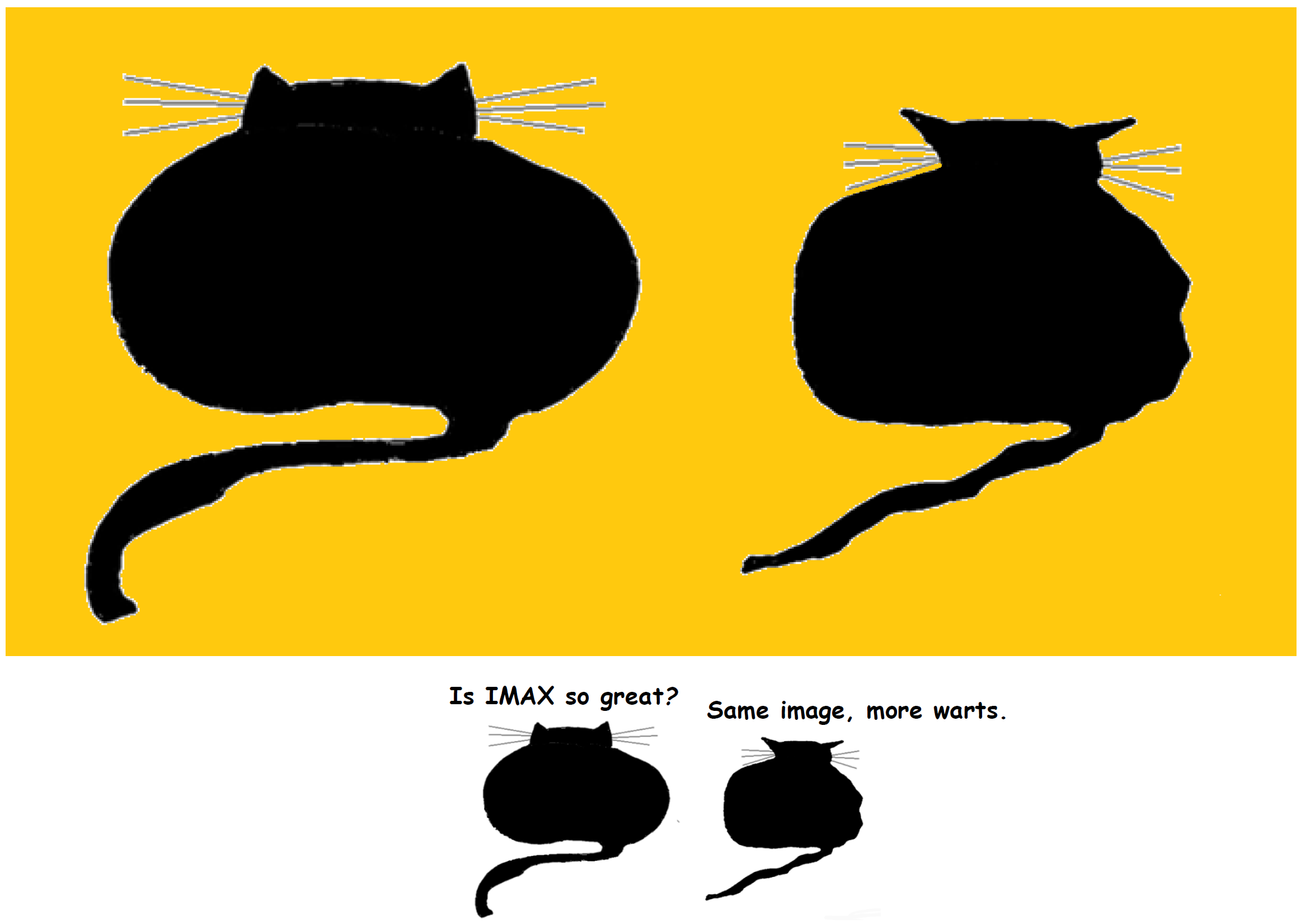
by Brooks Riley

Enjoying the content on 3QD? Help keep us going by donating now.

by Ashutosh Jogalekar
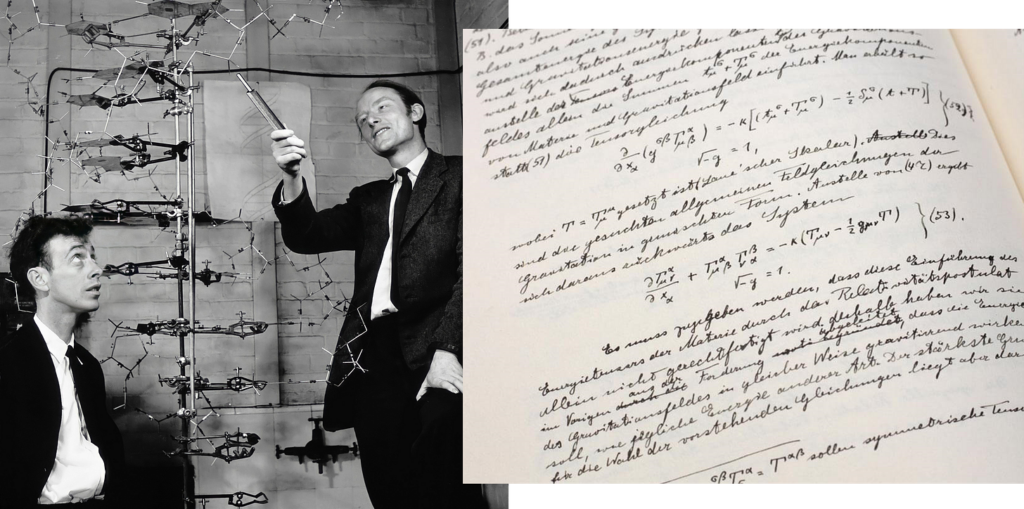 AI is collapsing barriers in scientific disciplines, most notably in math. An 87-year old conjecture named the Jacobian conjecture was recently solved with help from AI. An AI model solved another 80-year old conjecture, the distance conjecture. Many Erdős problems, named after the prolific late mathematician Paul Erdős, are swiftly succumbing to AI. Some mathematicians like Terence Tao – regarded by some as the greatest living mathematician – have simply come to terms with using AI in their research and think that AI will be as integral to math as were slide rules and calculators. Nor is math the only field that is is seeing striking inroads made with AI. Other theoretical disciplines, including theoretical computer science, are also being rattled. Theorist Henry Yuen sounded a bit shaken to see how many problems in his discipline were being solved by AI, and said that he could “feel the importance of these problems in his bones.”
Given this spectacular progress of AI in math and science, it does not seem unreasonable to ask the next question: how long before AI solves outstanding problems in all sciences: physics, chemistry, biology, astronomy, geology? And then how long before it also solves outstanding problems in other adjacent disciplines: neuroscience, psychology, anthropology, sociology, philosophy? Will we soon live in a post-human world, at least so far as science is concerned, which considering that science is what helps us make sense of the universe, means a post-human world, period?
First of all, let’s state the obvious. Any kind of optimism that AI will solve problems in applied sciences like chemistry and biology anytime soon is misplaced for obvious reasons: unlike math and theoretical computer science and even parts of theoretical physics, these disciplines need experimental verification and the right data. Unlike math, you simply can’t think your way to a new drug or material. In fact if you look at most of the Nobel-winning discoveries in these disciplines, you will realize that while AI could likely have helped accelerate them by generating ideas, most of them involved the serendipitous discovery of new biological molecules or mechanisms. An equal number involved the invention of new tools and techniques. It’s hard to see how AI could have possibly done this by itself. At least in the near future, I don’t see how AI can simply think its way to a new cancer drug, a new mechanism of memory or a new technique to unravel the mysteries of life, hype from AI leaders notwithstanding.
But beyond these specific domains, the entire debate around AI revolves around a more profound question. Read more »
by Lei Wang
 1. The Odyssey
I did not expect to enjoy this recent adaptation of The Odyssey, and indeed I did not. I watched for purposes of cultural touchstoning and schadenfreude, the way I enjoyed survivalist fiction as a child. Thank goodness I, unlike the main character in Hatchet and Brian’s Winter, get to be safe and warm and don’t have to plot to trap a bad-tempered moose just to survive, or use my own urine as a hot water bottle. Over the three hours in the theater, I was extremely grateful not to have to spend time on an undulating boat without sunscreen, kill, or be a man in any era. Which is perhaps not supposed to be the takeaway.
And yet I feel there must be something there to stories that have lasted, stories I don’t quite have the taste or patience for, which just means I don’t have enough understanding. The ex-journalist in me maintains that anything can be interesting; I am still waiting to love baseball, if only someone could explain to me the metaphysical implications. Film adaptations of great literary works often feel unsatisfactory because the parts that make literature great and literary—the interiority and insights—are lost. The odyssey is an internal story being told as an external adventure story, which is nonetheless a great marketing trick more philosophers could use.
When Dr. Athena Potari (yes, her name is actually Athena) explained the internal story of the epic on a recent Zoom meeting for a group of idealist philosophers and taggers-on like yours truly, she deployed so much etymology I felt as if I were listening to conspiracy theories, except coming from a Greek scholar who’s taught at Harvard and Oxford.
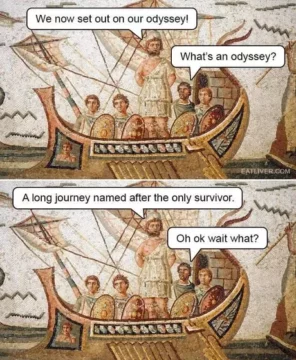
Consider the name Odysseus, which Homer himself translated as “he who gives or receives pain,” and which any quick Google search will tell you has been traditionally linked to the Greek verb odussomai—“to be angry at,” “to hate,” “to be grieved,”—in short, to suffer. Read more »
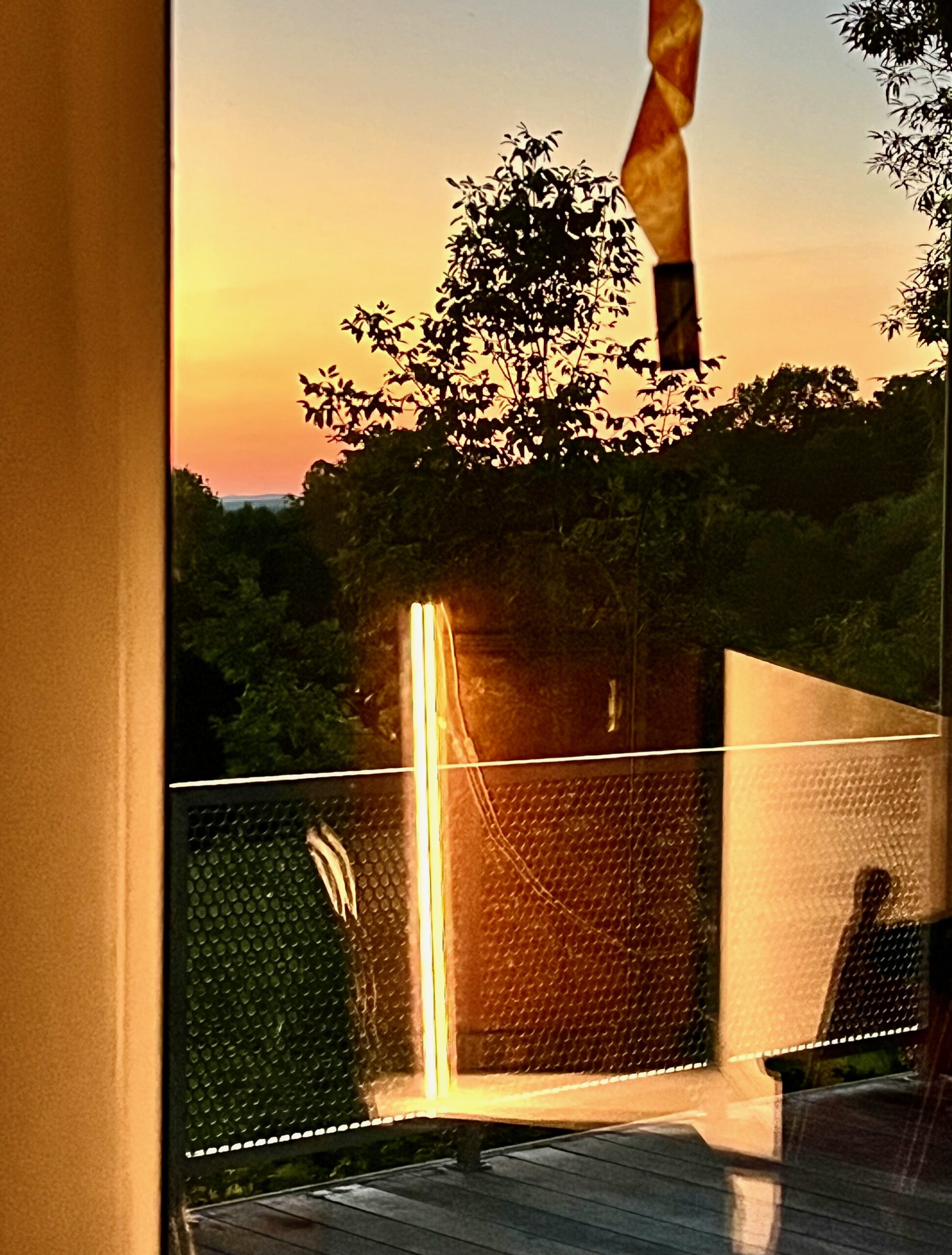 Sughra Raza. Fly Paper (sunset series). Late July, 2026.
Digital photograph.
Enjoying the content on 3QD? Help keep us going by donating now.
by Tim Sommers

Honestly, in academic philosophy a great, or even a good, title is not really necessary. Perhaps, the most influential philosophy article of the twentieth century is called “On Denoting.” Really, Russell? That’s all you got? Compare Donald Davidson’s “A Nice Derangement of Epitaphs.” Now, that’s a title. Unfortunately, given that he argues there is no shared language, it has faded from view a bit. Thomas Nagel’s “What is it Like to be a Bat?” has got to be near the top of any “best of” list, especially considering its influence. But my favorite title, which I have borrowed for this article, is “Sometimes There Is Nothing Wrong with Letting a Child Drown” by Travis Timmerman.
I met Professor Timmerman a couple of years ago, a nice guy with no documented history of drownings, and asked him about it. (You don’t meet George Lucas and not ask him about Star Wars, right?) He told me that when the article is reprinted in textbooks and anthologies, it is consistently retitled “Reply to Singer.” Why?
Well, it is a reply to Singer. But really, I suppose, the point is to deemphasize the whole “children drowning” thing – which is too bad because it’s a real attention grabber. The article to which Timmerman is replying is the one in which Singer introduced a thought experiment, called “The Pond,” second nowadays only to the trolley problem in terms of how well-known it has become.
You are walking to work and pass a shallow pond. A small child has fallen in and is drowning. No one else is around. You could wade in and save her easily, but doing so will ruin your shoes and make you late to give a lecture. Almost everyone agrees, of course, that you must save the child; ruined shoes and a missed (or late) lecture are trivial next to a child’s life.
Singer builds a much larger argument on this shared intuition. If it is wrong to let the child drown to protect your shoes, it is equally wrong to spend money on luxuries like new clothes, restaurant meals, vacations, etc. while children elsewhere die preventable deaths that the same money, spent differently, could have saved them. Distance – spatial, temporal, or relational – he insists, is morally irrelevant. A drowning child ten feet away and a starving child ten thousand miles away place the same demand on us, provided our help would work equally well in both cases. Read more »
by Carlota Figueroa
Actually, I can bet you another $5 that when you read the title of this article you thought that I was crazy and that there is no universe in which these two things can be the same. After all, you’d probably tell me that one is a stylish piece of clothing and the other is a kitchenware article that holds the magic potion to wake you up in the morning — definitely not the same thing. And you would be right. Well, partially right. But let me ask you just one thing: how do we define the word same? If we use every normal person’s definition of same as “resembling in every relevant respect,” (maybe you’re a normal person and you’d use a different definition, but this is Merriam-Webster’s so I’ll take it as a good point of reference) then yes, you win: a skirt does not resemble a coffee cup in every relevant respect. It’s not even a close call. However, if we use many mathematicians’ definition of same as “homeomorphic to one another”, then I’m sorry to tell you, but you owe me $5.

Now, unless you have some background in mathematics or physics, the adjective “homeomorphic” probably sounds rather made up. What does it mean for two spaces to be homeomorphic to one another? It means that there exists a homeomorphism between them. I know, way to go, using the word to define itself. The truth is, in mathematics, a homeomorphism is one of the most important and magical functions there is. In technical terms, a homeomorphism is a bijective and continuous function between topological spaces that has a continuous inverse function. Don’t panic, we will break down this sentence so you can get the full essence of what a homeomorphism is. Read more »
by Mike Bendzela
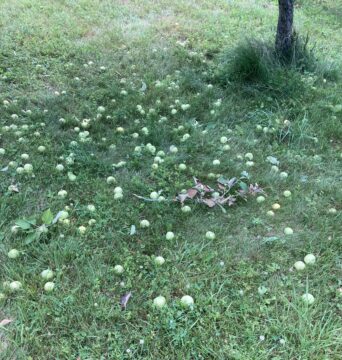
It is said that farmers grow things, but that is not right. I view it as a metaphorical statement. The organisms grow themselves as they have been doing for hundreds of millions of years. Farmers stand by and select, tend, and kill. Mostly they kill. It is built into the way the system works. Sometime around 10,000 years ago we discovered how to usurp the powers of natural selection (not that we knew what we were doing) to wrench the earth into providing for us alone rather than following the law of willy-nilly. We have been reaping the whirlwind ever since. The planet is now terraformed to grow large-brained apes and its favorite crops, the wilderness reduced to a shadow of itself, the atmosphere severely perturbed.
Historically, we would rip weeds out of the soil with wood or iron implements and pick off adult bugs by hand. In the last one hundred years or so we’ve come up with many clever ways of suppressing weeds and exterminating arthropods that compete for our crops. This usually involves novel chemical formulations, frequently using petroleum as a feedstock, that when applied to organisms shut down metabolic pathways in plants and impair the nervous systems of insects. For the mammals and birds that feed on crops, there are traps, poisons, barriers, and bullets. Your picturesque Midwestern farm sits atop a charnel house.
We try to outwit nature itself by using “natural” and mechanical methods to avoid and/or eliminate pests, but these are usually insufficient at scale. This is called Integrated Pest Management (IPM). We can select organisms that have natural resistances, provide barriers or even structures to protect them from hazards, plant beneficial companions next to vulnerable crops to suppress pests, release natural predators into the environment that feed on the hungry hordes waiting to decimate our crop. But unlike chemical means which work indiscriminately — they kill every pest they touch — IPM is not so thorough and is a lot of work on top of it. In the end, a farmer will resort to chemical means to get a crop through the season. Read more »
by Carol A Westbrook
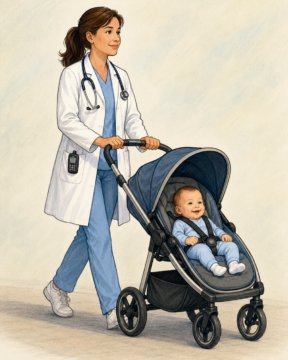
I was the first resident to become pregnant and deliver a child at the University of Chicago–perhaps in any medical residency in the country at the time. It was 1979. I had suffered several months of “internship amenorrhea” before I realized I might be pregnant; a trip to the ED to sneak a pregnancy test confirmed my suspicions. By then I was 16 weeks along.
I imagined that other residents in similar situations would have left their medical training for motherhood; others would have terminated the pregnancy and then continued on with their training. In 1979, abortions weren’t restricted as they are today, but I had a (failed) IUD in place in the cervix, which made termination a bit riskier. After discussion with my husband (also a medical student) we decided to carry the pregnancy to term; we had planned to eventually have a family, we might as well continue since we already had a start. We were thrilled and delighted, and terrified.
One reason that pregnancy and motherhood were uncommon among medical students in1979 was that the percentage of female med students was low, only about 24% of the entering class. But by 2018-2019 the gap between men and women was beginning to close, and the distribution is now about equal.
Still, until recently, medical schools conducted themselves as if the student body were primarily male. At a recent reunion, the women in my class discussed the problems related to this perception. These problems are due to inequalities in facilities and in women being “outsiders” – they will never become part of the men’s “club.” Read more »
by Eric Feigenbaum

There are few acts that express a belief in globalism like phasing out agriculture. From the city-state’s independence in1965 until 1990, Singapore reduced its agricultural land from 13,160 (roughly 22% of the island’s then-size) to 1,500 hectares (roughly 1% of Singapore’s area) of which only 600 were used by the year 2000.
Singapore’s leadership made this controversial shift for three major reasons: it believed the land had higher value use in industry and housing than in agriculture; Singapore’s agricultural output wasn’t nearly enough to feed the country as it was, making food importation was already a fact of life; and livestock farming – particularly pigs – polluted land, streams and the Singapore River.
Naturally, all but abandoning agriculture came with great risk. Singapore had to believe in the stability and quality of its imported food supply which could be hampered by many things from meteorological phenomena causing droughts in supplier nations to the international relationships secure enough to believe no one would try to choke off or siege Singapore.
To that end, Singapore has always diversified its basket of suppliers – receiving the same or similar items from multiple countries. In a Singaporean supermarket, you can expect to find your choice of onions from Malaysia, the US and Australia, for example. Chicken from Malaysia or Brazil. This provides multiple price points and greater food security. Read more »
by Steve Szilagyi

Woodman, Spare That Tree is a poem by George Pope Morris, published in 1837, and quickly set to music by the prolific songwriter Henry Russell (Cheer, Boys, Cheer). It begins:
Woodman, spare that tree! / Touch not a single bough! / In youth it sheltered me / And I’ll protect it now.
By the late 1830s, much of the primeval forest along the settled East Coast had already disappeared. One of the striking discoveries in 19th-century photographs of American towns and countryside is the sheer emptiness of the landscape beyond the main streets and Carpenter Gothic houses. If you can tear your eyes away from the corpses in the foreground of a Civil War battle photograph, you’ll see, behind them, treeless vistas that seem to go on forever.
In muscular young North America, trees were the enemy. Once you got your land, the first task was to clear it of trees and stumps — no easy thing to do with an axe. All across the continent, strapping young men went to war against the forests. They were so successful that, by 1837, those once-heroic fellows could appear as villains in poems of performative sentiment.
I’ve been listening to Woodman, Spare That Tree since 1977, when it was released on the Nonesuch LP An Evening with Henry Russell, sung by Clifford Jackson, accompanied by William Bolcom on piano. I’m still moved by the poem and its plangent musical setting.
So you can imagine my discomfort in July of 2026, when I found myself in the same situation diagrammed by the figures in “Woodman, Spare That Tree” — with one big difference: I was both the woodman and the poet. Read more »
by Peter Topolewski
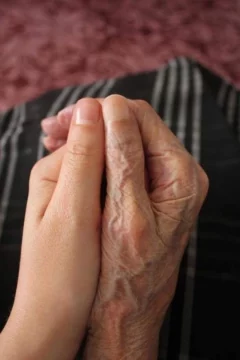
Biohackers pour in effort to extend it, the ultrarich pour in money to make it eternal. Life, that is. But death does not discriminate. It takes us all.
We know this, and yet a death rarely fails to shake us out of our routines.
Death likes to creep up at inopportune times. While people are skipping rope or cutting a rug on the dancefloor. Riding a scooter without a helmet or chopping down a tree. Number crunchers can narrow the likelihood of death’s arrival by parsing the demographics: income, gender, whether we brought a gun into the house and where that house is located. Avoiding such places and activities doesn’t change the outcome. Death finds you, somehow to your surprise.
Tornadoes, earthquakes, high rise fires, war—death works in bulk at these events. We know this. Yet we so often tsk tsk the final body count.
Murderers—the solo and the state variety—try to put death in their service, but that only lasts so long, and it never wins them a free pass. Death comes for them, too.
We don’t like to think about death, the yarn goes. That’s why it catches us off guard. Maybe. But we’re also getting used to the idea that it operates way out there, in the foggy future. Because while death still operates in the freak accident genre, among others, in much of the world its work has gotten increasingly predictable. It sidesteps the young and thrives among the elderly.
Improved nutrition, basic hygiene, proliferating lawfulness, and widening food supplies—banal hallmarks of civilization—have all helped push lifespans higher. They’re about 80 in the U.S., 80-plus in Canada, China, Japan, Australia, and throughout Europe. Globally, they average 73 years. Read more »
by Anton Cebalo
It goes without saying that one can talk oneself into problems. Your own stories become pathological like a slow drip eroding your senses. And you may find yourself circling a narrative so many times over that language starts to fail. What’s left then is just feeling. Exhaustion with it all gives way to resentment and anxiety as many morbid symptoms appear. This used to be called “neurosis.”
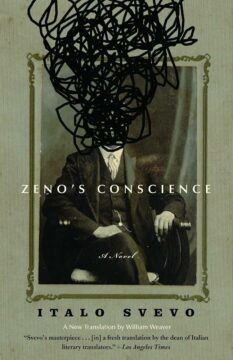 Zeno’s Conscience (1923) by Italo Svevo is the story of one such man suffering from talking too much (to himself). Zeno is a person with deep interiority, long meandering monologues, and feeling. However, despite his never-ending rhetorical skills and eccentricity—having gone through the tunnels of his mind many times over—he ironically enough lacks a conscience. He fails in health, in love, in his addictions, and in business. Rumination and ceaseless inner conversation do not produce moral clarity for Zeno. Instead, his often-comical interior life is insidious because his obsession with sentimentality and grand justifications prevents his self-actualization. And so, he lacks a real moral center. However, he does not fail to be incredibly entertaining as a personality.
World War I enters the story in the last section of the novel, largely as an afterthought and an inconvenience to his lifestyle. The whole time, the catastrophe slowly forming outside is ignored because the obsession is instead inward. The book is intended for his psychotherapist, who publishes his words to spite Zeno because he stopped meeting him. Even the supposed doctor is obsessed with petty grudges.
The novel is in conversation with the general social environment of Europe then. High-speed rotary presses and new typesetting machines made print media ultra-accessible and cheap, and for the first time there was a mass public to enjoy it. In just Germany alone, thousands of newspapers printed some 14 million copies per day by 1912. In England, The Daily Mail was the first publication to sell a million copies daily as early as 1896. And in France, daily press circulation reached around 5 million per day by 1910.
The result was a collapse of meaning, not more of it. Many felt they were trapped in their heads. In The Chandos Letter (1902), Hugo von Hofmannstahl fictionally writes of a man (Lord Chandos) describing a world where language fails him:
For me, everything disintegrated into parts, those parts again into parts; no longer would anything let itself be encompassed by one idea.
Single words floated round me; they congealed into eyes which stared at me and into which I was forced to stare back – whirlpools which gave me vertigo and, reeling incessantly, led into the void.
In the decades before World War I, Europe might as well have ‘talked itself into a catastrophe.’ As we, too, live in a time flooded by narratives and discourse, we risk finding ourselves like Zeno—exhausted by it all, receding into our inner lives, and making the world into just a passive ornament: “If only the world understood my ‘true intentions and difficulties,’ then all would be well.”
by Thomas Fernandes
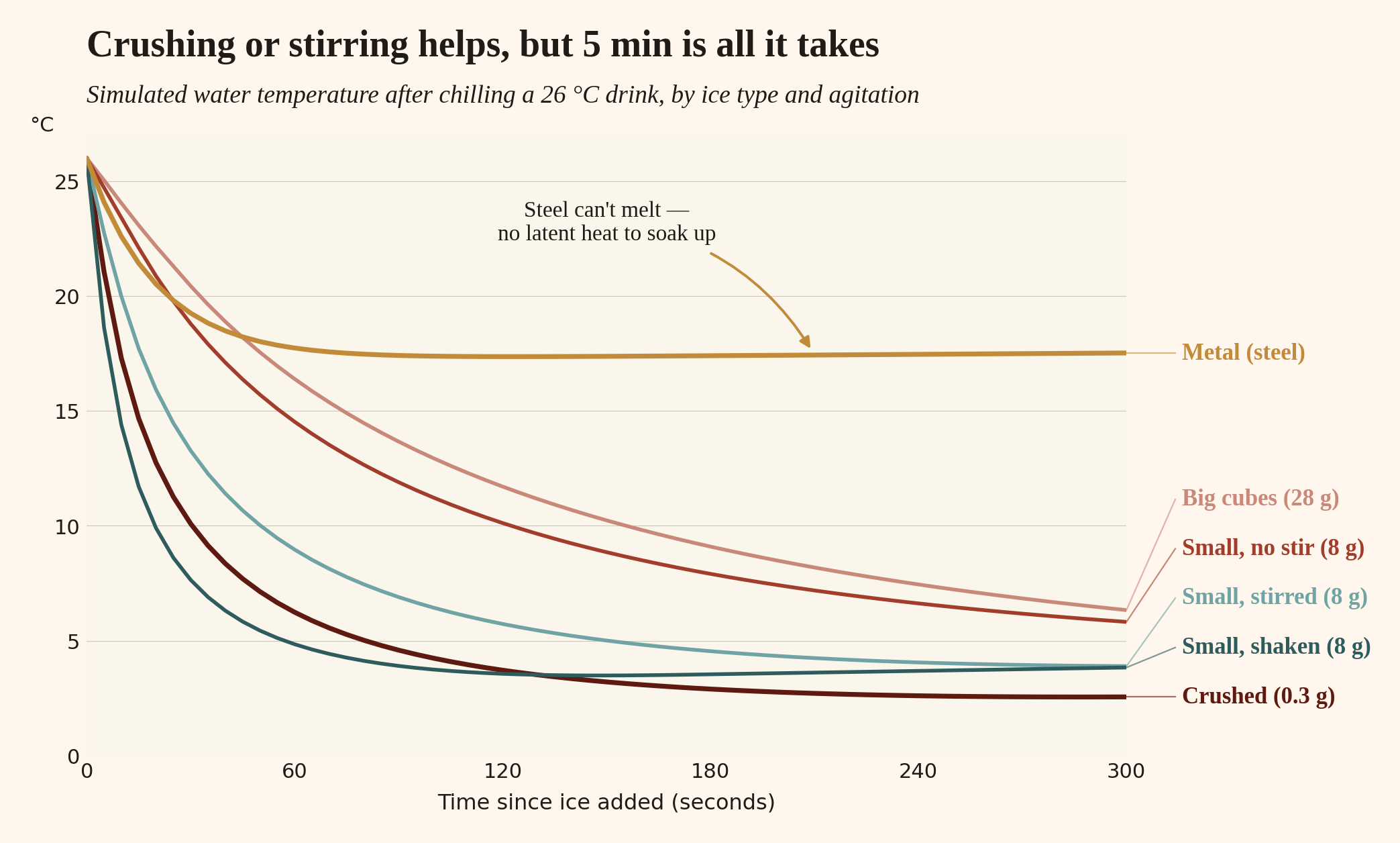
Hot days bring the urge for cold drinks. I’ve never been much of an ice user for cooling but, in a rare event for me, I walked into a Starbucks and was given a cold brew with more ice than liquid in it. It looked suspiciously like a way to sell water at a premium, but it also got me wondering: how much ice do you actually need to cool a drink?
We have so much data on the properties of materials now that a quick calculation gets you the answer. For 500 ml of liquid at 26 °C (room temperature on a hot day) you need 134 g of ice, about 18 cubes 2 cm a side, to reach a final temperature of 4 °C. I included the fact that the ice also has to cool the glass holding the drink, though that only accounts for 7 % of the total energy. The rule of thumb is roughly 25 % of the drink in ice.
Four times less ice than liquid matches everyday experience well enough, which makes the Starbucks move look plainly dubious. But if you think about it, it’s almost magical that so little matter can cool so much, and the reason is the energy of fusion. The energy needed to turn ice at 0 °C into water at 0 °C is enough to heat that water from 0 °C to 80 °C. Overall, 86 % of the cooling from ice starting at -17 °C comes from the melting itself, not from the cold.
Knowing how much ice you need is one thing, how fast if cools your drink is another. I wanted a back of the envelope estimate but this soon turned into a real engineering problem and reminded me of the messiness of fluid dynamics. Nobody understands it, people just pretend to by using neat formula masking a messy reality. Here is what I simulated anyway.
I checked the no-stirring case myself by timing how long ice takes to melt, about 400 seconds, though it was nearly done by 300 s, which lines up with the prediction. Read more »
by Sean Murphy
i.
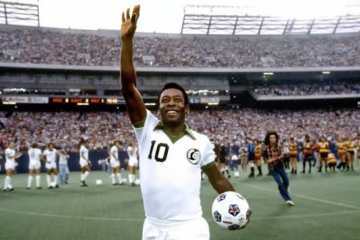
I learned about death and taxes later but first; I understood that there was also the World Cup. It loomed almost as large as reality and, for large segments of the world, was as important as existence, was existence—at least every four years. Those of us in the states didn’t have those emotional or historical attachments, but in the ‘70s we all had Pelé.
It’s difficult to explain to someone raised in this century, but it’s not enough to merely suggest Pelé was the Michael Jordan of his time. He was much, much more: an amalgamation of every single athlete in every sport, as well as the coolest rock star, actor, politician, and superhero. He was Pelé, and he didn’t wear a cape. He played football, or Jogo Bonito (The Beautiful Game, translated from the Portuguese and the Brazilian team that, for a decade as golden as their shirts, epitomized the ethereal grace of this sport, elevating to its own artform.)
Pelé was among the first icons who could be—and always was—known by a single name, and he was ubiquitous before attaining ubiquity was the apotheosis, after achievement and wealth, of any celebrity’s career. It’s all but impossible, in 2026, to articulate how well-known, and beloved, Pelé was in a pre-internet world. As the man himself once remarked, the arrogance underscored by its unassailable truth: “Wherever you go, there are three icons that everyone knows: Jesus Christ, Pelé, and Coca-Cola.”
Pelé also did the impossible on more than one occasion. No, I’m not referring to his bicycle kicks, or his single-handedly making soccer gain traction in the United States (that it still languishes as the least popular of our major sports is a travesty that he can in no way be faulted for), or his winning role as a big-time movie actor (via the seminal young man’s soccer fantasy flick Victory); no, Pelé was even able to make Henry Kissinger, the seemingly unkillable cretin who never found an opportunity or occasion he could not personally sully, seem prescient, even brilliant. Read more »
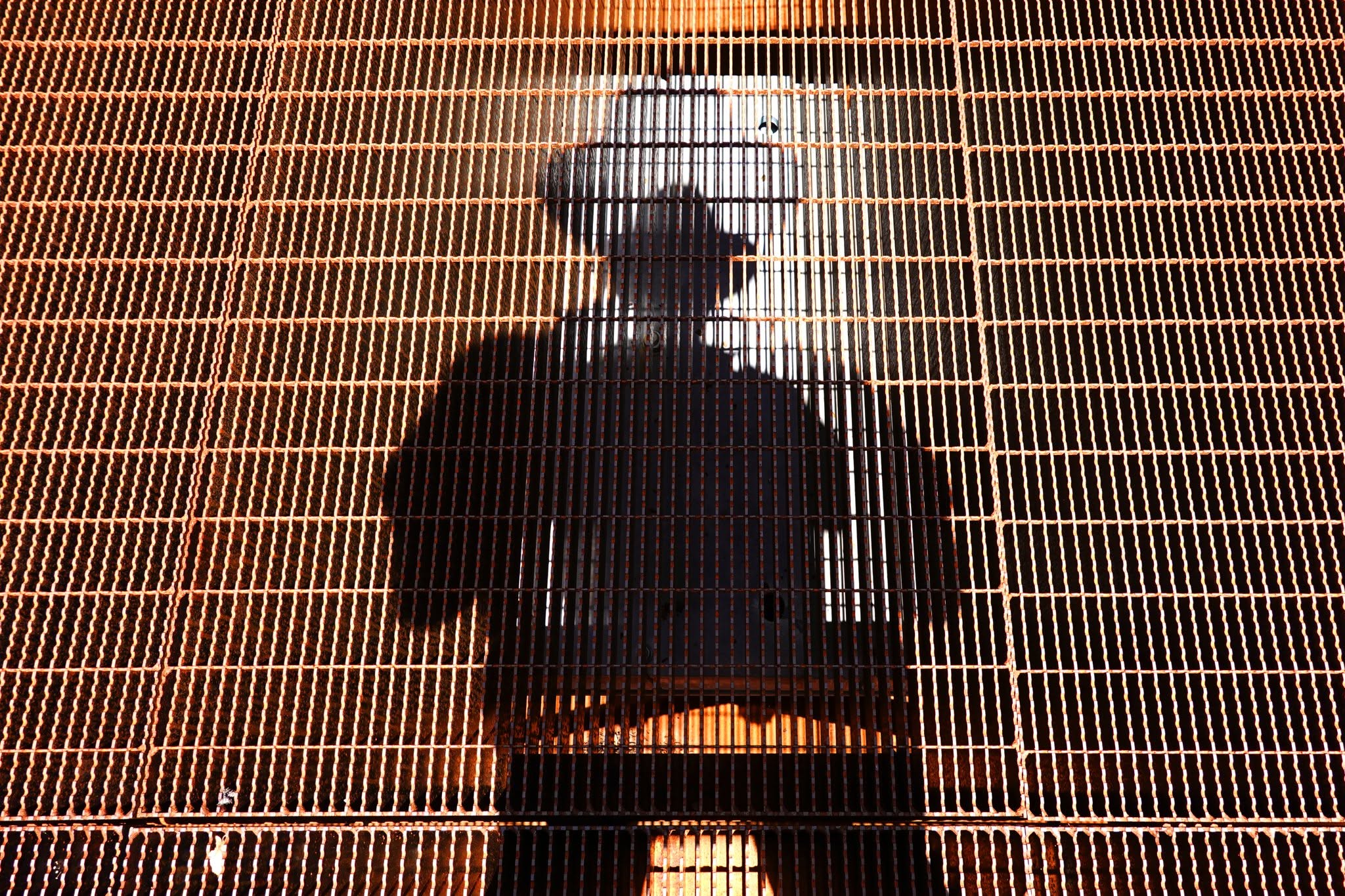
Larger shadow of me on the grate which is the floor of the new bridge across the river Eisack in Franzensfeste, South Tyrol. Smaller shadow is on a metal plate a couple of feet under the grate.
Enjoying the content on 3QD? Help keep us going by donating now.
by TJ Price
An excerpt from “The Collectors,” by Matt Bell.
No self without these ghosts.
No ghosts, without—
No. No ghosts, or rather:
No ghosts except in things.
They surround you, press closer, waiting for the rapidly approaching moment when you too will be just a thing, an object, a static entity slowly falling into decay.
Packrat. My maternal grandmother was what we called a “packrat,” when I was growing up—we never used the word “hoarder” to describe her until after she died. After a backyard picnic, she would direct my sister and I to gather up the used plastic utensils, to wash them at the sink before tucking them away in plastic containers. These containers themselves had once held pre-sliced deli meat, purchased at the grocery store, and had been used and reused until they went filmy like cataracts. She “saved everything,” we used to say. But that wasn’t the extent of it—she was also a collector. She would make pilgrimage to the McDonald’s on the Berlin Turnpike for the toys that came in the Happy Meals, yet would never be lucky enough to acquire the entire set of a particular run. To this day, I recall her bedroom, every nook and every cranny jammed full of boxes or bags, every drawer teeming with the luscious susurrus of plastic-wrapped plastic. “Someone might need it,” my grandmother protested thinly at any mention of her habits. “I’ll bring it to the church bazaar, or drop it off at the hospital.” Despite the fact that nobody would want any of it, she clung to it desperately. Despite the fact that she herself often forgot she had something, she wouldn’t let any of it go. It seemed to me that she was attracted more to the idea of having something rather than actually having it; drawn to the sheer mass of accumulation. She seemed to nurture it, constantly feeding it with more—I would see her duck into her room, which she kept locked and to which lock she wore on a thin piece of twine around her neck, clutching some plastic-wrapped souvenir that might have a second life. She seemed determined to throw away as little as possible, a habit which I respected and by which I felt a kind of awe. Mom always called it “junk.” Said, “your grandma’s a packrat.” I figured it had something to do with Depression-era mentality: save, save, save, for you don’t know where your next anything will come from, if it will come at all.
Instructions for My Funeral (I). On the hard drive of my computer, I have a document entitled “Instructions for My Funeral,” which addresses my husband. Read more »
by Dilip D’Souza
Potholes and education. What connects the two? Not much, I imagine. But in recent days here in India, I’ve been musing over one, possibly tenuous, link. Especially on the night before I started writing this column, when we bumped and rattled through various pothole-ridden Bombay streets on our way home from a distant suburb.
Let me start with a list of statements made by Eknath Shinde. Shinde is now the Deputy Chief Minister of my state, Maharashtra. But between 2022 and 2024, he was the Chief Minister.
To sum up: That’s over two years of Shinde promising my city something in two years. There’s something poetic there. The promises may have continued beyond September 2024, too. That month is when, somewhat wearily, I gave up keeping track of the man’s pothole pronouncements. So I have no idea if he has repeated them.
But remember: nearly two years after the last one I noted, I did bump and rattle through various pothole-ridden Bombay streets on our way home from a distant suburb. So much for a city free of potholes.
Still, considering that politicians the world over make empty promises all the time, why am I inflicting this man’s pronouncements on you? Because recent events in India have brought me a reminder.
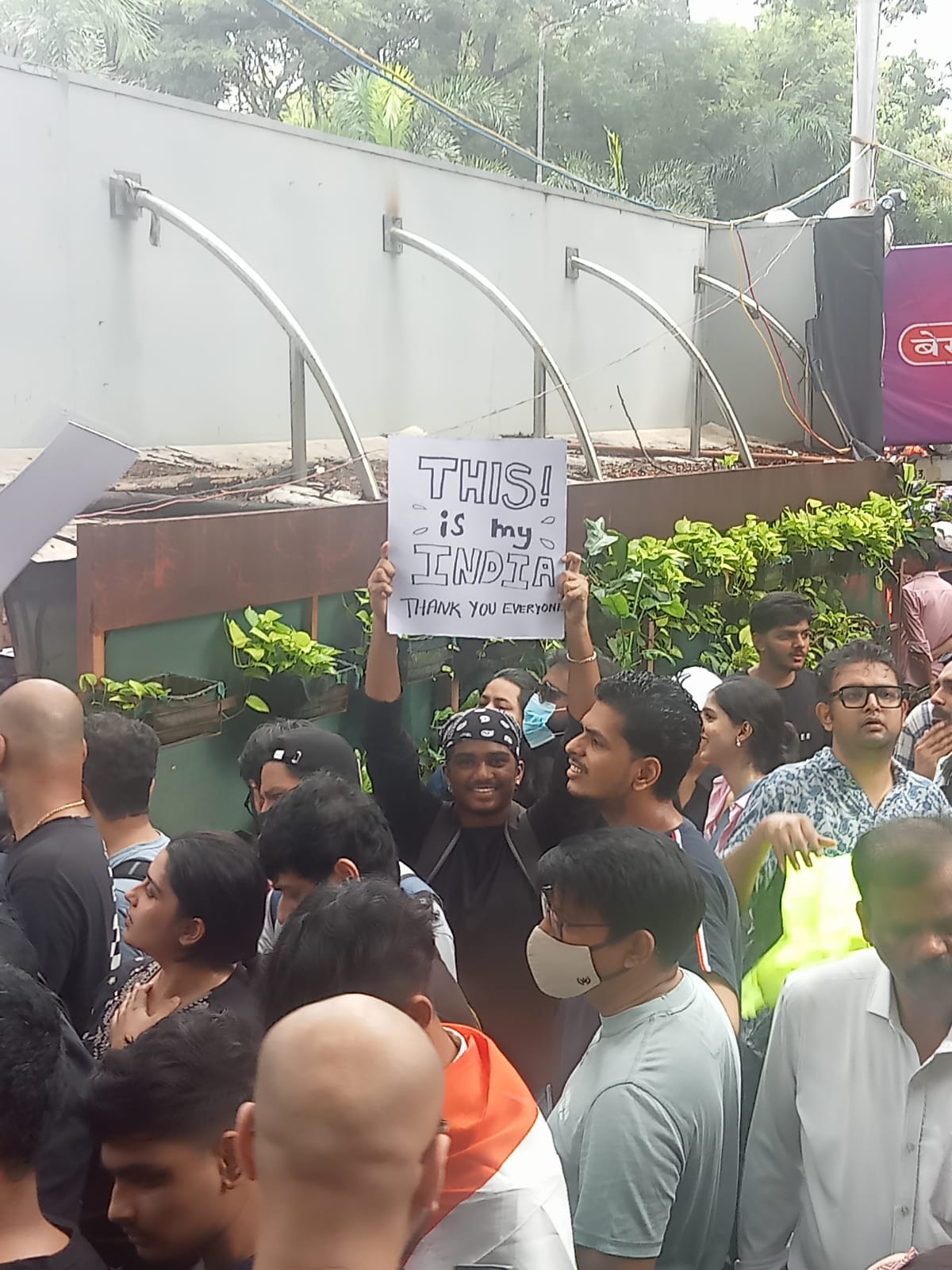
Maybe you know what events I refer to. Still, the sheer energy, inventiveness and passion we’ve seen in recent weeks demand at least a quick recap. Read more »
by Bill Murray
 For most of the last hundred years, ships sailed the globe without much thought to who ruled the sea. Governments agreed on organizations and protocols for getting along, capital flowed, scientists collaborated and manufacturers built supply chains stretching around the world. The international commons became so ordinary as to disappear from view. That didn’t happen by accident, and it isn’t guaranteed to continue.
To preserve America’s place in all this, its next president must abandon the Trump administration’s goal of hemispheric dominance. The future won’t be secured by controlling more territory, but by building stronger networks of allies across institutions, industries and technologies. America’s next leader must be a builder.
Former Secretary of State George Schultz once compared diplomacy to gardening. Maintaining relationships, he thought, was “one of the most underrated aspects of diplomacy.” He believed that “the way to keep weeds from overwhelming you is to deal with them constantly and in their early stages.”
The United States spent the seventy years before Donald Trump pruning away at the public commons, deterring great-power war, developing and enforcing trade rules, keeping the dollar the global currency and the sea lanes open—in short, maintaining the alliances that made its global position possible.
Neglected for the past decade, the public commons is in disrepair. The question for our moment is how future American leadership might restore an international commons that promotes progress based on common interests, and fend off the return of the law of the jungle. Read more »
by Philip Graham
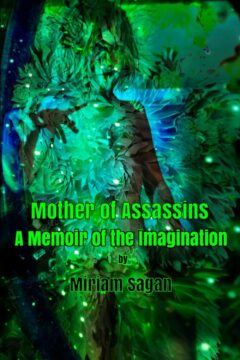 In December of 2025, Miriam Sagan published a stunning merger of memoir and fantasy fiction, Mother of Assassins: A Memoir of the Imagination. In a conversational prose that is deceptively simple, this short book weaves together what is remembered and what is imagined with such uncanny glue that at times they can’t easily be distinguished from each other. I’ve read Mother of Assassins twice now, and look forward to another return to its subtleties and pleasures.
My conversation with Miriam Sagan began with a discussion of Mother of Assassins, but soon enough we delved into some of her earlier work, and we found intriguing connections between her newest book and her extensive oeuvre of poetry, memoir, and fiction. Then we spoke of how this oeuvre has been built: over forty books created, thanks to her singular approach to a writing career. Rather than overly worrying about the world discovering her writing (thereby avoiding the often exhausting trap of self-promotion), Sagan has focused her main concern on discovering the world and herself through the simple act of writing, quietly producing a steady flow of book after book after book.
*
Philip Graham: The first chapter of Mother of Assassins begins with Layla, an old woman recounting her long life that began in the exotic Blue City. The second chapter begins with you, Miriam, declaring that you invented the Blue City when a child, though you’ve neglected it for over fifty years. In the wake of an alarming medical diagnosis, you allow yourself to return to that imagined world and discover it has continued to exist. Its characters live their lives without you. And this is where the subtitle of your book kicks in: A Memoir of the Imagination.
Miriam Sagan: We often hear writers say that their characters take on a life of their own. This can be confusing to readers and the writer too—as in “who’s in charge here?” But for me writing a book can be like living in an ongoing dream. And it isn’t a lucid dream. I don’t feel like I’m controlling the initial action at all times. How can this be? I feel like it asks an essentially unanswerable question—where does the creative impulse to make a narrative come from? I most usually find it in a half conscious state, a consciousness that lies between sleep and waking. In the past few years I tried to “work” that slippery state, or at least be aware of it. I was writing poems from a hypnagogic mind, and the Blue City seems to be there too, located on an initially private map. Read more »