
by Charles Siegel
Last month I attended two conferences a week apart, one in Norway and one in Italy. The first conference was held in Bergen. From there, my law partner and I proceeded down the coast to Stavanger, for a meeting with a lawyer there about some potential cases.
Our meeting was late on the afternoon of November 16th. When we finished, we looked around for somewhere to have dinner. Most restaurants were closed on a Sunday evening in autumn, but eventually we found a decent place. As we walked back to our hotel afterward, we passed a pub and decided to go in and watch the soccer match that was playing on TV.
This turned out to be a World Cup qualifying match between Norway and Italy. There wasn’t actually much riding on the outcome; Norway was going to qualify unless it lost by nine goals or more, and Italy was going to stay alive but have to win an extra two matches to qualify, as part of an additional playoff round for European teams. But the fans in the pub were excited nonetheless.
When we sat down, the game was about midway through the second half, and the score was 1-1. It was clear, of course, that Norway was not going to lose by nine goals or anything close to that, and so they were going to the World Cup for the first time in 28 years. But even as the clock ticked down toward qualification, those in the pub still were hoping for a win.
And they got it, in lightning fashion: Erling Haaland, the bustling striker who plies his trade in the Premier League for Manchester City, scored two goals in two minutes. Norway added a fourth in stoppage time, and that was it. Jubilation for the Norwegian players, many of whom weren’t alive the last time Norway played in a World Cup, and humiliation for Italy, who were beaten at home and who now are in danger of missing the tournament for a third time running.
I haven’t always been a soccer fan. Growing up in Texas in the 60’s, 70’s and 80’s was much different than it is now. Soccer was much less popular and most kids didn’t play it. There was no MLS. (The previous attempt at a professional league, the NASL, folded in 1984.) You couldn’t turn on the TV on a random Wednesday afternoon and find a German or Brazilian league match the way you can today.
So like most boys growing up in that time and place, I really didn’t pay attention to soccer. I vaguely remember watching some of the 1986 World Cup final and being bored by it. My main recollection is of thinking that the German goalkeeper, Toni Schumacher, looked a little like Robert Plant, from a great distance on our family’s black and white TV.
In 1994, of course, the World Cup was held in the U.S. One day during the tournament, I was walking through the Dallas Love Field airport, coming home from a business trip, when I passed a restaurant and saw a lot of people gathered around the TV, all looking up at it. I stopped to see what they were watching, and saw there was a pause in the action. This is what happened next: https://www.youtube.com/watch?v=48x5dX-x7r4 To this day it is still one of the best free kicks I’ve ever seen — maybe the best. The whole choreography of it was enthralling. In Berlin during the 2006 World Cup I had a great time with some Swedish traveling fans I met in a bar, when I explained to them that their team’s goal was the reason I was there.
Because from then on, I was hooked. I watched the rest of the tournament avidly. I still can’t get over the fact that I missed several matches played here in Dallas. These included Germany barely holding off the tireless, game South Koreans; Germany was up 3-0 at halftime but wilted in the heat and only won 3-2. Brazil won by the same score over the Netherlands in a quarterfinal, and Branco had a great free-kick goal in this match as well: https://www.youtube.com/watch?v=iYf6LdfGnu8
Since then it’s been a big part of my life. Two friends and I saw the World Cup final in Japan in 2002, and a few games in Germany in 2006. On a luckily-timed business trip to Brazil in June, 2000, I saw Brazil draw with Uruguay in a World Cup qualifier in the famous Maracanã stadium in Rio de Janeiro. Brazil were extremely fortunate to avoid losing in their spiritual soccer home; they were awarded a soft penalty in the 86th minute which Rivaldo converted. Until that point they had been kept at bay by the excellent young Uruguayan keeper, Fabian Carini.
I attended the match with another American lawyer and our Brazilian co-counsel. As we were walking up the stairs from our seats after the match ended, our co-counsel stopped and said something to a man sitting by himself. The man answered pleasantly, and then our co-counsel introduced us to him.
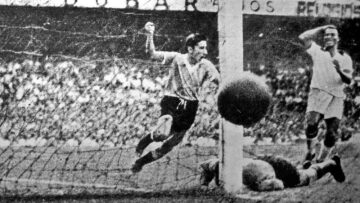
This man, sitting by himself in a high seat far from the field, was Alcides Ghiggia. He had scored perhaps the most famous goal ever scored in the Maracanã. Indeed, it might be the most famous goal ever scored anywhere. Except he scored it against Brazil.
Fifty years earlier, Brazil had played Uruguay in the Maracanã in the final of the 1950 World Cup final. The game was technically not the “final,” as that tournament had an unusual last group stage rather than knockout rounds, but for all practical purposes it was a final since the other two teams in the last group were already eliminated.
Brazil was heavily favored, and in fact only needed a draw to win the tournament, whereas Uruguay needed to win. On the day, Brazilian newspapers and politicians had already crowned the team champions. The crowd was in a festive mood. And what a crowd! The official attendance figure was 173,850, easily making it the highest number of paid spectators for a soccer match ever. At the time, the Maracanã consisted mostly of concrete terraces with no seats. Tens of thousands more fans are believed to have entered the stadium illegally, putting the real attendance estimates at well over 200,000.
The match was scoreless at halftime, but two minutes into the second half Brazil scored. The crowd knew the title was theirs, but Uruguay equalized 20 minutes later. Then, 13 minutes after that, Ghiggia scored the winner. It wasn’t the most impressive goal ever scored, but it is surely the most dramatically decisive. The crowd was devastated; it is said, although this has never been officially confirmed, that one fan committed suicide by leaping from the terraces, and three others died from heart attacks. This short video shows the goal at 1:10, but it’s worth watching in its entirety for a sense of the size and intensity of the crowd:
https://www.youtube.com/watch?v=Pu1WanatiAM. Much later in life Ghiggia was quoted as saying that “only three people have ever silenced the Maracanã: the Pope, Frank Sinatra and me.”
The Ghiggia I met, 50 years after his goal of goals in the same stadium, could not have been nicer. He shook our hands and exchanged pleasantries, and remarked on the tight game we’d just seen. He died in 2015 at age 88, 65 years to the day after his thunderbolt.
Since that match, I’ve seen other great matches too. On another fortunately-timed work trip, I saw Argentina beat Chile in a qualifier at the Estadio Monumental in Buenos Aires, which, since the Maracanã was renovated over time to remove the terraces and install seats, is now the largest stadium in South America. Messi scored the only goal on a penalty. I saw Portugal beat Spain 1-0 in Lisbon at the 2004 Euros, and I witnessed the infamous Thierry Henry handball in Paris in 2009. (Although I didn’t actually witness it–even though we were sitting almost directly behind the Irish goal, I somehow missed it.)
I got to take my son to a match at the old White Hart Lane. I’ve seen Millwall at Cold Blow Lane, and club matches in Norway and Sweden. On another family vacation to London a few years ago, the Premier League hadn’t started up yet but the Championship was underway, so my son and I went to a Brentford match. It was a lot of fun going to that small ground, Griffin Park. That day the club honored some longtime fan, who had just turned 100 or something like that, and hadn’t missed a match in several decades. Brentford has since been promoted to the Premier League, and moved into a much bigger stadium, but I doubt the atmosphere there is any better than what I saw.
At the conference I attended in Italy, I listened to a London solicitor’s presentation, and while doing so I looked up his bio on his firm’s website. This said that his Brentford FC season ticket was his prize possession. I chatted with him during a break later in the conference, and he was quite surprised to hear that my son and I had seen a match at his club’s old ground.
In all, I’ve spent a large part of the last three decades watching, reading and thinking about soccer. I even joined a coed team when I was 40, for one less-than-stellar season as goalkeeper. I’ve read and reread Brian Glanville’s history of the World Cup. I’ve wondered about the psychology of penalties, and read a book about why England consistently missed them, or at least used to (“On Penalties” by Andrew Anthony of the Guardian). I enjoy the Guardian’s daily humorous, sardonic take on events on the pitch and machinations off it, “Football Daily.”
Brazil won the 1994 Cup, of course. I began following them, and for quite a few years I naively bought into the whole image of Brazilian soccer as charmingly innocent and romantic. Eventually I came to realize that this was mostly a myth. Brazilian players are every bit as mercenary as players everywhere else, and the club game in Brazil is violent and corrupt. Neymar playing in Saudi Arabia isn’t very romantic.
So I gradually lost the romantic attachment to Brazil, and began following Argentina instead. To some degree this was because, like millions of other people, I just liked Messi, who was and is such an endearing figure. But I also made a few business trips to Argentina, and just ended up being more interested in the team.
For about the last dozen years, this has meant mostly desperate disappointment. In 2014 they made the final, but lost to Germany late 1-0 in extra time. The game was cruel; Higuain missed a clear chance at goal, then later had a goal disallowed for offside. In the second half he was absolutely clobbered by the German keeper Neuer, but no card or penalty was given. In the 2018 tournament, Argentina lost, 4-3 in the round of 16 to the eventual champions France. France’s last two goals were scored, four minutes apart, by their young phenom, Kylian Mbappe, then only 19.
Then, finally, to the 2022 Cup, and its inexpressible catharsis. The final, against France again, was perhaps the greatest final match ever played; some commentators called it one of the greatest matches ever played, period. To end in penalties was frustrating but somehow fitting. Argentina kept their nerve and were carried by their terrific goalkeeper Emiliano Martinez, who saved one penalty, and essentially saved another by psyching the French player out so badly that he missed wide. Before Montiel took the winning penalty, Messi could be seen looking up to the sky and saying “Puede ser hoy, abu,” or “it could be today, grandma.” When Montiel’s shot went in to the left corner, Messi collapsed to his knees.
Next year’s Cup will be played in the U.S., Canada and Mexico. Dallas is one of the host cities, and nine matches will be played here — more than in any other city. I should be excited about this, but I’m not really. The matches will be played at the AT&T Stadium in Arlington, midway between Dallas and Fort Worth. This stadium is known around here as “Jerry World,” since it was built by Jerry Jones, the owner of the Dallas Cowboys. Some people call it the “Death Star.”
I hate the place. I haven’t been to a game there in almost 15 years, and have little desire to ever go again. It is a massive expanse of corporatism at its soulless worst. There is no public transit to the stadium; if someone attending a match there next summer drives their car, they may pay $125 for a parking spot more than a mile away. Then they may pay $25 for a hot dog. Another thing about the stadium is its massive overhead video screens. In 2009 when Jerry World opened, they were officially the world’s largest HD video display. You find yourself just watching the screen, instead of the field, for long periods of time, and then you realize you could have just watched the game on TV at home and had the same experience, without the hassle and the expense.
Instead, I look forward to doing what I’ve always done. There is a French restaurant where my friends and I like to sit at the bar and watch matches. There is also a tapas place we go to; the food is good, and the company is genial and enthusiastic. Once we watched a match there in which Chile was playing. A man—a very serious – looking businessman—had brought a Chilean flag, and when the national anthem was played he stood and wrapped himself in the flag and sang.
I’m rooting for Argentina to repeat. I’m also rooting for some of the new countries, who are appearing for the first time, to steal a match or two—maybe Cape Verde or Curacao. There’s been a lot of debate about the bloated size of this tournament, now expanded to 48 teams. I agree with those who oppose the expansion, but I also see the benefit of allowing the so-called “minnows” a chance to participate and maybe even to knock off an established power.
Will there be, at some point in the 104 (!) matches to be played, a goal to rival Brolin’s finish of that exhilarating move by Sweden in 1994? Whatever happens, it will be fun. And if Argentina ends up playing in Dallas, maybe I’ll make the trek out to Jerry World. Even that place can’t ruin the excitement of a World Cup match you care about.