
by Mark R. DeLong
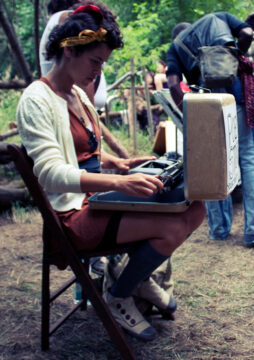
“People tell me that I could do much better,” David McCullough said in an interview included in California Typewriter, a documentary about typewriters “and the people who love them.” “I could go faster and have less to contend with if I were to use a computer—a word processor—but I don’t want to go faster. If anything, I would prefer to go slower.” He liked the straightforward mechanism of his Royal Standard Typewriter that he bought, used, in 1965 for about twenty-five dollars. “To me, it’s understandable: I press the key and another key comes up and prints a letter on a piece of paper and then you can pull it out. It’s a piece of paper upon which you have printed something.
“You’ve made that. It’s tangible. It’s real.”
That tangible quality, that reality comes clear in Richard Polt‘s Typewriter Manifesto, which concludes with a series of contrasts of typewriter life and digital life (using the red and black colors of some typewriter ribbons):
We choose the real over the representation,
the physical over the digital,
the durable over the unsustainable,
the self-sufficient over the efficient.
And then the manifesto concludes, “THE REVOLUTION WILL BE TYPEWRITTEN” of course.
Keyboards are keyboards, you might say. It’s the fancy stuff behind them that matters. Typewriters also have had their incremental improvements, electrification being the most obvious and, less obvious perhaps, the improvements on font rendering. The old fashioned levered hammer bearing the inverse shape of letters gave way to ingenious “balls” as in the IBM Selectric and “printwheels” that look like a miniature, heavy-duty bicycle wheel with spokes that bear the letters. (My own old typewriter has this technology.) These innovation allowed for font changes and vastly improved print typesetting. That story about the ingenious QWERTY keyboard layout minimizing key jambs and speeding production of words? I’d say, probably false. A more likely reason for that innovation was probably a simple marketing trick: a salesman who didn’t know how to type could still peck out T-Y-P-E-W-R-I-T-E-R using only the letters on the top row. Read more »
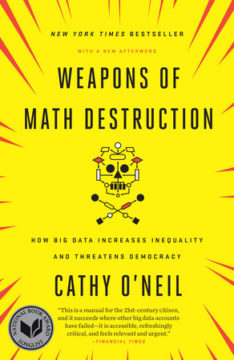 And then I started trying to warn people about the dangers of algorithms when we trust them blindly. I wrote a book called Weapons of Math Destruction, and in doing so I interviewed a series of teachers and principals who were being tested by this new-fangled algorithm called the value-added model for teachers. And it was high stakes. They were being denied tenure or even fired based on low scores, but nobody could explain their scores. Or shall I say, when I asked them, “Did you ask for an explanation of the score you got?” They often said, “Well, I asked, but they told me it was math and I wouldn’t understand it.”