by Akim Reinhardt
 I was born before language. Only waterfalls and wind and tumbling rocks.
Nothing needed to be said if you only knew how to listen.
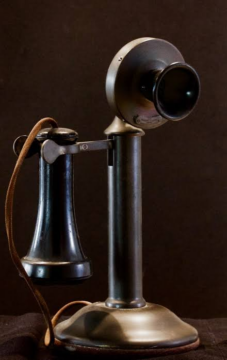
I still remember my grandparents phone number. 828-3973. They, on the other side of the Bronx, had the same area code as us, as the whole city: 212. No need to add it. Seven digits were plenty.
Placing my finger in our rotary phone’s circular template led to a swirling dance when dialing their number. Long, short, long short, long, long, short. Our own number was a marathon for whoever dared to spin it. 2 sixes, 3 sevens, an eight, and a nine.
My grandmother was the talkative one. A natural polyglot who got spit out of the Austro-Hungarian Empire and eventually into the Lower Eastside before she married my grandfather and he took her up to the South Bronx. Hungarian from her family, Yiddish from being a European Jew, Romanian from the post-WWI schools, and English in the new country. She was completely fluent in her fourth language, with some slight quirks. “Do you have what to drink?”
My grandfather never spoke another word of Polish after he and his family got chased out, and just in time. Despite coming over as a teen, his English was forever deeply accented and a little broken. Yiddish was his main language, and as a result, my mother’s first. She learned English on the playground. I loved my grandfather deeply, but talking to him on the phone was awkward. He would ask rote questions, mostly the same ones each time. I would offer quiet, curt responses. We were much better in person, where he taught me how to play chess and read the stock page.
My best friend during elementary school lived in the next building. Our phone time was minimal. Why bother when we could just meet in the playground, or one of us could hop over to the other’s apartment on a bad weather day. You home? Okay, I’m coming over.
By high school, some of my friends were a little further flung, a neighborhood away. But by then we were building our masculinities. Our fathers and popular culture made it clear that yakking on the phone was for girls. Don’t be a chatty Cathy. Or a yenta, in my grandparents’ lingo. Read more »

 Over what is slowly becoming a lengthy session of being alive, I’ve found this statement to be absolutely true. I’m usually thrilled with the variety and my experiences so far. However, those things the world is full of aren’t necessarily always pleasant. Or desirable. We’re thrust, will we, nil we, into a stew of unknowns.
 Had the historian of California, Mike Davis, lived long enough to take in the spectacle of the AI boom, he very well may have seen a through line to earlier hybrids of unvarnished hype, greed, military research, science fiction, and techno-millenarianism, all perduring elements of a unique California ecosystem that has evolved some of the nation’s more distinctive cultural formations. If you think Peter Thiel’s itinerant, closed-door lectures on the Antichrist, Elon Musk’s high-volume procreation, or Sam Altman’s fascination with Napoleon and his notion of founding a company like you’re founding a religion were each a bit unusual, you have not read the history of California’s Church of Scientology.
 Thomas R. Wells
  I started reading the Bible after Easter of this year. Five months later, I’m about halfway through-
 In
In 
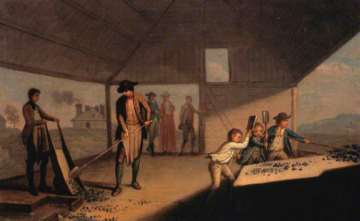
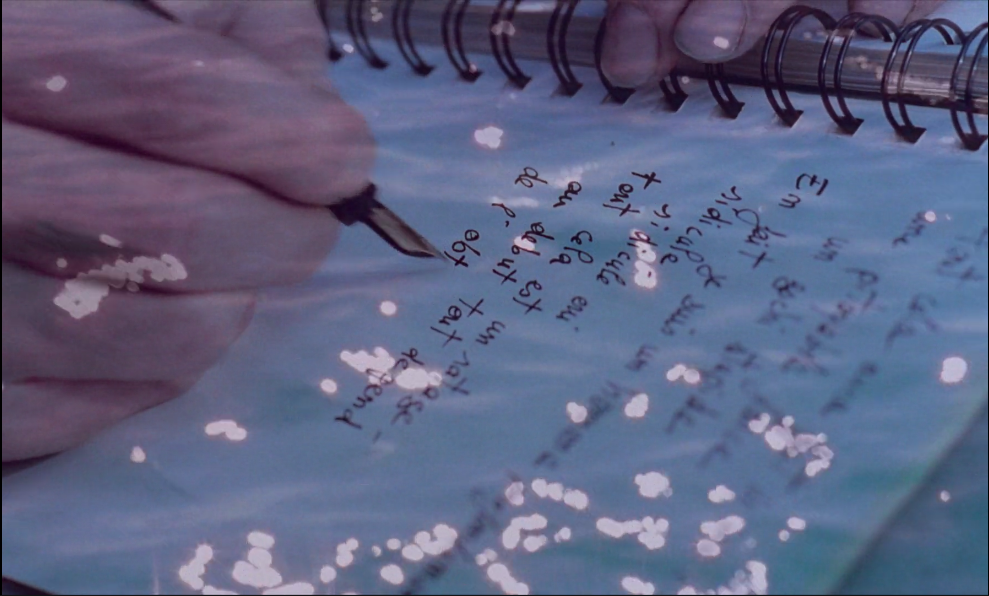 What if you took Paul Schrader’s “man in a room” concept and transposed it to the vast expanse of the African desert? You would get something like Claire Denis’ Beau Travail (1999), which shows that the room a man locks himself in doesn’t need to be literal—a prison can be made anywhere. In Denis’ film, the man in a room is Galoup, a French Foreign Legion sergeant who commands a group of some 15 men in Djibouti. He is, he tells us in voiceover, “a perfect Legionnaire,” and like Schrader’s protagonists, he writes in a journal and narrates his memories, a storytelling technique stretching back to Robert Bresson’s Pickpocket. The story thus proceeds along two timelines: one, with Galoup in Marseille, writing in his notebook after he has been dismissed from the Foreign Legion; and the other, the memories of the desert and the Legion that the notebook engenders.

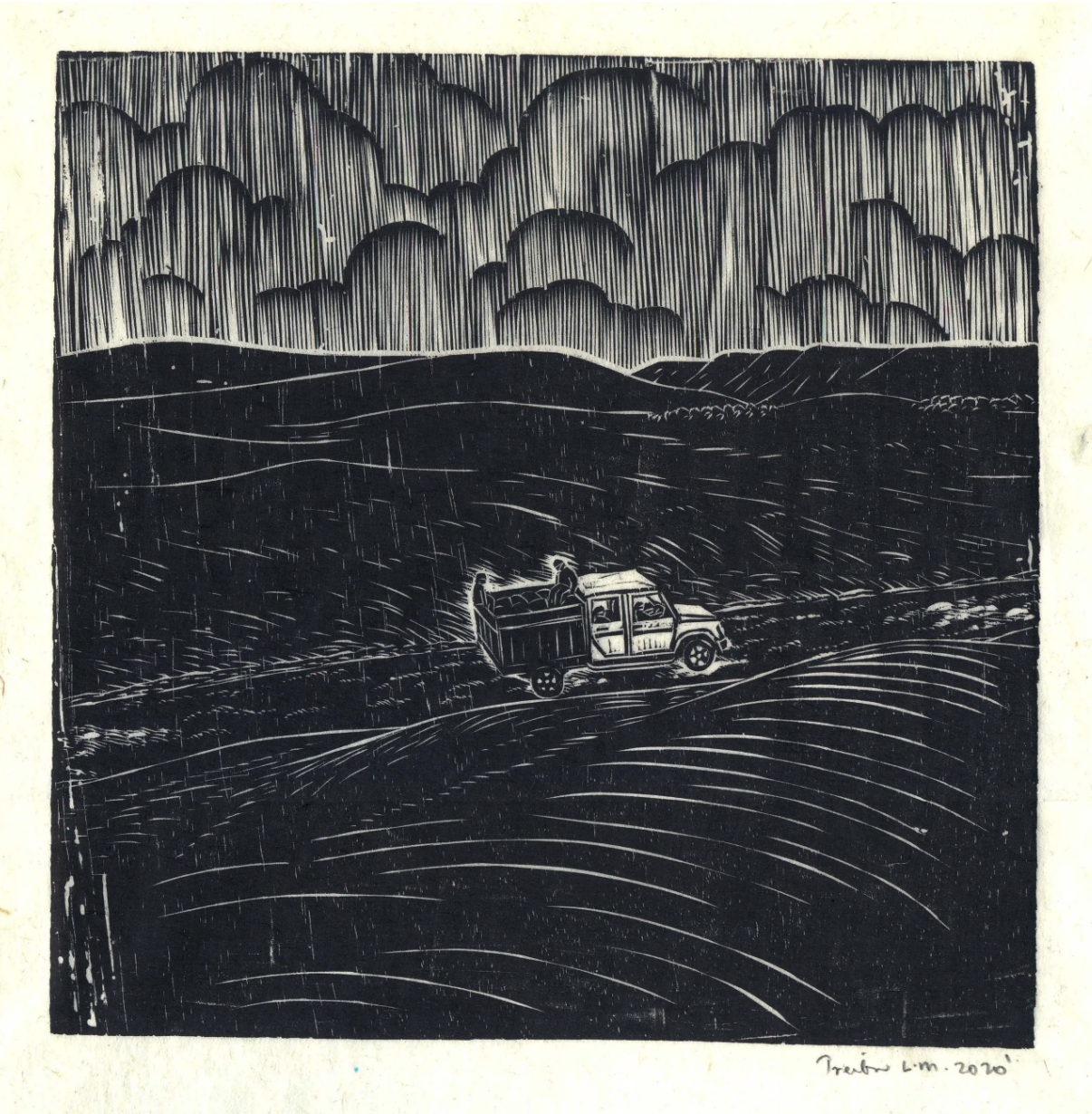 Treiborlang Lyngdoh Mawlong. From “Somewhere, Elsewhere, Here”, 2020.
 The
The 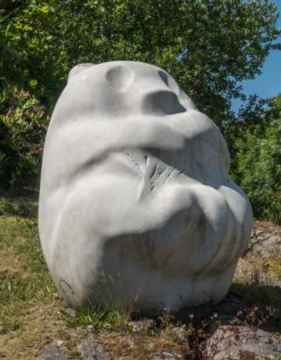 There is a white marble panda at the edge of the pier road in Sneem, and as a boy I walked past it most mornings on the way to Christian’s shop without once wondering why a panda should be standing in Kerry. It was cold in the mist and faced whatever the morning brought in off the bay, and I gave it about as much thought as I gave the wet tarmac.
 We went to the movies the other day, a rare occurrence. It wasn’t easy to find a film, since in Zurich at the moment most cinemas seem to be showing The Odyssey, which I don’t particularly want to see. This is for idiosyncratic reasons, some private red flags that were unfurled when the trailer evoked my last excruciating experience of a star-studded cinematic makeover, Kenneth Branagh’s 1996 Hamlet. (Anyone who remembers Billy Crystal’s cameo as the First Gravedigger may feel the same way.) My resolve was then strengthened by Emily Wilson’s