
by Marie Snyder
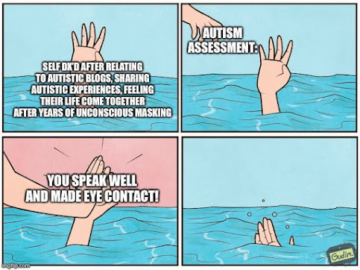 There are a few ideas I’ve seen floating around on social media about people with Autism Spectrum Disorder (ASD) having no empathy, no Theory of Mind, and being in need of fixing instead of accommodating. I just ignored them. But then I heard similar statements in a university class with controversial Autism Speaks and Hopebridge videos on the curriculum. I relayed my concerns about promoting only these organizations without explanation of current concerns and without providing other perspectives like from the National Autistic Society or Autistic Self Advocacy Network. This is a bit of a take-down on what appears to be an accepted curriculum around autism.
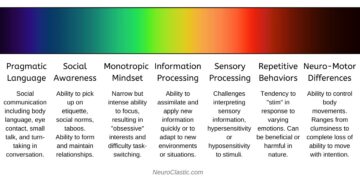 What is ASD? C.L. Lynch at NeuroClastic explains the spectrum really well using this illustration. You need to be affected in several of these areas regularly to be on the spectrum, and every person’s different. It’s complex. I went so far as to craft an assessment, the AQ-27, not remotely peer reviewed but rooted in the DSM-5, after being absolutely floored by the offensiveness or inaccuracy of the official assessments we had to learn in class.
The Controversy:
Some advocates are “furious over the tone of the [Autism Speaks] video. ‘We don’t want to be portrayed as burdens or objects of fear and pity.” Hopebridge suffered scandals when an employee was fired for reporting an abusive incident with accounts of “undertrained staff and high turnover, a lack of transparency and accountability, and practices that prioritize profit over the needs and safety of young people with autism.” Some implications that people with ASD require lifelong care have been questioned since original stats were based on studies of children in psychiatric wards: “This potential bias means that we still know relatively little about the achievements of individuals in whom the presentation of early symptoms is more subtle.” Read more »
 I read a great deal of Bertrand Russell when I was in my teens. I read various collections of essays, such as Why I Am Not A Christian, In Praise of Idleness and Other Essays, and Marriage and Morals, some of which my father had stored in a box in the basement, along with Orwell’s 1984, Huxley’s Brave New World, a book or two by this guy named Freud, though I forget which one, and some others. I also Russell’s – dare I say it? – magisterial
 Sughra Raza. Let Me Just Absorb Today.
 There is no genuinely effective lyric poem unless there is a line which lodges itself in the brain like a bullet. Often – though not always – these lines are the first in a poem, the better to abruptly propel the reader into the lyric. William Wordsworth’s “I wandered lonely as a cloud,” Walt Whitman’s “I celebrate myself, and sing myself,” or Langston Hughes’ “I’ve known rivers.” For example, John Donne and Emily Dickinson are sterling architects of not just the memorable turn-of-phrase, but the radiant introductory line as well. Think “Batter my heart, three-person’d God” or “I heard a Fly buzz – when I died.”



 In
In 

 Amy Sherald. They Call me Redbone but I’d Rather Be Strawberry Shortcake, 2009.
 In November 2023, in an essay for the German national newspaper die taz, I wrote that Germany’s Jews were once again afraid for their lives. It was—and is—a shameful state of affairs, considering that the country has invested heavily in coming to terms with its fascist past and has made anti-antisemitism and the unconditional support of Israel part of its “Staatsräson,” or national interest—or, as others have come to define it, the reason for the country’s very existence. The Jews I’m referring to here, however, were not reacting to a widely deplored lack of empathy following the brutal attacks of October 7. In an open letter initiated by award-winning American journalist Ben Mauk and others, more than 100 Jewish writers, journalists, scientists, and artists living in Germany described a political climate where any form of compassion with Palestinian civilians was (and continues to be) equated with support for Hamas and criminalized. Assaults on the democratic right to dissent in peaceful demonstrations; cancellations of publications, fellowships, professorships, and awards; police brutality against the country’s immigrant population, liberal-minded Jews, and other protesting citizens—the effects have been widely documented, but what matters most now is now: the fact that the German press is still, four months later, nearly monovocal in its support of Israel and that over 28,000 civilians, two-thirds of them women and children, have died.