by Marie Snyder
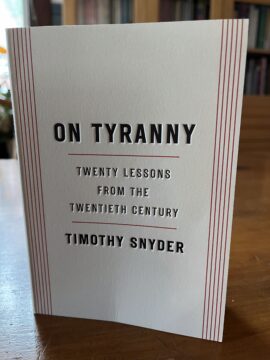
Timothy Snyder’s dictum, “Do Not Obey in Advance,” seems to be everywhere these days. It’s the title of the first chapter of his book out in 2017: On Tyranny: Twenty Lessons from the Twentieth Century, which is worth a revisit along with conformity experiments that back up his concerns and some clarification from a recent podcast.
When I first read this book seven years ago, it seemed like a concern for a far off future that would surely not happen in my lifetime. But it has lately reemerged as a prescient warning, and now there are more obvious signs that we need a path through potential political ruptures. In the first few pages, Mr. Snyder points out the power we have in avoiding acceptance of tyranny and the danger we fall into if we do obey:
“After the German elections of 1932, which permitted Adolf Hitler to form a government, or the Czechoslovak elections of 1946, where communists were victorious, the next crucial step was anticipatory obedience. Because enough people in both cases voluntarily extended their services to the new leaders, Nazis and communists alike realized that they could move quickly toward a full regime change. The first heedless acts of conformity could not then be reversed. …As the political theorist Hannah Arendt remembered, ‘when German troops invaded the country and Gentile neighbors started riots at Jewish homes, Austrian Jews began to commit suicide.'”
It’s the mere act of going along that could determine if we lose another mass of people in heinous ways, divided apart from among us in one way or another. We’re seeing that unnerving agreement already in some political speeches and pretty mainstream news outlets.
Mr. Snyder writes about Stanley Milgram’s attempts to “show that there was a particular authoritarian personality that explained why Germans behaved as they had” with his shock experiments conducted on hundreds of people. Instead, when most of his participants shocked another person until their perceived death, “Milgram grasped that people are remarkably receptive to new rules in a new setting. They are surprisingly willing to harm and kill others in the service of some new purpose if they are so instructed by a new authority.”
This experiment was one of many that came after WWII to try to figure out what could possibly have compelled regular people to participate in the rounding up and gassing of millions of people. Hitler couldn’t have done all that on his own, but he was able to sway the masses to join in. We need to be aware of this stark reality to ensure we, ourselves, don’t end up passively agreeing to harm others or allow harm to come to others. Read more »
 Some people use religion to get their life together. Good for them. I’m all for it. Although I myself am an atheist, I don’t think it much matters how someone gets their life together so long as they do.
 On the one hand, nothing has changed since August 2020, when I wrote
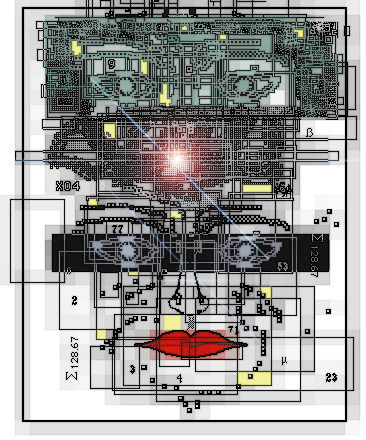
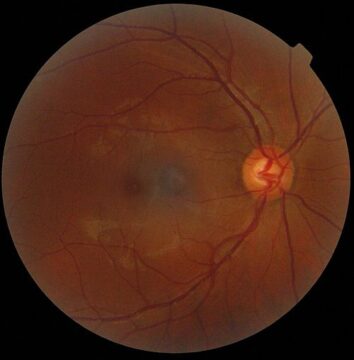 Anatomically, it’s the optic disc – the spot on each retina where neurons with news from all the light-sensitive rods and cones of the retina converge into the optic nerves. The optic disc itself,

 Sughra Raza. Rorschach Landscape, Guilin, China, January 2020.

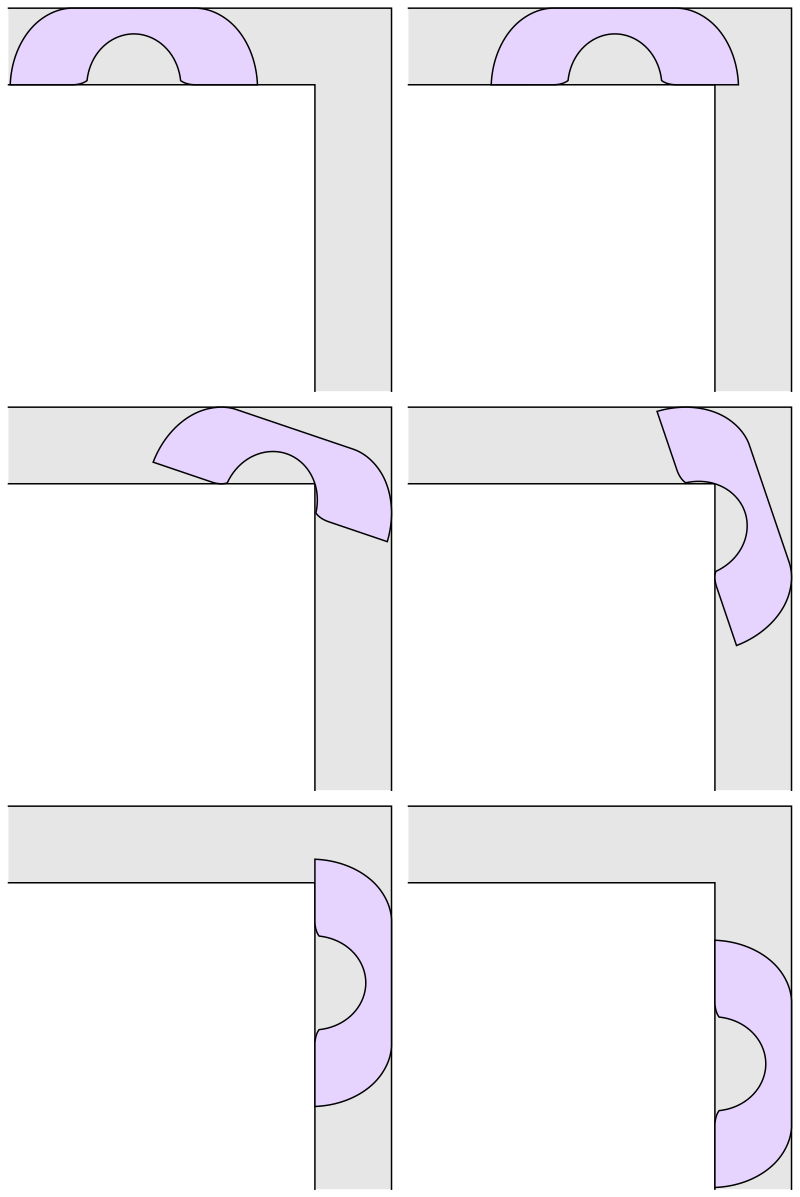
 Of course there was no guarantee that Gerver’s couch was the biggest possible. Dr. Gerver’s approach made no promises that it gave the best possible, after all. A little more convincing is the fact that in 30 years we haven’t been able to do any better. But mathematics is a game of centuries and millennia — a few decades is small potatoes. In 2018, Yoav Kallus and Dan Romik proved that the couch could be no larger than 2.37 square meters. But the gap in size between Gerver’s couch and the Kallus-Romik upper bound is an order of magnitude larger than that between the couches of Gerver and Hammersley.


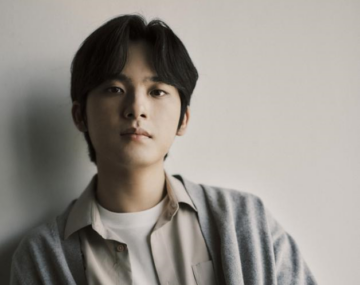 Someone else who understands the power of a single note is pianist Yunchan Lim, winner of the 2022 Van Cliburn competition at age 18, who electrified the classical music community with his performances of Rachmaninoff’s Concerto No. 3 and Liszt’s Transcendental Études and has since sold out concerts around the world. His reputation for virtuoso barrages of perfect notes at dizzying speeds belies a deep engagement in the sound he can extract from the piano with a single note—a process he demonstrated in