
Iran and the burden of knowledge

by Ashutosh Jogalekar
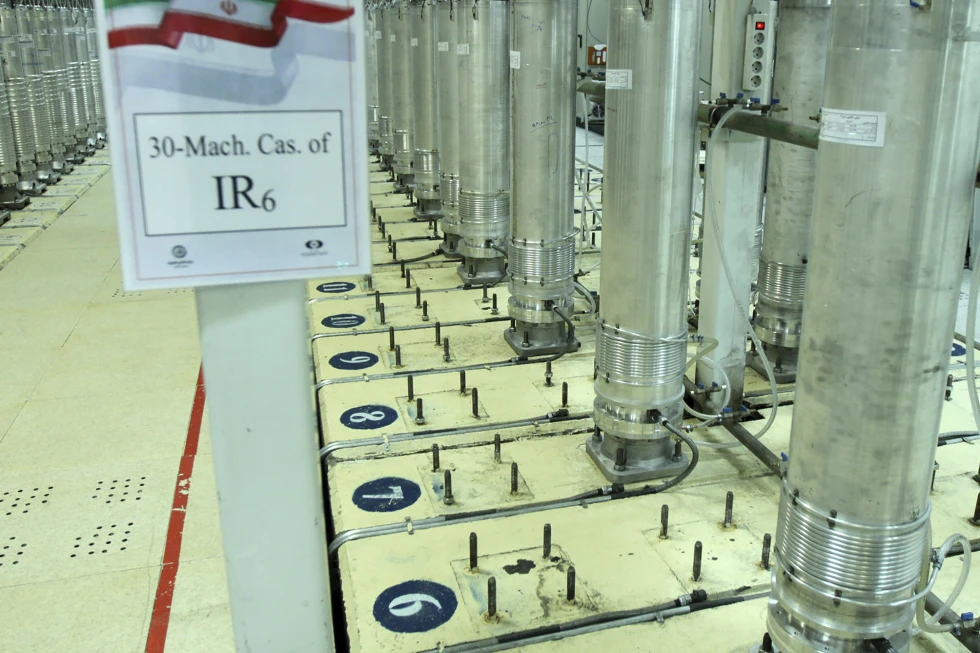
A cascade of IR6 centrifuges at the Natanz facility in Iran: a single IR6 can enrich a kilogram of U-235 from 60% to weapons grade (90%) in about 10 months.

After World War II ended, there began a running debate between American scientists and the American government about how to properly wield the fearsome nuclear power that America had discovered and unleashed. The government believed that this power could be hoarded and used by the U.S. to play geopolitical games in which they held all the cards. The scientists argued that the power that the government thought it possessed exclusively depended on discovering the basic laws of physics, chemistry and engineering, laws that were accessible to scientists in any country.

The scientists were right. Estimates of when the Soviet Union would get nuclear weapons ranged from three to twenty years, revealing a gulf between the scientists and the political and military establishments, with the latter betting on the longer timelines. As it turned out, the Soviets detonated their first bomb in August 1949, a little more than four years after the bombs fell on Hiroshima and Nagasaki. In 1955 they detonated their first thermonuclear bomb. While the Soviet fission bomb was aided by espionage, the discovery of the critical Teller-Ulam mechanism that makes thermonuclear weapons possible was an independent discovery, attesting to the ubiquity of scientific know-how. Britain, China and other countries followed with their own atomic and thermonuclear tests. The Soviet event marked the beginning of an eternal struggle between science and politics in which the government tried to use science for their national interests and the scientists, while sympathetic to this goal, tried to use their expertise to tell the government what was wishful thinking and what wasn’t.

That debate continues to this day and ignores a fundamental truth about science and weaponry that is so deep, fundamental and simple that it seems to be easily misunderstood and misused. That truth is the sheer inevitability of science in enabling the construction of weapons of mass destruction. The latest example of this misunderstanding is the U.S. strike on Iran’s nuclear facilities on June 21, 2025. The military used 14 “bunker busters” (Massive Ordnance Penetrators) to destroy Iran’s nuclear facilities at Natanz, Fordow and Isfahan. These bombs are designed to destroy targets that are 200 feet deep and were targeted at Iran’s uranium enrichment facilities.The enrichment facilities contain centrifuges that can enrich uranium to both reactor grade (4%) and weapons grade (90%) levels. Read more »

Monday, June 9, 2025

Richard L. Garwin (1928-2025): Force of Nature

by Ashutosh Jogalekar

There are physicists, and then there are physicists. There are engineers, and then there are engineers. There are government advisors, and then there are government advisors.

And then there’s Dick Garwin.

Richard L. Garwin, who his friends and colleagues called Dick, has died at the age of 97. He was a man whose soul imbibed technical brilliance and whose life threaded the narrow corridor between Promethean power and principled restraint. A scientist of prodigious intellect and unyielding moral seriousness, his career spanned the detonations of the Cold War and the dimming of the Enlightenment spirit in American public life. He was, without fanfare or affectation, the quintessential citizen-scientist—at once a master of equations and a steward of consequence. When you needed objective scientific advice on virtually any technological or defense-related question, you asked Dick Garwin, even when you did not like the advice. Especially when you did not like it. And yet he was described as “the most influential scientist you have never heard of”, legendary in the world of physics and national security but virtually unknown outside it.

He was born in Cleveland in 1928 to Jewish immigrants from Eastern Europe, and quickly distinguished himself as a student whose mind moved with the inexorable clarity of first principles. His father was an electronics technician and high school science teacher who moonlighted as a movie projectionist. As a young child Garwin was already taking things apart, with the promise of reassembling them. By the age of 21 he had earned his Ph.D. under Enrico Fermi, who—legend has it—once remarked that Garwin was the only true genius he had ever met. This was not idle flattery. After Fermi, Dick Garwin might be the closest thing we have had to a universal scientist who understood the applied workings of every branch of physics and technology. There was no system whose principles he did not comprehend, whether mechanical, electrical or thermodynamic, no machine that he could not fix, no calculation that fazed him. Just two years after getting his Ph.D., Garwin would design the first working hydrogen bomb, a device of unprecedented and appalling potency, whose test, dubbed “Ivy Mike,” would usher in a new and even graver chapter of the nuclear age. Read more »