3 Quarks Daily Is Looking For New Columnists

Dear Reader,

Here’s your chance to say what you want to the large number of highly educated readers that make up 3QD’s international audience. Several of our regular columnists have had to cut back or even completely quit their columns for 3QD because of other personal and professional commitments and so we are looking for a few new voices. We do not pay, but it is a good chance to draw attention to subjects you are interested in, and to get feedback from us and from our readers.

We would certainly love for our pool of writers to reflect the diversity of our readers in every way, including gender, age, ethnicity, race, sexual orientation, etc., and we encourage people of all kinds to apply. And we like unusual voices and varied viewpoints. So please send us something. What have you got to lose? Click on “Read more »” below…

NEW POSTS BELOW THIS ONE

Read more »

Decisions, Decisions

by Barry Goldman

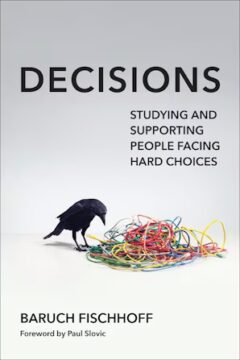
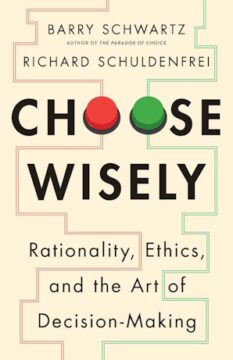
Two books came out recently in the field of decision-making. Baruch Fischhoff published Decisions: Studying and Supporting People Facing Hard Choices, and Barry Schwartz and Richard Schuldenfrei published Choose Wisely: Rationality, Ethics, and the Art of Decision-Making. The two books take very different approaches. In a word, Fischhoff represents the science of decision-making. Schwartz represents the art.

We are all in favor of rational decision-making. We want public policy decisions to be made by reasonable people following orderly procedures designed to give appropriate consideration to relevant factors and to maximize the probability of success. How could we possibly not want that? And the same is true of personal decisions. We may not have the patience or the attention span to work through the literature and pick the best health insurance plan for our family. But we have to agree it would be better if that choice were made on some rational basis rather than randomly or on the basis of the relative attractiveness of the models in the company brochures. We may conclude that any improvement in health insurance coverage is not worth the effort required to identify it. That’s fine. Some decisions are not worth thinking about. But even the decision that something is not worth thinking about is better if it is made according to some rational process.

At the same time, there is a false precision conveyed by the matrix of factors, weights and probabilities involved in rational choice theory. And there is something missing. If you’re trying to decide whether to uproot your family and move across the country or whether to start a war with, say, Venezuela, an algorithm and a spreadsheet are not what you need. As the saying goes, not everything that counts can be counted, and not everything that can be counted counts.

Baruch Fischhoff was present at the inception. Amos Tversky and Daniel Kahneman jointly advised his dissertation. He was at Hebrew University in Jerusalem with Kahneman and Tversky when they began creating the universe of judgment and decision-making, biases and heuristics, and what became behavioral economics. His name is most closely associated with hindsight bias, our tendency to think we knew it all along and to be “insufficiently surprised” by events. For the past 50 years Fischhoff has been applying Bayesian inference, game theory, measure theory and signal detection theory to an extraordinary array of real-world decision problems. Read more »

Panorama

by Derek Neal

The town had only one grocery store, and Steve wondered where the locals did their shopping. Certainly not here, but perhaps in a supermarket outside of town, one that required a car. Along with Julia, he picked up some Italian cheese, prosciutto, grapes, and a bottle of local wine, and they made their way up the hill to the house they’d rented for the week.

The two friends from college were proud of themselves. They weren’t staying next to the sea with the rest of the tourists, but in a different village altogether, one that required a short bus ride and where no other passengers got off. In the village, the few streets that existed were carved into the hillside, each one so narrow that they were forced to walk behind one another, instead of side by side.

It had been a long day, and they felt they deserved to indulge. They’d gone hiking high above the town, starting early and rising with the sun. The trail followed the curve of the hills, the open sea to one side, vineyards to the other. What lay before them not visible beyond a few yards. They heard fellow hikers before seeing them, but rarely was any Italian heard. When two groups passed each other, each group always smiled and let out a garbled “Buongiorno,” before reverting to their respective languages. Steve complied and mumbled “Ciao” a few times, but soon he began to feel like an imposter, playing at being Italian, or playing at being whatever it was people thought being Italian meant, and he resigned himself to nodding politely in response to the other travelers. Read more »

Tuesday, January 6, 2026

Varying Degrees of “Future Comfort” in AI predictions

by Malcolm Murray

Back when I worked for large corporations, people would often talk of being in “period of change” or how they could “see the light at the end of the tunnel” after a period of heavy restructuring or similar. These days, you might be forgiven for wondering where the tunnel went. Change is incessant and showing no signs of slowing down. In fact, it is quite the opposite. We are entering a period when change might in fact actually be speeding up, even from its currently historically high levels. While not the majority view, nor the most likely scenario in my estimation, there is still a nonzero likelihood that we are in fact in the last few years of an era. Through the development of AGI – artificial general intelligence – the world could become unrecognizable in just a few years.

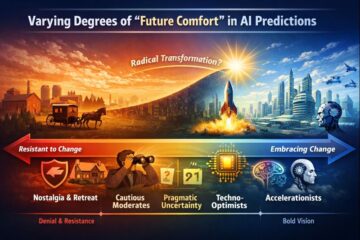
In a recent Astral Codex Ten piece, Scott Alexander referenced several examples of people seeing the clock as ticking down to a near-term singularity-level change, which would leave permanent patterns locked in. In one of the most talked-about AI forecasts from last year – AI 2027 – 2026 is not far from where the hockey stick starts to get seriously steep. This scenario, of humanity facing a potential precipice in our near future, makes for an interesting exercise in examining the varying levels of comfort people have in entertaining this possibility. We can name it “Future Comfort”. The degree to which people accept this possibility, fight against it, deny it, or even embrace it. Especially now at the turning of the year, with everyone making predictions, this seems like a useful lens for examining the world right now.

Let’s first look at the varying schools on the Future Comfort spectrum. On one far end, we have people who are deeply uncomfortable with this notion. They are actively fighting against the future and are actively and quixotically trying to bring back the past. We have seen this in some of the main political strands over the past years, driving everything from Brexit to MAGA to Soviet nostalgia. A little bit towards the center of the spectrum, instead of active resistance, you could place the groups exercising passive resistance. This would include people choosing to go “off the grid” or “back to nature” or other variants of the Amish lifestyle.

On the other far end of the spectrum, we have those who are deeply comfortable with a radically different future. Here, we find groups such as transhumanists and effective accelerationists. They are looking to bring the future closer, not further and long to merge with the machine, becoming cyborgs. Moving slightly toward the center, we find the libertarian techno-optimists such as Marc Andreesen, who want to let technology rip loose, in a wild Schumpeterian dance of creative destruction. It would be easy to dismiss these end points as fringe fanatics, were it not for the fact that they win elections in major Western democracies and have their own Super PACs with millions of funding. Read more »

The Wages of Aging

by Bonnie McCune

Never before have I worried about rolling out of my bed or a chair and falling down, kerplunk! For no reason. Now I have to. I feel like a spacer on the first outer space mission, alert with every breath, having always to think about where to place each foot. constantly aware. As I walk, my legs sometimes shake. Sharp pangs wander erratically across my legs, occasionally intersecting with a joint, others centered around a muscle.

I certainly empathize with people struggling with palsy or Parkinson’s or multiple sclerosis, or even just a major hangover. This physical response seems to occur at erratic times on its own, and it is damned inconvenient. It makes me believe in all the old wives’ tales about aging. It’s uncontrollable, it’s troublesome. It’s definitely NOT your golden years.

So what’s an aging person supposed to do, other than just ignore the annoyances and hope they don’t increase? I prefer to use them as life lessons. I quote Robert Browning to myself: “Ah, but a man’s reach should exceed his grasp, or what’s a heaven for?” Rather than bemoaning my increasing difficulty in moving, say an inability to skip down the sidewalk or the hardening of various parts of my body (called sclerosis), I simply adjust my goals. Congratulate myself on reaching my downsized objectives. Read more »

Monday, January 5, 2026

Cheers to Akim Reinhardt, Brooks Riley, and Happy 2026!

Dear Readers and Writers,

Akim in Baltimore

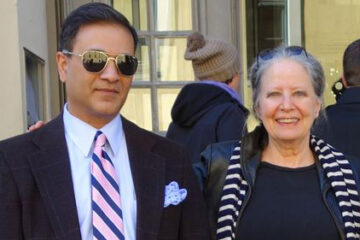
Five years ago, I wrote a note here to acknowledge and appreciate Akim Reinhardt for his amazing consistency in having written an excellent essay every four weeks for 3QD for 10 years, without missing his turn even once. Well, this week Akim has how completed 15 years at 3QD and has still maintained his record of solid dependability! He has now written 208 essays for us in a row and is still going strong.

Me and Brooks in Munich

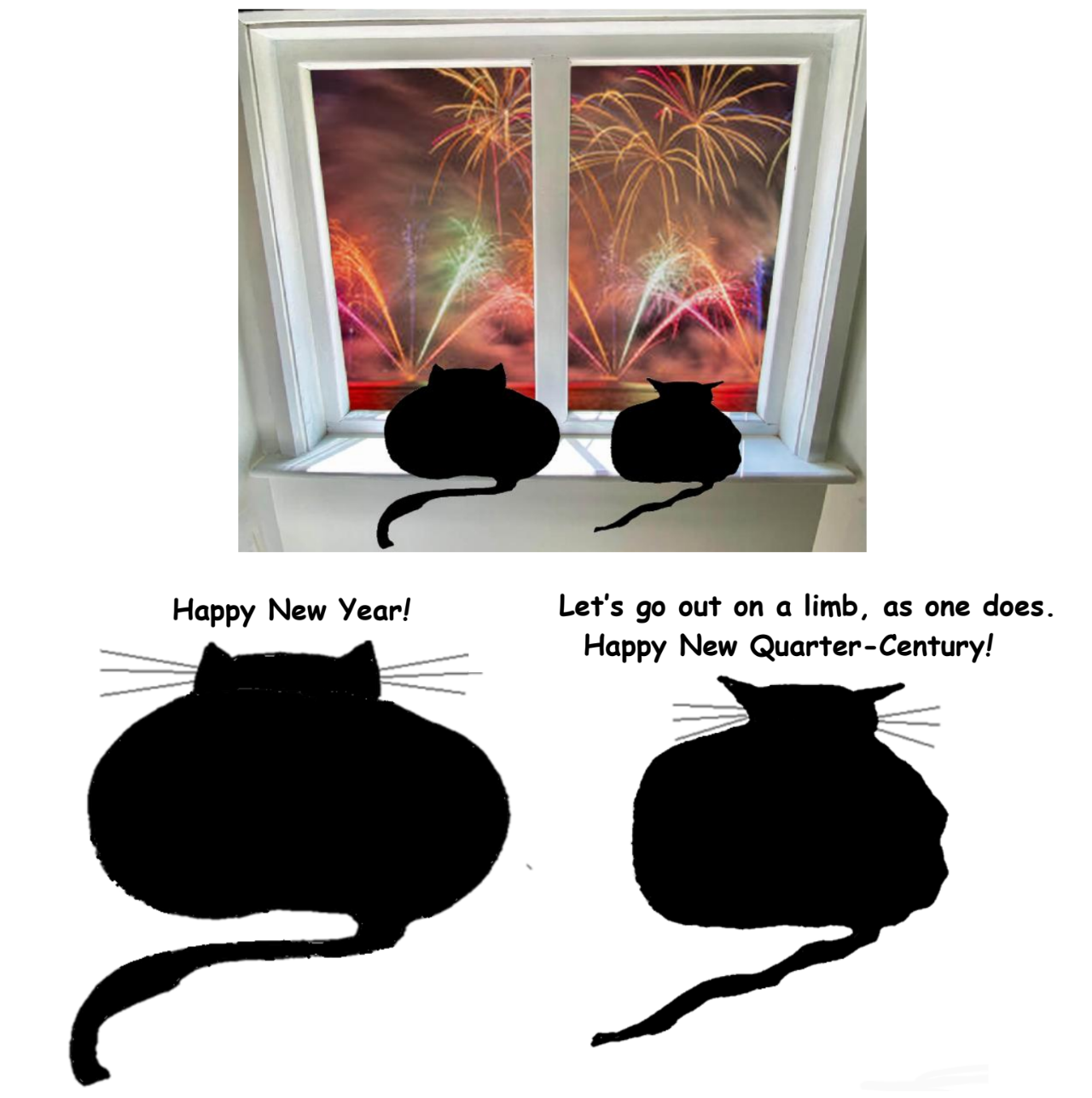
But there is another contributor with an equally impressive record of reliability: Brooks Riley published her first “Catspeak” cartoon at 3QD in the first week of October, 2013, and has never missed a single week in the more than 12 years since then. This week, somewhat unbelievably, she will contribute her 624th “Catspeak” in a row on Wednesday! You can see them all here.

Please join me in applauding Akim and Brooks!

With very best wishes for the new year,

Abbas

And if you like 3QD, please help us keep going by donating now!

Some Notes on the Earth Seen from Space

by Laurie Sheck

1.

It has been almost 58 years since astronaut William Anders lifted his Hasselblad camera toward the window of Apollo 8 and captured the now-iconic image of Earth hovering beyond the gray, desolate edge of the moon, blue-white and small and fragile, hanging in the pure blackness of space. How beautiful it looked, how vulnerable and unprotected. As if emptied of political borders and human strife. As if we had never touched it after all. Unbuilt, unpolluted. Familiar and strange at the same time.

“We came all this way to explore the Moon,” Anders said, “and the most important thing is that we discovered the Earth.”

And yet how secretive it looks from a distance, how beyond human knowing.

My online searches tell me there are now over 942,562 CCTV surveillance cameras in London; in Shanghai there are 12,825, 589; in Hyderabad, 900,000; that in a single day a human being in London could expect to be captured on CCTV an average of 70 times.

But in Anders’ photo the Earth looks mysterious, un-warlike, uninhabited, unpoliced.

2.

In the astronauts’ descriptions of Earth, the word fragile recurs often.

“It looked so fragile, so delicate, that if you touched it with a finger it would crumble and fall apart”—this from James Irwin, crew member of Apollo 15. Lauren Acton spoke of seeing it “contained in the thin, moving, incredibly fragile shell of the biosphere.”

To Alexi Leonov, the first person to walk in space, Earth looked “touchingly alone.”

When cosmonaut Vitali Sevastyanov was asked by ground control what he saw, he replied, “Half a world to the left, half a world to the right. I can see it all. The Earth is so small.” And Neil Armstrong remarked, “I put up my thumb and shut one eye, and my thumb blotted out the planet Earth. I didn’t feel like a giant. I felt very, very small.”

Ulf Merbold said: “For the first time in my life I saw the horizon line as curved, accentuated by a thin seam of dark blue light. I was terrified by its fragile appearance.”

For those of us who’ve never been to space, the reality of Earth’s vulnerability can be harder to hold onto. The way its beauty is inseparable from its vulnerability. How in a sense they are the same thing. Read more »


Poem by Jim Culleny

American New Year 2026

Just because the old year has
drifted out of sight because —well,
time is like that,
……………………… doesn’t mean
it’s disappeared, any more than
a rush of unbound river rolling over
dams assures that it is safely past
and gone.

It should be clear —as long as gravity
does its thing, and an unbound river
still moves on, its path is still surely
being written, its past will certainly
not be gone. 

Upstream, a bridge, raked down, still
sits, busted girders resting on the riverbed,
pylons angled toward sky, wrecked,
debris of busted pilings that mattered
reminding us, a way’s been shattered,
behind it, battered remnants of its past
build-up, collect. And if, below the dam, 
river’s banks are still weak and weary,
waters out of bounds, still running freely,

well, ,,,what else should we expect?

Jim Culleny, 1/1/26 

Enjoying the content on 3QD? Help keep us going by donating now.

Sunday, January 4, 2026

Roberto Chaves Chavarria, RIP

by Charles Siegel

Last week I learned of the recent death of Roberto Chaves Chavarria, of San José, Costa Rica, aged 90. His work benefited thousands upon thousands of his countrymen, and many thousands in other countries as well, who will never know his name. And he had a profound effect on my career as a lawyer, and on the direction of my life as a whole.

Chaves was a forensic toxicologist, and the first head of the Department of Forensic Sciences, an office in the Costa Rican “Poder Judicial,” or judicial branch. In the Costa Rican legal system, as in that of most Latin American countries, judges and other judicial officers often conduct their own factual investigations into cases before them.

In the late 1970s, Chaves learned of a large group of workers, on a banana plantation near the small town of Rio Frio, who were sterile. Over the course of many investigative trips, he interviewed workers and their wives, plantation managers, doctors and others. Chaves eventually concluded that the men had been sterilized through contact with a pesticide they applied to the roots of the banana plants. This pesticide, known as “DBCP,” was used to kill worms that infested the soil beneath the plants.

DBCP was invented by scientists at Shell Chemical Co., a subsidiary of the oil giant, and originally tested on pineapple plants in Hawaii. It proved to be very effective, and was used on pineapple and banana plantations around the world. DBCP-based pesticides were manufactured by several American companies, including Dow Chemical  and Occidental Chemical as well as Shell.

The cluster of sterile banana workers that Chaves discovered in Rio Frio was not the first such group. A few years earlier, men who worked in the Occidental factory making the stuff in Lathrop, California, had also been found to be sterile. This eventually led to a ban on DBCP use in the United States, but Dow and another smaller company continued to sell it overseas.

Meanwhile, Chaves continued his work in Costa Rica, and learned about the American developments. Read more »

Lessons From Singapore: Partnering Religion And The Secular State

by Eric Feigenbaum

The assertion that religion is a tool for preserving social order and for organizing large-scale cooperation may vex many people for whom it represents first and foremost a spiritual path. However, just as the gap between religion and science is smaller than we commonly think, so the gap between religion and spirituality is much bigger. Religion is a deal, whereas spirituality is a journey. Religion gives a complete description of the world, and offers us a well-defined contract with predetermined goals. ‘God exists. He told us to behave in certain ways. If you obey God, you’ll be admitted to heaven. If you disobey Him, you’ll burn in hell.’ The very clarity of this deal allows society to define common norms and values that regulate human behavior. —Yuval Noah Harari in Homo Deus, A Brief History of Tomorrow, 2015

In his books Sapiens, Homo Deus, 21 Lessons for the 21st Century and Nexus, celebrated author and Professor of History Harari goes further positing spirituality is an altogether different thing. The spiritual path involves an individual quest. Seeking, learning and experiencing are part and parcel to someone finding their way to the divine.

In Harari’s view, religion was a form of governance – in essence the creation of a common platform – before secular government came about. Religion is present in hunter-gatherer societies whereas true secular government doesn’t really begin until a society reaches the agrarian stage.

Even as societies create secular governments, they don’t usually abandon religion. In fact, the most successful liberal democracies including the United States have protected freedom of religion, recognizing that the moral core and social cohesion offered by various religions benefits society as a whole. Countries that have banned religion altogether – such as the Soviet Union – found repression their only tool for keeping social order. Not the recipe for thriving or longevity.

Forty years before Homo Deus, the founders of Singapore were wrestling with how religion would impact their society. The goal was how to harness the benefits of religion without opening the door to the volatile tribalism that can also go with it. Read more »

Friday, January 2, 2026

Uff Da! Yeah, You Betcha.

by Mark R. DeLong

A colorful ocean fish (cod?) with its tail curled as if swimming wears a Viking helmet with two horns.
Ingebretsen’s Nordic Marketplace, “Maybe Lutefisk Isn’t What You Think It Is”

My mother ordered the annual parcel of lutefisk from Olsen Fish Company in Minneapolis, Minnesota. Determined to bring some of her Minnesota Norwegian Christmas tradition to our home in Oklahoma, where our family moved when I was in high school, she phoned in the order in November or even earlier. The package appeared a few days later, fish solidly frozen in dry ice—probably the only package of lutefisk to arrive in the state. When she nestled the butcher-paper wrapped lump into the freezer, I knew we were doomed.

She was trying to invoke Christmases she had lived in Minnesota, and a big part of that had to do with smell, the sense especially tied with memory.

Lutefisk dinners were common in Lutheran church basements in the upper Midwest US, and still happen even though some never recovered from the disruption of the Covid pandemic. Nationally, lutefisk sales slumped then and only recovered to about 300,000 pounds in 2022, significantly lower than the 800,000-or-so pounds made in the early 1990s. In small towns like the one I grew up in, the feasts always took place around Christmas, and the rumor in my home village was that churches, despite their doctrinal differences, would coordinate schedules such that it was possible to have a lutefisk dinner several times during the season. The fish, I guess, drove a true ecumenical movement and drew together the large community of families whose ancestors had immigrated from Scandinavia. Generations knew the odd pleasures of lutefisk first-hand, though, no doubt, the draw of the Christmas dinner fish puzzles many of them (including me).

Lutefisk, to put it bluntly, stinks. And that, ironically, might be part of its charm. Read more »

Towers in a Park Revisited

by Angela Starita

Aerial view of Co-Op City, Bronx, NY

Large-scale housing projects have been the subject of the public’s wrath and ardor for at least the last 70 years. Considering the extraordinary housing crises in cities across the country, it’s not surprising that Herman Jessor, the engineer-turned-architect behind the best-known cooperative developments in NY, is the subject of two studies and exhibitions, both coming out of The Cooper Union, Jessor’s alma mater. I work as a writer at Cooper, so perhaps my Jessor-looms-large-in-the-zeitgeist notion is skewed in his favor, but I can’t help but think that his work, which so promoted community bonds, is ripe for a reassessment exactly because we seem suddenly aware of the dangers of solitude. It’s also a moment when most everyone wants to beat a fast exit from civilization. Magazine and newspaper articles describe women starting their own small-house community, LGBTQ collectives built around farms, and MAHA families embracing back-to-the-land philosophies reminiscent of the Whole Earth Catalog.

What makes Jessor all the more intriguing, though, is that his solutions were decidedly urban, on a very large scale, and highly successful by any number of metrics—he is estimated to have built more than 40,000 residences most of which are still occupied and have low turnover. The March 2025 exhibition at Cooper included a map of the five boroughs with all of the Jessor-designed projects, including Penn South in Chelsea, Seward Park Houses on the Lower East Side, Co-op City in the Bronx, and Rochdale Village in Queens, the largest Black-majority housing co-op in the world. Most were built for unions like the International Ladies Garment Workers Union and the United Housing Foundation which was run by Abraham Kazan, an organizer and frequent Jessor partner.

The buildings, variations on the towers in the park scheme popularized by the modernist architect Le Corbusier, prioritized ventilation, eat-in kitchens, and numerous shared spaces. Co-op City, for instance, includes gardens, playing fields, a cooperative grocery store, and schools. Jessor and Kazan developed streamlined construction systems that made for more affordable buildings. Most of them remain affordable thanks to programs like the Mitchell-Lama program in New York State that subsidizes housing for middle-class residents.

What Jessor’s work doesn’t provide is anything akin to low-rise neighborhoods like Greenwich Village and the aesthetics associated with them. Read more »

Thursday, January 1, 2026

The UFO Disclosure Trap

by David Kordahl

Government secrecy makes UFO claims impossible to verify—or disprove.

When I lived in Arizona, my next-door neighbor once told me that he had seen a time machine. These types of anecdotes are not uncommon in Arizona, out on the edge of the world. At the time, I was in graduate school for physics at Arizona State, and I presumed my neighbor was either lying or confused. He had seen the time machine, he told me, behind the door of a restricted area of his former employer, a defense contractor in Tucson. I nodded politely and let it slide, much as I would for the claims from our neighborhood Mormon missionaries or the 9/11 Truthers whose stand I passed daily on my walk to the cafeteria.

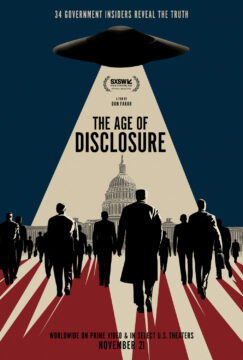
I was thinking about my old neighbor when I recently came across a clip of Joe Rogan speaking with Dan Farah, the director of a new documentary, The Age of Disclosure. If Farah is to be believed, my neighbor might indeed have seen something behind that door. The Age of Disclosure claims that crashed Unidentified Aerial Phenomena—and, yes, UAPs are just UFOs by another name—have been studied by defense contractors for some eight decades, and that failing to take them seriously poses a risk to national security.

Regular readers will know that UFOs and US government secrecy are both part of my beat here at 3QD, so I grabbed my tinfoil hat and pressed play.

The Age of Disclosure tells a story that, as many critics have noted, is by now pretty familiar, which doesn’t stop it from being pretty crazy. The vibe of the film owes much to conspiracy thrillers like The Parallax View or JFK, with frequent solemn shots of national monuments thrumming to a continuous soundtrack. A good deal of the runtime is filled by montages of dark-suited men saying things like “UAPs are real, they’re here, and they’re not human.” The movie’s poster tagline, “34 Government Insiders Reveal the Truth,” gives a good idea about what it offers: clips of military, intelligence, and congressional officials affirming, on the record and under their own names, that they think UFOs are a real concern. Read more »

Wednesday, December 31, 2026

The Year of the Whale: Re-Reading Moby Dick

by Leanne Ogasawara

1.

Maybe this is something that happens when you reach a certain age?

But lately, I’ve found myself yearning to revisit things like paintings and books. Ones I loved when I was young. Like standing before Raphael’s Madonna del Cardellino in the Uffizi again. I was nineteen when I first saw the picture. Viewing it again thirty years later, I asked myself: How has the painting changed? How has the viewer changed? Am I even the same woman now? Or maybe it is the world that has moved on….

It was not long after seeing the Raphael that I first read Moby Dick. A philosophy major at Berkeley, I read Melville’s novel in a class taught by world-renown Heidegger scholar Hubert Dreyfus. The class, was called “Man, God, and Society in Western Literature” and Moby Dick was the last work on the syllabus, after reading Homer, Virgil, and Dante. Indeed, it was the culmination of the class.

The greatest book of American literature ever written, Professor Dreyfus told us this again and again.

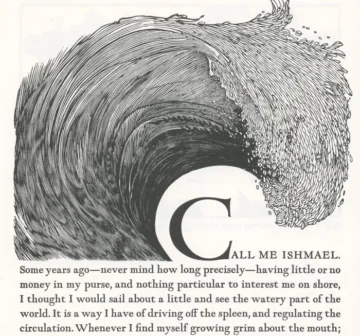
Call me Ishmael.

God, I loved that first sentence… But it was the rest of that opening paragraph that really grabbed and shook me.  That same one about which Ta-Nehisi Coates judged to be “the greatest paragraph in any work of fiction at any point, in all of history. And not just human history, but galactic and extraterrestrial history too…” Here it is:

Some years ago—never mind how long precisely—having little or no money in my purse, and nothing particular to interest me on shore, I thought I would sail about a little and see the watery part of the world. It is a way I have of driving off the spleen, and regulating the circulation. Whenever I find myself growing grim about the mouth; whenever it is a damp, drizzly November in my soul; whenever I find myself involuntarily pausing before coffin warehouses, and bringing up the rear of every funeral I meet; and especially whenever my hypos get such an upper hand of me, that it requires a strong moral principle to prevent me from deliberately stepping into the street, and methodically knocking people’s hats off—then, I account it high time to get to sea as soon as I can.

The words exert the same power over my imagination now as they did back then when I was nineteen. Re-reading the novel this year, as I am also consulting several other books about Moby Dick, I learned that nowadays people consider that Ishmael was depressed and maybe even suicidal during that dark and drizzly November of his soul.

But back when I was nineteen, I didn’t think of it like that.  Read more »

If the Poor Die, the Rich Die Too: A Review of “The Insider” by Teater Katapult in Hong Kong

by Daniel Gauss

Credit: Mathias Bender

The whistleblower in The Insider is introduced to us in a glass booth, evocative of the type defendants sit in at trial in some European countries. We wait for the theater piece to begin by listening through headphones to someone singing Money (That’s What I Want). We will hear everything through headphones. The only character in front of the audience will be the whistleblower/insider and all the voices he recalls and responds to, as well as anything he says, and any other sounds, will be piped into our ears.

The insider is trapped with his own recollections, which we are privy to. How he got trapped with these painful memories, and his way out, are the purpose of this theater piece. He is in the process of remembering and reliving his interrogation by a prosecutor, and other aspects of his life relevant to the Cum-Ex financial scandal he came forward to expose to the German authorities.

Cum‑Ex was a European‑wide tax fraud scheme, carried out from the early 2000s until its exposure in the late 2010s, in which bankers and investors exploited dividend tax loopholes to siphon off billions of euros. Some investigative journalists and researchers estimate that the scheme cost European treasuries up to €55 billion in total, with losses to Germany alone estimated at more than €30 billion.

The headphones mostly bring us voices – often the voice of the prosecutor. Many of the voices are intrusive memories that the insider cannot stop because he cannot answer them adequately due to his moral shame, struggle with denial and ambiguity concerning his own motives: his motives to first object to fraud at his bank, then to participate in the fraud and then to turn the bank in. This inner turmoil may mirror the internal trial, doubt and pain that many whistleblowers endure. Read more »

Tuesday, December 30, 2026

A Painful Paradox: Hoover And The Bonus March

by Michael Liss

We had reached a place in Virginia. It was a very hot day. In this jungle, there was a man, a very tall man. He had with him his wife and several small children. We invited them over to have something to eat with us, and they refused. Then I brought something over to them on an old pie plate. They still refused. It was the husband who told me he didn’t care for anything to eat. But see, the baby was crying from hunger. —Jim Sheridan, Bonus Marcher, quoted in Studs Terkel’s Hard Times

Bonus Army veterans heading to Washington, D.C., on the outside of a freight train, 1932.

There is a mood, a color, to the Great Depression. It’s a shade of gray, sooty and ominous, without sun, almost without hope. Wherever its victims stopped—on city streets and farms, on a muster line or on one for bread, outside tents or structures made of bits and pieces of packing boxes and cardboard, on trussed-up jalopies headed West, or on boxcars with hoboes like Jim Sheridan—there were chroniclers of images and words, all gray. Gray and ominous as well were the faces of those who were leaders in business and politics. Dark suits, white shirts, muted ties, emitting seriousness of purpose, and consciousness of class. Those men were Authorities—vested with power, but often remote from those who would be impacted by their actions, or non-action. They shared with their peers a fervent belief in their own self-worth, earned through moral superiority.

Herbert Hoover was in this second group. He had fought for and secured it through intensely hard work and great talent. He was the “Great Engineer,” the perfect man to be heir to a pro-business philosophy that had, in the Harding-Coolidge years, brought abundance. His landslide victory in November 1928 promised more of the same—more jobs, more innovation, more wealth, an appreciably raised standard of living, and the possibility of moving up in class, as he had. A better statesman for Capitalism, for the American Dream, for the American Promise was hard to imagine.

It blew up, of course, most spectacularly in the stock-market crash, but also as a result of secular forces both in the United States and abroad that made seemingly healthy economies reel. That these problems pre-dated Hoover’s taking office did not grant absolution for their existence. You don’t get a honeymoon in a crisis. Nor did successive governments in other Western countries get one. Democracy tottered because its stewards seemed inadequate to the task. Should they continue to prove to be inadequate, then more authoritarian forms of government might be the answer. Italy was already under the fist of Mussolini, Japan was eyeing China as a resource-filled morsel, and Germany was considering an angry man with a funny mustache who seemed a bit bellicose, but maybe could put people back to work.

What of the United States? In what direction would it go? Read more »