
A Painful Paradox: Hoover And The Bonus March

by Michael Liss

We had reached a place in Virginia. It was a very hot day. In this jungle, there was a man, a very tall man. He had with him his wife and several small children. We invited them over to have something to eat with us, and they refused. Then I brought something over to them on an old pie plate. They still refused. It was the husband who told me he didn’t care for anything to eat. But see, the baby was crying from hunger. —Jim Sheridan, Bonus Marcher, quoted in Studs Terkel’s Hard Times
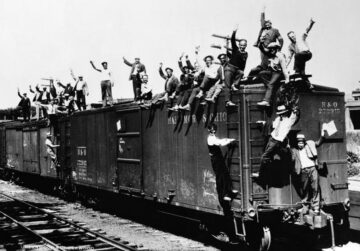
Bonus Army veterans heading to Washington, D.C., on the outside of a freight train, 1932.

There is a mood, a color, to the Great Depression. It’s a shade of gray, sooty and ominous, without sun, almost without hope. Wherever its victims stopped—on city streets and farms, on a muster line or on one for bread, outside tents or structures made of bits and pieces of packing boxes and cardboard, on trussed-up jalopies headed West, or on boxcars with hoboes like Jim Sheridan—there were chroniclers of images and words, all gray. Gray and ominous as well were the faces of those who were leaders in business and politics. Dark suits, white shirts, muted ties, emitting seriousness of purpose, and consciousness of class. Those men were Authorities—vested with power, but often remote from those who would be impacted by their actions, or non-action. They shared with their peers a fervent belief in their own self-worth, earned through moral superiority.

Herbert Hoover was in this second group. He had fought for and secured it through intensely hard work and great talent. He was the “Great Engineer,” the perfect man to be heir to a pro-business philosophy that had, in the Harding-Coolidge years, brought abundance. His landslide victory in November 1928 promised more of the same—more jobs, more innovation, more wealth, an appreciably raised standard of living, and the possibility of moving up in class, as he had. A better statesman for Capitalism, for the American Dream, for the American Promise was hard to imagine.

It blew up, of course, most spectacularly in the stock-market crash, but also as a result of secular forces both in the United States and abroad that made seemingly healthy economies reel. That these problems pre-dated Hoover’s taking office did not grant absolution for their existence. You don’t get a honeymoon in a crisis. Nor did successive governments in other Western countries get one. Democracy tottered because its stewards seemed inadequate to the task. Should they continue to prove to be inadequate, then more authoritarian forms of government might be the answer. Italy was already under the fist of Mussolini, Japan was eyeing China as a resource-filled morsel, and Germany was considering an angry man with a funny mustache who seemed a bit bellicose, but maybe could put people back to work.

What of the United States? In what direction would it go? Read more »
Monday, December 19, 2011

Occupy and History: Are We Near the End and What Will it Mean?

by Akim Reinhardt

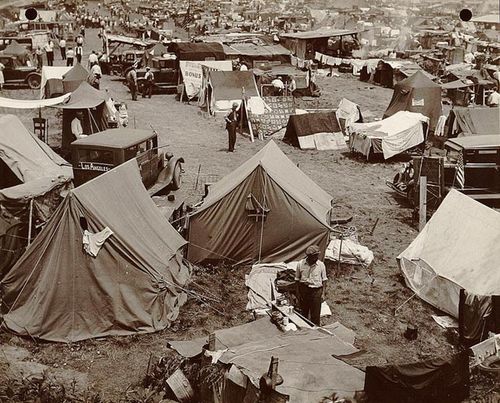
Bonus Army encampmentWe may now be gazing upon the fading days of the Occupy movement as an actual episode in which numerous, large scale occupations are taking place and having immediate impact. Then again, maybe not. But if so, it is perhaps time to begin reflecting upon the movement and how we might measure it.

Elsewhere I have written about Occupy within the contest of two earlier American social protest movements against poverty: Coxey’s Army of unemployed men looking for work in 1894, and the Bonus Marchers of impoverished World War I veterans in 1932.

During the depression of 1893-98, the second worst in U.S. history, many Americans began to agitate for a federally-funded public works project to build and improve roads across the country. In addition to building up the infrastructure, such projects could also put men to work during an era when unemployment was in the teens and there was no goverment welfare safety net to speak of. Coxey's Army, led by an Ohio millionaire named Jacob Coxey, was the largest of many protest movements advocating this approach. Thousands of men marched to the nation's capital in support of the plan.

Later on, the Bonus Marchers were a collection of homeless and unemployed World War I veterans who sought government action during the darkest depths of the Great Depression. During the roaring `20s the government had promised to award them a one time bonus of $1,000 in gratitude for their wartime service, payable in 1945. However, unemployed vets, many of them homeless, sought early payment of the bonus in 1932. They too crossed the country in caravans, arriving in the nation's capital.

Despite their numbers, organization, and commitment, neither group was able to achieve its immediate goal. Congress did not create a public works job program as Coxey requested, nor did it award early payment of the cash bonus promised to war veterans as the Bonus Marchers requested. In both cases, the press and political opponents smeared peaceful and patriotic protestors as criminals and revolutionaries. And after arriving in Washington, D.C., both groups suffered state violence from police and even the military. Indeed, in 1932 one of America's lowest moments came when future WWII heroes Douglas MacArthur, Dwight Eisenhower, and George Patton all played a direct role in leading military forces against their former fellow servicemen, who had assembled peaceably

As we now witness what may very well be the decline of the Occupy movement, in the face of similar smears and violence, it is worth considering the following questions:

How do Historians look back upon Coxey’s Army and the Bonus Marchers; how do they measure their political significance; and what might that portend for the way history comes to view the Occupy movement should it soon fade from the scene as did its predecessors?

Read more »