
by Derek Neal
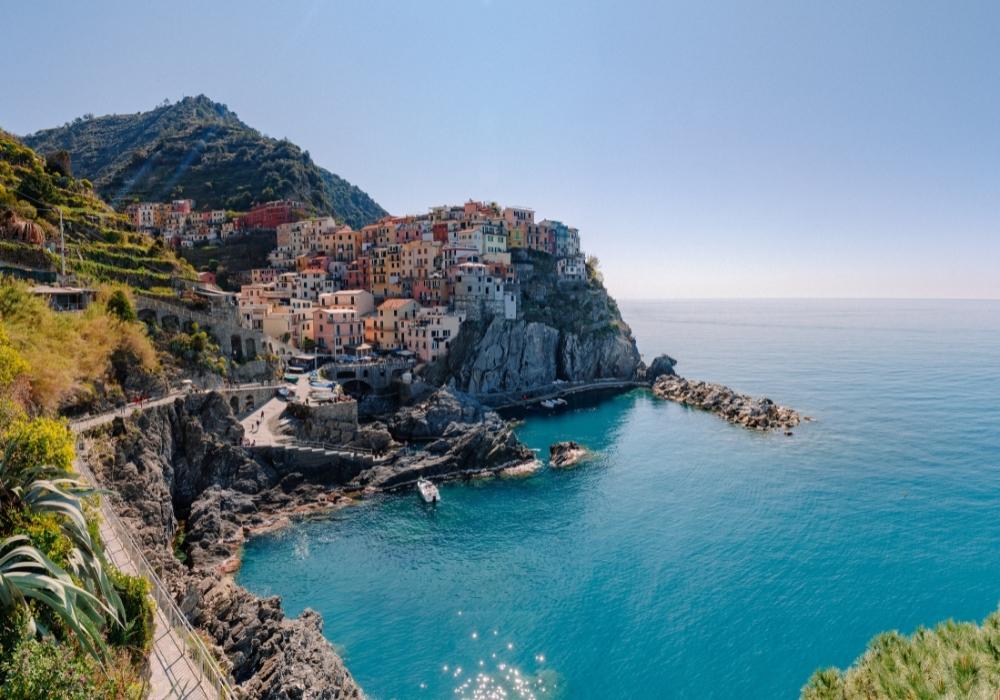 The town had only one grocery store, and Steve wondered where the locals did their shopping. Certainly not here, but perhaps in a supermarket outside of town, one that required a car. Along with Julia, he picked up some Italian cheese, prosciutto, grapes, and a bottle of local wine, and they made their way up the hill to the house they’d rented for the week.
The two friends from college were proud of themselves. They weren’t staying next to the sea with the rest of the tourists, but in a different village altogether, one that required a short bus ride and where no other passengers got off. In the village, the few streets that existed were carved into the hillside, each one so narrow that they were forced to walk behind one another, instead of side by side.
It had been a long day, and they felt they deserved to indulge. They’d gone hiking high above the town, starting early and rising with the sun. The trail followed the curve of the hills, the open sea to one side, vineyards to the other. What lay before them not visible beyond a few yards. They heard fellow hikers before seeing them, but rarely was any Italian heard. When two groups passed each other, each group always smiled and let out a garbled “Buongiorno,” before reverting to their respective languages. Steve complied and mumbled “Ciao” a few times, but soon he began to feel like an imposter, playing at being Italian, or playing at being whatever it was people thought being Italian meant, and he resigned himself to nodding politely in response to the other travelers.
Back at the house, they opened the windows to let the late afternoon sunshine in, and realized they could access a small platform via their own bedroom window. It seemed to be a sort of roof, but instead of a house below, there was a suspended passageway that you could pass beneath. Steve climbed through the open window, and from inside Julia passed him a plastic table, two chairs, and what they’d bought at the store. Once everything had been arranged, it was a sight to behold: on one side, the hills bathed in light from the low hanging sun, on the other, the pink and yellow hued town perched atop the blue sea; then there were the two of them, and a plate of rich, sumptuous food in the middle.
They touched their wine glasses together, looked each other in the eye, and made a toast: “To Italy!”
They continued to eat and drink, and before long daylight faded away. Steve found himself alone on the roof. Suddenly, he heard a loud sound from somewhere below, and he looked down to see an older man clapping his hands at him.
“Hey! You can’t be up there! Get down from there!” the man yelled in Italian.
Steve stared back at him, dumbfounded; but the man, now in the company of an old woman, continued to yell. Slowly, the words arranged themselves in Steve’s brain, and he realized what was happening.
“Ok, ok,” he stammered. “Don’t worry, I’m going inside,” he said in his best Italian.
He took everything and began to pass it through the window to Julia, who had appeared from inside. They sat down on the couch together, staring at each other. Had they done anything so wrong? Before they could make sense of the situation, more noises came to them from outside. Now five or six people were gathered there, all exclaiming in disbelief.
They listened, waiting for things to settle down, but the voices only grew louder. Then, as they struggled to understand, the voices subsided, and Steve breathed a sigh of relief.
Julia smiled, “This is just so Italian! The whole village coming outside to yell and throw their hands in the air—over nothing!” She laughed, but was cut short by a new voice coming to them, this time in accented English.
“Ehi…tourist! Come! Come!”
They looked at each other again, and realized that one of them would have to go and face these people. Steve would do it, since he spoke better Italian. As he left the house and walked down the narrow steps, what had seemed so quaint before now took on a sinister character, and he felt as if he were walking down a blind alley to his execution. When he arrived, the townspeople appeared to be dispersing, and he was able to approach one of them who was alone, a middle aged woman with a kind face.
“Excuse me,” he said. “It was me who was up there,” and he gestured towards the roof. “We didn’t want to cause any trouble.”
She looked back at him with her kind, benevolent face. “It was good of you to come down. But it’s not me to whom you must beg forgiveness, but her,” and she pointed to a doorway below the roof, where an old woman was bent over, leaning on a walking cane.
He hurried over to the old woman, wanting nothing more than to have everything be as it was before. As he approached her, she lifted her grey head and stared at him.
“I…I just wanted to apologize. We didn’t mean any harm. We didn’t know we couldn’t be up there.”
At this, her face changed, and the hand holding the cane began to shake. “But one does not do that,” she said in disbelief. “One does not exit from a window to go onto a roof—it’s not done.” She was picking up speed now, and he had to focus to keep up with everything she was saying, “You people—you people who travel the world, coming and going as you please…You people with no concern for anyone but yourselves!”
He averted his eyes and began to mumble another apology, but she had already turned her back and gone inside, shutting the door on him forever.
***
Enjoying the content on 3QD? Help keep us going by donating now.