
by Laurie Sheck
1.
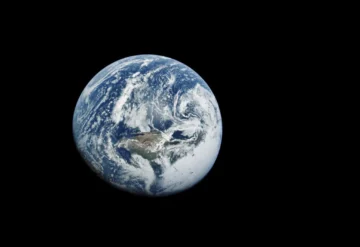
It has been almost 58 years since astronaut William Anders lifted his Hasselblad camera toward the window of Apollo 8 and captured the now-iconic image of Earth hovering beyond the gray, desolate edge of the moon, blue-white and small and fragile, hanging in the pure blackness of space. How beautiful it looked, how vulnerable and unprotected. As if emptied of political borders and human strife. As if we had never touched it after all. Unbuilt, unpolluted. Familiar and strange at the same time.
“We came all this way to explore the Moon,” Anders said, “and the most important thing is that we discovered the Earth.”
And yet how secretive it looks from a distance, how beyond human knowing.
My online searches tell me there are now over 942,562 CCTV surveillance cameras in London; in Shanghai there are 12,825, 589; in Hyderabad, 900,000; that in a single day a human being in London could expect to be captured on CCTV an average of 70 times.
But in Anders’ photo the Earth looks mysterious, un-warlike, uninhabited, unpoliced.
2.
In the astronauts’ descriptions of Earth, the word fragile recurs often.
“It looked so fragile, so delicate, that if you touched it with a finger it would crumble and fall apart”—this from James Irwin, crew member of Apollo 15. Lauren Acton spoke of seeing it “contained in the thin, moving, incredibly fragile shell of the biosphere.”
To Alexi Leonov, the first person to walk in space, Earth looked “touchingly alone.”
When cosmonaut Vitali Sevastyanov was asked by ground control what he saw, he replied, “Half a world to the left, half a world to the right. I can see it all. The Earth is so small.” And Neil Armstrong remarked, “I put up my thumb and shut one eye, and my thumb blotted out the planet Earth. I didn’t feel like a giant. I felt very, very small.”
Ulf Merbold said: “For the first time in my life I saw the horizon line as curved, accentuated by a thin seam of dark blue light. I was terrified by its fragile appearance.”
For those of us who’ve never been to space, the reality of Earth’s vulnerability can be harder to hold onto. The way its beauty is inseparable from its vulnerability. How in a sense they are the same thing.
3.
When, on March 18, 1965, Alexi Leonov exited the main capsule of Voskohod2 by pushing himself headfirst out of the opening, a sixteen-foot lifeline held him to the spaceship. If that line broke free he would drift away forever. He concealed a cyanide pill in his spacesuit pocket; no one had ever done this before, it was impossible to know what might happen.
Later he recounted what he felt: “The silence was so vast and deep I could hear my muscles and blood vessels stretch and contract. I swam smoothly in one direction, then another. The whole sky was a fathomless deep black and at the same time bright with sunlight. From the quiet of my heart, I sent greetings to the lilies of the valley. The only moving thing I saw was the Earth revolving.”
A few months later, Edward White became the second man to walk in space. But when he was told to return to the capsule, he didn’t want to go back. He said, “This is the saddest moment of my life.” His copilot pulled him back in.
4.
Among the human-made objects still circling as orbital debris: paint flakes, rocket slag, screws, burnt rocket stages, various tools, cameras, solidified liquids, Edward White’s outer glove.
In 1963, the United States sent 480,000,000 copper needles into space as part of a military-sponsored operation meant to “facilitate global radio communication.” It was claimed that sunlight pressure would cause the needles to remain in orbit for only a few years, but today many thousands still orbit the Earth.
As of 2025, there are approximately 35,000 human-made objects still actively tracked by space-surveillance, along with hundreds of millions of others too small for tracking.
We have turned the sky into a mirror of our persistence and our forgetting.
5.
While Neil Armstrong and Buzz Aldrin were taking their first steps on the moon, Michael Collins circled alone in Apollo 11.
As he flew across the far side of the moon, there were 48 minutes of radio silence when even Houston couldn’t reach him.
“Cut off from all communication, I was truly alone, the only person in the solar system who could not even see the planet of his birth.”
The astronauts were each allowed one small white satchel for personal belongings. Inside Michael Collins’ were five packs of chewing gum, and a small hollow dried bean from India carrying inside it 50 tiny carved ivory elephants—through the blackness of space, these delicate creatures traveled with him.
From where he looked, Earth was simply blue and white, “not rich or poor…not envious or envied.” “Up close,” he said, the moon looks like “a withered peach pit….mysterious, subtle, but there is no comfort in it.”
6.
In her book, Power of Gentleness, the philosopher and psychoanalyst Anne Dufourmantelle writes of how gentleness is neither a form of weakness nor a recoil from the realities of power.
“Being gentle with objects means understanding them…in their precariousness…It means not wanting to add to suffering, to exclusion, to cruelty.” Gentleness “beckons to our responsibility as human beings toward the world around us, toward the beings making up this world and even toward the thoughts we commit to it…it is a part of an intimate connection to animality, to the mineral, the vegetal, the stellar.”
It is “an intelligence… that carries life, that saves and enhances it…It implies a relation of the subject to otherness.”
“Gentleness is a verb: we perform acts of gentleness.”
It is not naïve, or blind, or weak. Instead, it acts with eyes wide open.
“It has made a pact with the truth.”
It seems this is what the astronauts discovered having traveled far from Earth and then returning. And how such knowledge as they gained of the Earth involves a kind of gentle care mixed in with hope and mourning.
7.
When I look at early photos of Earth seen from space, those photos so often reproduced now as posters and online, often I feel like I am looking at another planet, a planet almost wholly unknown to me, fiercely secret in its otherness. And in its otherness it looks so quiet and unharmed.
Anne Dufourmantelle: “In our age, so prolific in reproductions, a desirable thing immediately deteriorates into multiple versions.”
But “A thing does not need to be hidden to keep its secrets.”
8.
“The feeling was less like flying than like being alone in a boat on the ocean at night. Stars above, pure black below….” (Michael Collins)
And: “I know from pre-flight press questions that I will be described as a lonely man (‘Not since Adam has any man experienced such loneliness’)…I don’t mean to deny a feeling of solitude. I am alone now, truly alone, and absolutely isolated from any known life. If the count were taken, the score would be three billion plus two over on the other side of the moon, and none plus God only knows what on this side. I feel this powerfully—not as fear or loneliness—but as awareness, anticipation, satisfaction, confidence, almost exultation.”
9.
Recently I read that Jeff Bezos envisions that within the next 10-20 years there will be gigawatt-scale data centers in outer space. “The next step is data centers and then other forms of manufacturing.” He points out that in space there is constant solar power; space is already cold, so cooling is less of an issue. There are no environmental laws regarding power usage or water consumption. Unlike on Earth, massive facilities can be built without purchasing land.
What gentleness do we owe to outer space, to ourselves, to our planet?
10.
Michael Collins: “The Earth from orbit is a delight—Alive, inviting, enchanting….The thing that really surprised me was that it projected an air of fragility. And why I don’t know. I don’t know to this day. I had a feeling it’s tiny, it’s shiny, it’s beautiful, it’s home, and it’s fragile.”