by Kyle Munkittrick
Thanks to the failure of bioethics’ and billionaires going full Genghis Khan, a radical Marxist feminist’s dream is about to come true.
In her 1970 polemic The Dialectic of Sex Shulamith Firestone makes a radical argument even by radical Marxist feminist standards: Liberation from patriarchy requires liberation from biology. The cornerstone of her cybernetic communist utopia? Artificial wombs.
Now, of course, this was over fifty years ago and that other classic text of artificial wombs, Brave New World, was already forty years old when Firestone was writing. While making them a reality will require some serious capital-S Science, the problem has never, really, been one of technology. It’s that idea of artificial wombs is so repellent that, in a There is No Anti-Memetics Division kind of way, they are a self-defeating concept. Outside the most extreme thinkers like Firestone, the technology is so off-putting that little to no effort has been put into pursuing it, let alone banning it. We haven’t even made it past debating the precursors—stem cell research, animal cloning, IVF, surrogates, and designer babies.
Or we hadn’t. Ours is an era of leap-frogging. But in the few years, everything changed. It’s so early you can’t quite see it, but the market for artificial wombs is now here, without debate or discussion. Just as the once-science-fictional shot for obesity is here today, there will be push-button babies in a tomorrow closer than you think.
To understand how this has happened, you have to ask yourself not why artificial wombs now, but why don’t we have them already? And to answer that, you need to answer a stranger question still:
Why don’t billionaires have way more kids? Read more »
 Dear Reader,



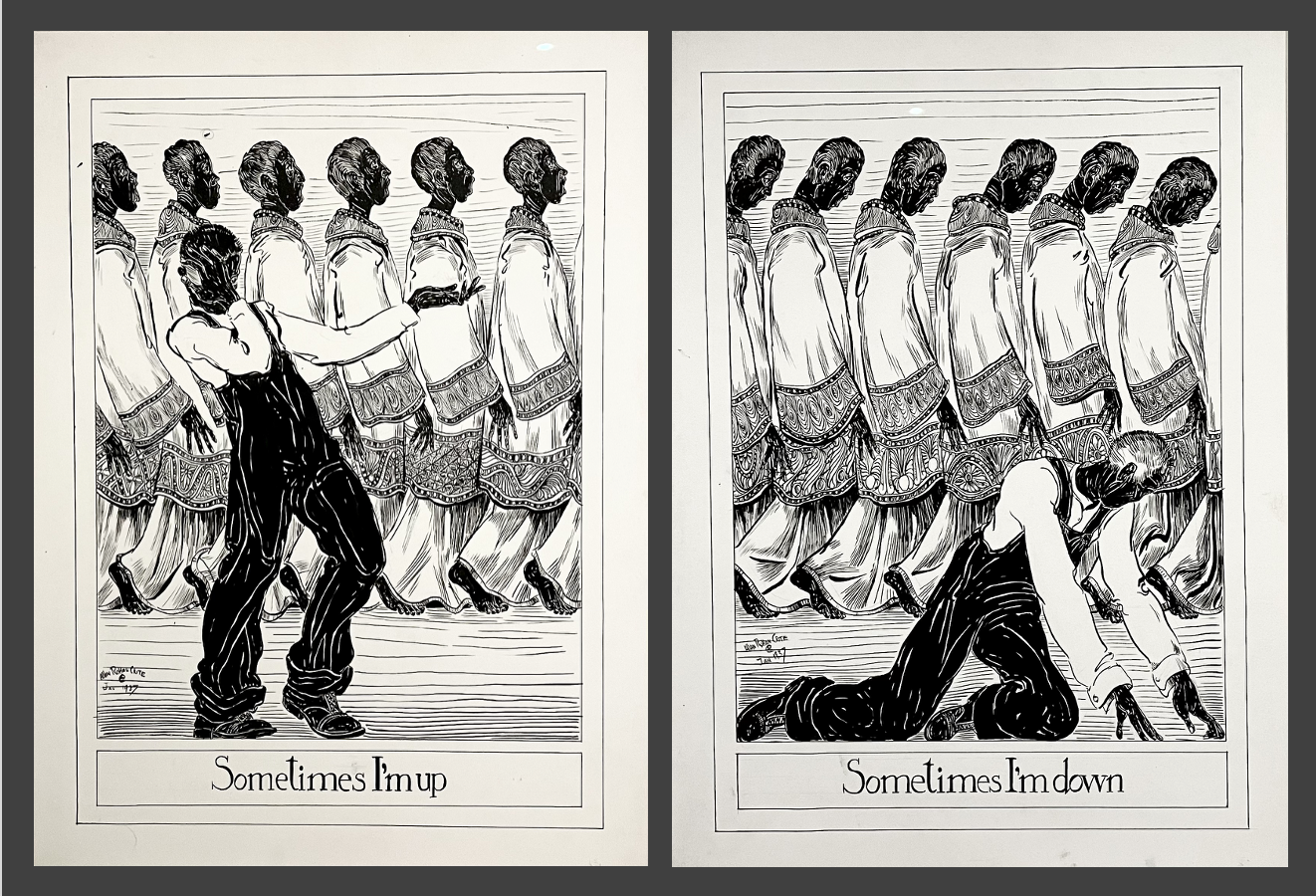 Allan Rohan Crite. Sometimes I’m Up, Sometimes I’m Down. Illustration for Three Spirituals from Earth to Heaven (Cambridge, Mass., 1948),” 1937.
  Dear Reader,
 We sometimes say that someone is living in the past, but it seems to me that the past lives in us. It lives in our houses; it lies all around us. As I write this, I’m sitting on the couch under two blankets crocheted by my grandmother, who was born around the turn of the 20th century. The laptop sits on a folded blanket that came from Mexico via a friend years ago. And that’s just the surface layer. My closets and file cabinets are also full of the past.