
by Angela Starita
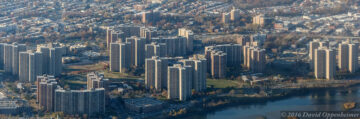
Large-scale housing projects have been the subject of the public’s wrath and ardor for at least the last 70 years. Considering the extraordinary housing crises in cities across the country, it’s not surprising that Herman Jessor, the engineer-turned-architect behind the best-known cooperative developments in NY, is the subject of two studies and exhibitions, both coming out of The Cooper Union, Jessor’s alma mater. I work as a writer at Cooper, so perhaps my Jessor-looms-large-in-the-zeitgeist notion is skewed in his favor, but I can’t help but think that his work, which so promoted community bonds, is ripe for a reassessment exactly because we seem suddenly aware of the dangers of solitude. It’s also a moment when most everyone wants to beat a fast exit from civilization. Magazine and newspaper articles describe women starting their own small-house community, LGBTQ collectives built around farms, and MAHA families embracing back-to-the-land philosophies reminiscent of the Whole Earth Catalog.
What makes Jessor all the more intriguing, though, is that his solutions were decidedly urban, on a very large scale, and highly successful by any number of metrics—he is estimated to have built more than 40,000 residences most of which are still occupied and have low turnover. The March 2025 exhibition at Cooper included a map of the five boroughs with all of the Jessor-designed projects, including Penn South in Chelsea, Seward Park Houses on the Lower East Side, Co-op City in the Bronx, and Rochdale Village in Queens, the largest Black-majority housing co-op in the world. Most were built for unions like the International Ladies Garment Workers Union and the United Housing Foundation which was run by Abraham Kazan, an organizer and frequent Jessor partner.
The buildings, variations on the towers in the park scheme popularized by the modernist architect Le Corbusier, prioritized ventilation, eat-in kitchens, and numerous shared spaces. Co-op City, for instance, includes gardens, playing fields, a cooperative grocery store, and schools. Jessor and Kazan developed streamlined construction systems that made for more affordable buildings. Most of them remain affordable thanks to programs like the Mitchell-Lama program in New York State that subsidizes housing for middle-class residents.
What Jessor’s work doesn’t provide is anything akin to low-rise neighborhoods like Greenwich Village and the aesthetics associated with them. Jane Jacobs, of course, was famously an advocate of walkable cities where sidewalks are center of community and exchange. She’s a presence, stated and implied, in “Thank You, Herman Jessor,” the first of the two exhibitions of Jessor-related research, this one mounted last winter in Cooper’s Third Floor Hallway Gallery, with vivid photos of the buildings and their residents.
The usual Jacobs dyad pits her against Robert Moses, a boring and reductive comparison that reads essentially as small is good, big is bad, and Jacob’s “eyes on the street” sensibility comes out the hero. In the story of Jessor’s work, Jacobs is again pitted against an advocate of large-scale construction, but this time she’s the heavy. As Daniel Jonas Roche, a curator of “Thank You, Herman Jessor” and an editor at The Architect’s Newspaper, put it, “Jessor is pretty much the bogey man in Jane Jacobs’s urban saga; his buildings were, apparently, everything that was wrong with architecture at the time. And now we’re in a world where it costs $6,000 a month to live in the Greenwich Village that Jacobs romanticized.”
Roche and the photographer Zara Pfiefer have studied Jessor’s work extensively and aptly present his work as offering possible solutions for New York’s current housing crisis. But to call Jane Jacobs a romantic is to minimize, among other things, the context of her writing, not to mention the importance of aesthetics. The Death and Life of Great American Cities (1961) was published just as the impact of the federal urban renewal program, started in 1949, was proving its racist and anti-urban agenda. Jacobs argued that housing towers were alienating in appearance and themselves alienated from the street life of a city, while objecting to the ways they were created, often built on the sites of razed neighborhoods. Jessor dismissed this kind of objection on class (and perhaps sexist) grounds as a romanticization of poverty and a misguided belief in aesthetics over affordability. Kazan agreed, saying “we do not accept the theory that the exterior design of a building is worth the difference of $7.00 a room per month.”
But it’s true that the Jessor projects were markedly different and deserved to be distinguished from the sorts of public housing that characterized edges of so many American cities, built more as punishment than sustenance. “Thank You, Herman Jessor” and a future exhibition on the Jessor-Kazan partnership, expected to open in 2027, shows the extraordinary success of these complexes as seen through the eyes of past and current residents, many of whom staunchly defend their homes as thriving, highly social communities. That resident turnover is low speaks to the success of these projects. The upcoming exhibition will be based on research conducted by two Cooper Union architecture professors, Mersiha Veledar and Kayla Montes de Oca, and will include 100–150 interviews with residents. Like Roche and Pfeifer, they see projects like Penn South and Rochedale Village as models for future housing that, like the Jessor precedents, will deploy design to foster true community, the kind of interconnectedness prized by Jacobs. It’s yet to be seen if the next Cooper exhibit will address some of the valid concerns raised by critics, questions about scale, relationship to the street grid, and aesthetics.