
by Mark R. DeLong
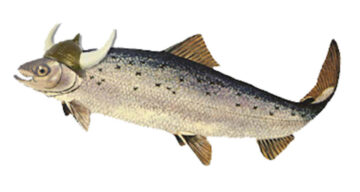
My mother ordered the annual parcel of lutefisk from Olsen Fish Company in Minneapolis, Minnesota. Determined to bring some of her Minnesota Norwegian Christmas tradition to our home in Oklahoma, where our family moved when I was in high school, she phoned in the order in November or even earlier. The package appeared a few days later, fish solidly frozen in dry ice—probably the only package of lutefisk to arrive in the state. When she nestled the butcher-paper wrapped lump into the freezer, I knew we were doomed.
She was trying to invoke Christmases she had lived in Minnesota, and a big part of that had to do with smell, the sense especially tied with memory.
Lutefisk dinners were common in Lutheran church basements in the upper Midwest US, and still happen even though some never recovered from the disruption of the Covid pandemic. Nationally, lutefisk sales slumped then and only recovered to about 300,000 pounds in 2022, significantly lower than the 800,000-or-so pounds made in the early 1990s. In small towns like the one I grew up in, the feasts always took place around Christmas, and the rumor in my home village was that churches, despite their doctrinal differences, would coordinate schedules such that it was possible to have a lutefisk dinner several times during the season. The fish, I guess, drove a true ecumenical movement and drew together the large community of families whose ancestors had immigrated from Scandinavia. Generations knew the odd pleasures of lutefisk first-hand, though, no doubt, the draw of the Christmas dinner fish puzzles many of them (including me).
Lutefisk, to put it bluntly, stinks. And that, ironically, might be part of its charm.
Red Stangland, radio broadcaster and creator of the endless ethnic jokes about Lena and Ole, wrote a song celebrating the dish. The first (and relatively tame) stanza follows, and you can sing it to the tune of “O Christmas Tree”:
O Lutefisk, O Lutefisk, how fragrant your aroma,
O Lutefisk, O Lutefisk, you put me in a coma.
You smell so strong, you look like glue,
You taste just like an overshoe,
But lutefisk, come Christmas Day,
I think I’ll eat you anyway.1You can listen to the whole song on Youtube, if you dare: https://www.youtube.com/watch?v=LQAZ4IKcncw
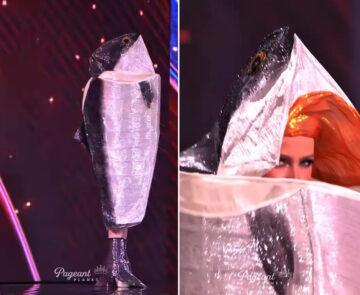
Real Norwegians—that is, the ones who live in Norway—are fish lovers, for obvious reasons. Norway’s landscape and weather challenge farmers, but the North Sea and its abundant fish run along Norway’s west, from top to bottom. Some Norwegians are fish crazy, with annual per capita consumption(over 49 kg/110 lb) over twice as much as the US (a meagre 22 kg/48 lb).2Data from 2022 from Our World in Data: “Fish and Seafood Consumption per Capita.” Accessed December 28, 2025. https://ourworldindata.org/grapher/fish-and-seafood-consumption-per-capita. Perhaps among the the fish lovers is this year’s Miss Norway, Leonora Lysglimt-Rødland, who some say stole the Miss Universe pageant even though she didn’t “place.” She showed up dressed as a Norwegian Salmon.
But lutefisk isn’t salmon. It’s cod that’s been dried in the freezing winds of Norway—a product known as “stockfish”—and then reconstituted in a lye solution. (Sounds caustically dangerous, I know, but Olsen Fish Company says they wash their lutefisk in water for ten days before final packaging.) The reconstituted fish is somewhat plumper than fresh cod, and, as a former President of a Sons of Norway lodge reported, the jelly-like blob is “essentially pre-digested by the lye treatment” making it highly digestible and nutritious. He also admitted that he was intrigued by the lutefisk phenomenon but not its taste.
But the Norwegians in Norway and the Norwegian-Americans don’t see eye-to-eye about the fish delicacy itself.
One theory explains the different cultural stances of the (real) Norwegian and the Norwegian-American regarding lutefisk this way: The Norwegians in Norway know lutefisk as old fashioned and as the peasant food that it was, and they find nothing particularly funny about it. The American-Norwegians, if they still consume lutefisk at all, approach their gelatinous Christmas fare with self-deprecating humor—a humor fortified by the pride of heritage their immigrant great-grandparents maintained in an America that looked down on them and their festive fish meal. The hardship of immigration in early twentieth-century America turned lutefisk into more symbol than food, perhaps.3Kathleen Stokker’s Keeping Christmas (2001) lays out some of the circumstances of these national differences (including lutefisk) and how they were shaped by US culture and immigration.
Trouble is that the food humor never really overcomes the smell.
On Christmas Eve, my extended family would usually gather around my grandparents’ dining room table, and the lutefisk would come out of the kitchen to join the other Scandinavian fare: Lefse, a thinly pressed mashed potato, pan-fried like a tortilla, its thin surface covered with butter and sprinkled with white sugar before being rolled up—quite delicious, actually! White cream sauce. Pale melted butter. Mashed white potatoes. And, since the staples of the meal were all pale white, or darned close to white, a bowl of yellow corn or orange carrot coins relieved our eyes with some color. Cranberry relish, too. That festive setting was not unusual, and you could probably determine who in your town was eating lutefisk by driving through and noting which houses had kitchen windows opened wide to the winter chill.
Prayers were said, and perhaps someone uttered a joke about the main course fish. And we ate amidst the glow of Christmas with family, all sharing not-so-far-off Norwegian and Swedish ancestral heritage. I loaded white gravy and butter onto my bite of lutefisk, which I discovered actually took on the taste of whatever you could put on it.
We actually filled up on the Swedish meatballs, which my mother, grandmother, and aunt provided as an option “for those who don’t want the lutefisk.”
This Christmas feast is a tradition that, in my view at least, has a certain embedded, almost divinely inspired, humor, since the main course challenges, and in some fashion unites. Another of the “poetic” masterpieces of lutefisk humor, “The Lutefisk Lament,” recounts a boy’s struggle to face the fish. It ends with a wisdom, of sorts. “Uncle Kermit” who, having hoovered up his lutefisk,
. . . flashed me an ear to ear grin
as butter and cream sauce drip from his chin.
Then to my great shock he whispered in my ear,
“I’m so glad that’s over for another year.”It was then I learned a great and wonderful truth
that Swedes and Norwegians from old men to youth
must each pay their dues to have the great joy
of being known as a good Scandinavian boy.
One thing I know: On Christmas Day and into the last week of the year, I can make a sandwich with the leftovers of Christmas Eve’s Swedish meatballs. The same can’t be said of the leftover lutefisk, since once a year is enough, just as Uncle Kermit said.
For the bibliographically curious: Heartwarming story of another Norwegian-American in Minnesota: Samantha Childress, “The Ghost of Norwegian Christmas Past,” Caravanserai, December 19, 2024. https://samanthachildress.substack.com/p/the-ghost-of-norwegian-christmas-033. The business of lutefisk. Herring is the up-and-coming fish, apparently: Britt Aamodt, “Christmas Lutefisk: Love It or Leave It? Orders Are Dwindling, but Still Big,” MPR News, December 15, 2022. https://www.mprnews.org/episode/2022/12/15/christmas-lutefisk-love-it-or-leave-it. A Sons of Norway lodge president seeks an answer to the eternal question: Terje Birkedal, “‘The Great Lutefisk Mystery,’ Solved,” The Norwegian American, December 16, 2016. https://www.norwegianamerican.com/the-great-lutefisk-mystery-solved/. What happens at a Lutefisk dinner: John Andrews,.“Summit’s Lutefisk Tradition,” South Dakota Magazine, November/December 2017. http://www.southdakotamagazine.com/summit-lutefisk-tradition. Rhymed to align with “‘Twas the Night Before Christmas,” a lament: The Lutefisk Lament. 2017. 04:02. https://www.youtube.com/watch?v=JfkXOBfBPVs. And what’s with that Norwegian Salmon costume, anyway? Jessica Roy, “At Miss Universe, a Salmon Costume Steals the Show,” Style sec. The New York Times, November 25, 2025. https://www.nytimes.com/2025/11/25/style/miss-universe-norway-salmon-costume.html. And on the sociological underpinnings of the lutefisk humor among Norwegian-Americans: Kathleen Stokker, Keeping Christmas: Yuletide Traditions in Norway and the New Land. (Minneapolis: Minnesota Historical Society Press, 2001); https://shop.mnhs.org/products/keeping-christmas. And, the “backlash” of immigrant assimilation policies, with a focus on the case of Germans in post-WWI US: Vasiliki Fouka, Backlash: The Unintended Effects of Language Prohibition in U.S. Schools after World War I. Working Paper 591. Stanford Center for International Development, 2016.
***
Enjoying the content on 3QD? Help keep us going by donating now.
Footnotes
- 1You can listen to the whole song on Youtube, if you dare: https://www.youtube.com/watch?v=LQAZ4IKcncw
- 2Data from 2022 from Our World in Data: “Fish and Seafood Consumption per Capita.” Accessed December 28, 2025. https://ourworldindata.org/grapher/fish-and-seafood-consumption-per-capita.
- 3Kathleen Stokker’s Keeping Christmas (2001) lays out some of the circumstances of these national differences (including lutefisk) and how they were shaped by US culture and immigration.