
by Barry Goldman
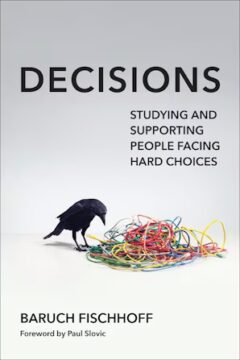
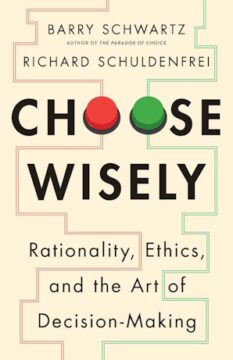
Two books came out recently in the field of decision-making. Baruch Fischhoff published Decisions: Studying and Supporting People Facing Hard Choices, and Barry Schwartz and Richard Schuldenfrei published Choose Wisely: Rationality, Ethics, and the Art of Decision-Making. The two books take very different approaches. In a word, Fischhoff represents the science of decision-making. Schwartz represents the art.
We are all in favor of rational decision-making. We want public policy decisions to be made by reasonable people following orderly procedures designed to give appropriate consideration to relevant factors and to maximize the probability of success. How could we possibly not want that? And the same is true of personal decisions. We may not have the patience or the attention span to work through the literature and pick the best health insurance plan for our family. But we have to agree it would be better if that choice were made on some rational basis rather than randomly or on the basis of the relative attractiveness of the models in the company brochures. We may conclude that any improvement in health insurance coverage is not worth the effort required to identify it. That’s fine. Some decisions are not worth thinking about. But even the decision that something is not worth thinking about is better if it is made according to some rational process.
At the same time, there is a false precision conveyed by the matrix of factors, weights and probabilities involved in rational choice theory. And there is something missing. If you’re trying to decide whether to uproot your family and move across the country or whether to start a war with, say, Venezuela, an algorithm and a spreadsheet are not what you need. As the saying goes, not everything that counts can be counted, and not everything that can be counted counts.
Baruch Fischhoff was present at the inception. Amos Tversky and Daniel Kahneman jointly advised his dissertation. He was at Hebrew University in Jerusalem with Kahneman and Tversky when they began creating the universe of judgment and decision-making, biases and heuristics, and what became behavioral economics. His name is most closely associated with hindsight bias, our tendency to think we knew it all along and to be “insufficiently surprised” by events. For the past 50 years Fischhoff has been applying Bayesian inference, game theory, measure theory and signal detection theory to an extraordinary array of real-world decision problems.
Paul Slovic, another giant in the field, wrote in the foreword to Decisions:
The breadth of topics that Baruch has examined in depth and to which he has made important substantive contributions is vast, including risk perception and decisions about seat belts, adolescent risk taking, mammography, terrorism, vaccination, diabetes, product liability, nuclear energy in space, alcoholism, nuclear war, HIV disease, social trust, cancer, investment decisions, food-borne illness, science communication, cyber risks, and many more topics pertaining to decisions about health risks, environmental protection, and national security.
The influence of Baruch’s published articles has been enormous, but it has been magnified even more by his participation on many committees of the National Academy of Sciences and the Institute of Medicine, often as the committee chair, and his membership and leadership on key advisory committees of federal agencies such as the Food and Drug Administration, the Environmental Protection Agency, and the Department of Homeland Security.
Fischhoff acknowledges there are limitations to a formal, quantitative approach to decision-making. He says, “There is no point in getting the numbers right unless they are the right numbers.” But he also says it is not the calculation that makes a structured process valuable. It is the clarity that results from the analysis.
Successful analyses describe decisions clearly enough to be calculable, in the sense that someone could “run the numbers” and calculate the best choice if they had the numbers to run. Those numbers are the probability that each choice option will lead to each valued outcome and the relative importance of each outcome, sometimes measured as utility.
Barry Schwartz has also been at this business for a long time. (Both men were born in 1946.) Schultz is most famous for his book The Paradox of Choice. There he argued that the material abundance of late capitalism gives us more choices but is not making us happier. It is making us stressed out. The solution is a simpler life with fewer choices, and a return to Aristotelian virtues. Kahneman wrote a blurb for the cover, as did Martin Seligman and Philip Zimbardo. Kahneman said this:
This book is valuable in two ways. It argues persuasively that most of us would often be better off with fewer options and that many of us try too hard to make the best choices. While making its case, the book also provides an engaging introduction to current psychological research on choice and on well-being.
I mention all this to emphasize that both Fischhoff and Schwartz are royalty in this field. Fischhoff’s new book is published by MIT Press. Schwartz’s is published by Yale. These are the 10th Degree Black Belts in the psychology of decision-making. There is no higher level. And yet, they fundamentally disagree.
Schwartz says:
Formal methods do not – and more important, cannot – tell us how to frame a problem well, how to specify options and attributes, how to formulate the options and attributes as measurable, how to disentangle various options and their attributes, or how to quantify the relevant probabilities and values. Nor can formal methods provide a criterion for when we have framed and closed a problem well. And the decision is no better than the framing and closure of the problem allows.
What are we to make of this? I don’t know. But I know an apocryphal story that pretty well captures the problem.
It seems a decision theory professor at a university on the east coast was offered a job at a university on the west coast, and he didn’t know whether to accept it or not. He went to see a colleague for advice. The colleague said, “Why don’t you do what you’ve been teaching your students to do for the past 20 years? List all the factors you need to consider, assign a value and a weight to each factor, multiply the values by the weights, add the scores, and pick the option with the highest score.”
The professor said, “C’mon, this is serious.”
***
Enjoying the content on 3QD? Help keep us going by donating now.