by Rafaël Newman
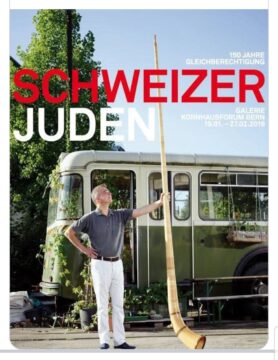
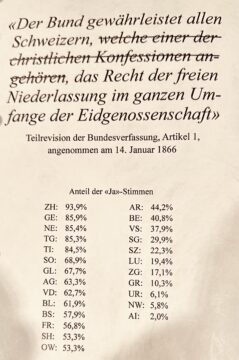
One hundred and sixty years ago this month, in a national referendum held on January 14, 1866, Jews were given the official right to reside throughout Switzerland. Jewish people, whether of foreign provenance or Swiss-born and already living on Swiss territory, had been explicitly forbidden to establish residency in Switzerland in its constitution of 1848, the year modern Switzerland was founded. Since the Middle Ages, when they were re-admitted following the pogroms and expulsions of the 14th century, such permanent domicile as was permitted to Jews among the Swiss had been confined to the two villages of Endingen and Lengnau, in the canton of Argovia. It was only under economic pressure from its main trading partners, the US and France, which threatened the young state with punitive tariffs, that Switzerland—in the form of contemporary Swiss suffrage: in other words, exclusively Christian men—agreed to make the change. Even so, rates of approval in 1866 were drastically unequal across the country, with 93.9% of voters in the populous canton of Zurich favoring Jewish residency, and the tiny, remote half-canton of Appenzell Innerrhoden, which would continue to deny women, whether Christian or otherwise, the right to vote until the late 20th century, rejecting the measure by 98%.
Seventy-five years later, with World War encroaching on its frontiers, the Swiss establishment saw this enforced tolerance tested anew, as Jews fled the Third Reich for asylum within Switzerland’s neutral borders. Although they accepted some of these refugees, Swiss officials notoriously sent many back, their passports marked with a “J”, and placed restrictions on the professional and political activities of those they did admit (such as the poet and philosopher Margarete Susman, on whom see here and here), both to protect “native” Swiss from competition, and to avoid provoking the Nazi authorities, with whom clandestine relations were being maintained.
Nevertheless, in January 1941, a group of Jewish residents in Zurich, several foreign-born, was able to join the musician Marko Rothmüller in founding Omanut, an association for the promotion of Jewish art. The Swiss organization was created in memory of the original Omanut, which Rothmüller, a Yugoslav immigrant, had founded in 1935 in Zagreb, but which had since vanished under the Nazi occupation of Croatia. Read more »



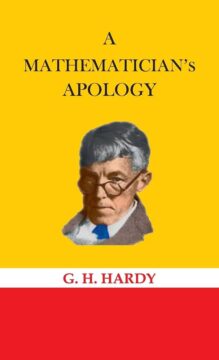 I have put off reading G.H. Hardy’s Mathematician’s Apology (1940) to the end for too long. Now that I have, I can say with conviction that if you ever find yourself needing to justify why people should learn at least some mathematics, then this is the text to avoid, and Hardy provides the arguments you should stay away from furthest. And yet, it grew on me as an honest presentation of Hardy’s perspective on why anything is worth doing.
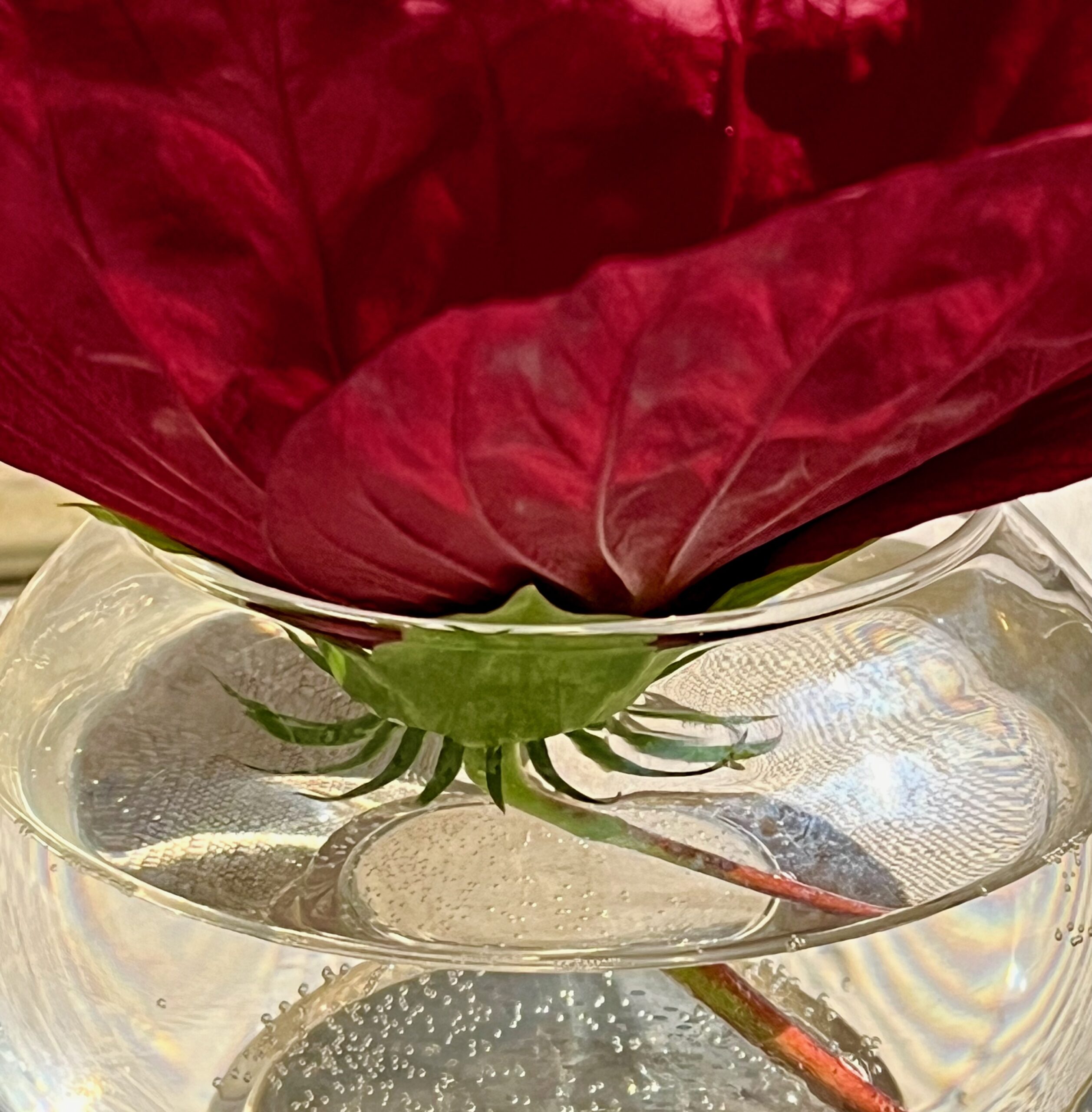 Sughra Raza. Blood. August 2024.

 a prickly pine’s upon one nub,

 Dear Reader,