
by Charles Siegel
Oh the streets of Rome
are filled with rubble
Ancient footprints are everywhere
You can almost think
that you’re seeing double
On a cold, dark night
on the Spanish Stairs
Those are the first lines of “When I Paint My Masterpiece,” a song written by Bob Dylan in 1971. I remember that the first time I heard the tune, I thought it was by The Band, because they actually released it first in September of 1971. Two months later, Dylan’s version came out, oddly enough on the album “Bob Dylan’s Greatest Hits Vol. II.”
Many artists have covered the song, most notably the Grateful Dead. They played it 144 times, according to gratefulsets.net. This sounds like a lot, but it means the song doesn’t even make the top 85 in terms of number of live performances by the band. This is because they only began performing it in 1987, and the band stopped playing entirely in 1995 upon the death of their lead guitarist and talisman, Jerry Garcia.
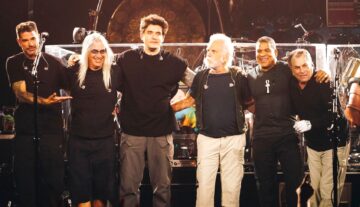
The Grateful Dead ended in 1995, but the band has lived on since then in a series of groups. These groups have contained various original members, gradually decreasing in number. The first was The Other Ones, followed by The Dead. But the longest-lived and most successful has been Dead & Company, which today includes two members of the Grateful Dead: Bob Weir, the rhythm guitarist and vocalist, and Mickey Hart, the drummer. It also includes another drummer, Jay Lane, and the bassist Oteil Burbridge and keyboard player Jeff Chimenti. Finally, there’s John Mayer on lead guitar and vocals.
On a fortunately-timed business trip to Las Vegas last month, I saw Dead & Company on a Thursday night and Friday night. This was the last weekend of their second two-month “residency” at the Sphere, the futuristic new music venue that looks as if it simply fell from outer space and landed a block from the Strip, and now blinks out strange messages all day and night.
If they were tired and happy to be nearing the end of this run, they sure didn’t sound like it. The up-tempo songs were crisp and driving. The ballads felt right, too. The old folk tune Morning Dew has been covered dozens of times in the 65 years since it was written, but the Grateful Dead made it their own early on. Dead & Company played it even more slowly than their forebears, turning it into something that was somehow both a haunting dirge and a reverie at the same time.
The ensemble was in top form. John Mayer is a terrific guitarist. Large portions of his career have been spent in the tabloid spotlight, but there’s never been any doubt about his chops. In any particular song, during the four sets I saw over two nights, he could go from jazz to funk, to a wailing blues solo, to classic power riffs, back to jazz. And he handled a good deal of the vocal duties as well.
There was a great sequence during Brown-Eyed Women, on the first night, when Mayer traded solos back and forth with Chimenti. It was a thrill to see these two aces locked in, affectionately bouncing off each other while almost anticipating what the other would play in advance. Meanwhile, the rhythm section of Oteil Burbridge and Jay Lane kept a rock-solid anchor.
That leaves the two members of the Grateful Dead who play in Dead & Company. Weir, the rhythm guitarist who also sings some of the tunes, and who wrote many of the Dead’s songs, is the elder statesman of the band. At 77, he is now a sort of emeritus figure presiding over the proceedings. He’s never been known as much of a player, but for some time now, he has been the living embodiment of the Grateful Dead’s soul and continuing identity. He stands in the center of the stage, wearing some kind of giant biblical poncho; with his long white hair and bushy white beard, he looks like nothing so much as Moses being played by Charlton Heston, carrying ancient wisdom down to us from Mount Sinai. Or perhaps he’s carrying the “ancient tones,” as Bill Monroe called them, down to us from the Haight.
The last is Mickey Hart, still drumming at 81. Hart wasn’t exactly an original member of the Grateful Dead, but he joined pretty early on, in 1967. He left the band in 1971, after his father, who had briefly been the group’s manager, embezzled a large amount of money; he also had a serious heroin problem that affected his playing. But he rejoined a few years later and has occupied one of the two drum chairs ever since. He looked very absorbed most of the time; occasionally a broad smile broke out, as he and Weir shared some memory or other, formed from making music together on stage for over half a century.
The band is tight, and the songs are timeless. I was lucky, over the two nights, to hear many of my favorite Dead tunes. On the first night, they included Friend of the Devil, Bertha, Jack Straw, I Know You Rider, Brown-Eyed Women, and Turn on Your Love Light. On the second, there was St. Stephen, Althea, and perhaps my favorite of all, Cold Rain and Snow.
Cold Rain and Snow was originally a folk tune. There are lots of versions out there (I recommend Molly Tuttle’s — she plays it hauntingly and inverts the lyrics to tell the story from the other side). But for over half a century, this has been an essential Dead song, and it will be forever. During a difficult period in my life, I listened to it constantly. The pain in the lyrics, and the elemental propulsion of the music, somehow helped.
And then there’s the show going on behind the band, and over it and all around you. The visual effects that now form an equal part of the concert experience at the Sphere are a spectacle that’s hard to describe. Imagine a planetarium show from 50 years ago, except a thousand times as big, in stunningly vivid color, with endless, looping Dead imagery. Uncle Sam riding a technicolor motorcycle, showers of roses, skulls traveling through space, infinite swirling circles of dancing bears. All interspersed with live shots of the players on the stage, and clips of the Grateful Dead playing decades ago. At one point we were suddenly inside Barton Hall at Cornell University. This is holy ground for Deadheads: in 1977 the Grateful Dead played a show there that many hold to be their best ever.
Ever since the first Sphere shows last year, an existential debate has raged among Deadheads. Some see these shows as a cheesy surrender to money-spinning commercialism. The Grateful Dead, they say, would have been appalled by the crass nature of it all: the outrageously expensive tickets, the thirty-dollar drinks, the fact that nowadays the “band,” such as it is, only plays in Las Vegas, and so on.
Others have no problem with it. Weir and Hart, they figure, have long since earned the right to retire. If they play for a few weeks each year, together with several great players who love and understand the music, what’s to complain about? At least a few hundred thousand people will get to see a great show and hear their favorite tunes.
Nick Paumgarten, writing in the New Yorker about last year’s shows at the Sphere, acknowledged the “downright beautiful” visual show, but found the whole thing slightly off-putting. “It wasn’t the Dead,” he said, “or even an adulteration of the Dead, so much as a presentation about the Dead, confusingly featuring a couple of its survivors. It brought to mind a Civil War reenactment, with a few Vicksburg veterans thrown in for authenticity.” That is great writing, but I respectfully disagree.
The opener on my second night was When I Paint My Masterpiece. In some ways it’s an odd choice to open a concert, especially one at a large venue. Bands usually want to come right out of the gate with energy, but this is a slow, relaxed tune. As with Morning Dew, it was slower than I’ve ever heard it. It sounded elegiac.
What is the song about? Is it about life on the road — “I left Rome, and landed in Brussels” — the kind of life an itinerant musician like Dylan led back then (and still does more than 50 years later)? Is it just a series of reflections on historic sites in Rome? And what on earth did Dylan mean by “a date with Botticelli’s niece”?
Who knows? Debate rages on, and probably will forever, on the Dylanology websites and in the subreddits. I’ve always thought it was just a poignant take on an artist who never loses faith that, despite a lifetime of mediocrity, he really will paint a masterpiece one day. She really will write the Great American Novel. He really will compose a hit song. “Someday, everything is gonna be different, when I paint my masterpiece.” Most of us never do.
The show picked up from there with Playing in the Band. Then Althea, supposedly Mayer’s favorite Dead song, and on through eight more songs until the first set closed with Sugaree. We were enveloped in a giant multicolor tent which gradually opened up into a beautiful desert landscape, that slowly transformed into an endlessly morphing tie-dyed shirt with close shots of Mayer playing. The song continued on at a stately clip, with Mayer lacing in jazzy filigree solos between the verses. Then he tore off several choruses of pure blues rock riffing, the band sauntering on through the old Dead standard locked in right behind him.
It was all terrific. I haven’t enjoyed a concert this much in a long time. Great old songs, played by excellent, tight musicians and two stalwarts who were playing them before the others were born.
And the visual show. The Sphere is about as far away, in every sense, from the Spanish Steps (Dylan had to call them Stairs to make the rhyme work), as it is possible to be. But watching the Dead & Company show there in all its glory, you can almost think you’re seeing double. Put it all together, and you think they just might have painted a masterpiece.