

Erasing Other, Erasing Self: Reflections on Black History

by Herbert Harris

National Museum of African American History and Culture, Washington, D.C.

This year’s Black History Month is different.

Black history itself has become contested. Not debated at the margins but questioned at its core. School curricula are scrutinized, and institutions that preserve Black memory are accused of being “divisive.” Should Black history exist, or should it disappear, erasing its many uncomfortable truths and leaving a more homogeneous national narrative?

Narratives are what hold us together as individuals and as societies. To have the wholeness and continuity essential to our survival, our stories must be heard, recognized, and validated by others. Identity is not a monologue in an empty room; it requires an audience and a full cast.

History is our shared narrative. It is how a nation understands what has happened and who it is. It is also how we relate to those who came before us. To deny or erase significant portions of that history is not merely to rearrange a syllabus. It distorts the self-understanding of the entire society. A narrative that excludes central truths becomes brittle. It depends on selective memory and strategic forgetting. That society’s connections to reality inevitably fray, eventually breaking.

As a psychiatrist, I have spent much of my professional life listening to narratives. Read more »
Monday, January 26, 2026

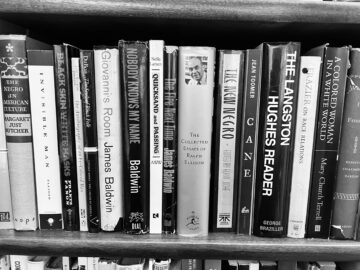
A Room For Books

by Herbert Harris

The greatest privilege of my childhood was growing up in a house where books had their own room.

My father’s library occupied the second floor, the only room without a window air-conditioning unit. On summer afternoons in Washington, DC, when the heat and humidity pressed down like a weight, the rest of the house hummed and rattled with machines straining to keep up. The air in the library stayed stubbornly still. It was the early 1970s, and I was on summer break after tenth grade, retreating there to find the peculiar solitude this room alone offered. Each book I opened sent up a cloud of dust that glittered in the angled sunlight. Shutting the door turned the room into a sauna, but in that quiet stillness, I didn’t mind. It felt like the price of admission to a different world.

The previous summer had unfolded differently. I had just finished ninth grade, where we surveyed the classics of English literature and retraced the decisive moments of Western civilization, reliving the deeds of its great men and women. I spent long afternoons in the library, sinking into those books as the heat pooled around me. I melted into a reclining chair and wandered through the past. That immersion had felt complete, even sufficient. But this summer, I arrived with a different appetite. I was growing skeptical of the Eurocentric narratives threaded through everything I was learning. I sensed there were other stories and vantage points, and I came looking for them.

I picked up the book I had been reading a few days earlier and turned to the page marked with an index card. I searched for the sentence I remembered, but at first the words slipped past me. James Baldwin was writing about a Swiss village, about children shouting “Neger” as he walked through the snow. Seeing the word on the page registered instantly, not as surprise but as recognition. I had learned early what it meant to be called that name in its American form. That knowledge had settled into my body long before I could articulate it. Read more »