
by Jeroen Bouterse
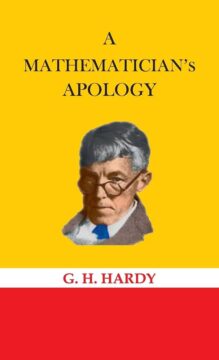 I have put off reading G.H. Hardy’s Mathematician’s Apology (1940) to the end for too long. Now that I have, I can say with conviction that if you ever find yourself needing to justify why people should learn at least some mathematics, then this is the text to avoid, and Hardy provides the arguments you should stay away from furthest. And yet, it grew on me as an honest presentation of Hardy’s perspective on why anything is worth doing.
Hardy doubted that composing his Apology was one of those things. In the first paragraph, he apologizes for it: writing about mathematics is the business of second-rate minds, unable to do innovative math themselves. He assures us that he is only embarking on it because past sixty, he is now too old to do the real thing. This sets the tone for an essay full of quick and haughty judgments. Compliments paid with authority to the greats, confident generalizations based on personal or historical anecdote, and a great deal of dismissive hand-waving towards people or things beneath Hardy’s attention. “Newton made a quite competent Master of the Mint”, Hardy knows; and on we go, to the next item of an enumeration illustrating that mathematicians past their prime rarely excel in anything else. In a footnote, he is generous enough to add: “Pascal seems the best.”
The Apology still constitutes an interesting argument, though a structural weakness lies in the stress Hardy puts on what Ian Hacking would call ‘elevator words’: terms such as real, beautiful, or serious do most of the work separating mathematics from everything else, and the worthwhile kind of mathematics from the rest. Throughout his essay, we can see Hardy alternating between throwing those terms around as if their meaning is self-evident, and feeling pressed to prop them up with some kind of clarification. Between chess problems and certain mathematical theorems, for example, there is “an unmistakable difference of class. [The theorems] are much more serious, and also much more beautiful; can we define, a little more closely, where their superiority lies?”
A new word is introduced: serious theorems contain significant ideas. ‘Significant’ is a difficult concept, however, “and it is unlikely that any analysis which I can give will be very valuable.” But essentially, significant ideas are general – not the kind of ‘general’ you are thinking of, because in that sense even trivial theorems would be general; no, “a more subtle and elusive kind of generality”. They are also deep. ‘Depth’, unfortunately, is an elusive notion too, “even for a mathematician who can recognize it, and I can hardly suppose that I could say anything more about it here which would be of much help to other readers.”
Importance and uselessness
Hardy seems unfazed by his own consistent inability to define his terms. If you want clear and distinct ideas, you should be doing math, not talking about it, he might have retorted to my hostile summary. The virtues Hardy ascribes to mathematical theorems are simply not to be found in texts.
Similarly, Greek mathematics is “more permanent even than Greek literature. Archimedes will be remembered when Aeschylus is forgotten, because languages die and mathematical ideas do not.” A mathematician is a maker of patterns, like a painter or a poet; but his patterns are more permanent, because they are made with ideas. Don’t painters or poets work with ideas, too? Yes, but their ideas are unimportant; they just happen to be presented in a beautiful way. “Poetry is not the thing said but a way of saying it.”
Hardy will not consider the possibility of artful writing that communicates ideas any further. It is typical of his apology: he formulates a thought on the uniqueness of mathematics, cannot prevent a rather grave complication from bubbling up, but manages to provide some feeble solution that allows him to carry on anyway. The same pattern applies to the motif that has stood out most to later readers: Hardy’s claim that real mathematics (as opposed to trivial mathematics) is useless.
It has become commonplace to point out the many practical applications that Hardy’s favorite examples of real mathematics turned out to have. Editor of the Apology Alan J. Cain thinks this misunderstands him; Hardy’s claims on the uselessness of real mathematics are already presented as contingent facts. Indeed, Hardy writes:
“The great modern achievements of applied mathematics have been in relativity and quantum mechanics, and these subjects are, at present at any rate, almost as ‘useless’ as the theory of numbers. It is the dull and elementary parts of pure mathematics, that work for good or ill. Time may change all this.”
Time has. Cain’s point is well taken; Hardy knows he has not demonstrated a necessary connection between beauty and uselessness. He is no less vocal about it, however: the point recurs throughout his essay, and is the last topic he returns to before he sums up his argument. It would be silly to pretend that the argument remains unaffected because Hardy managed to squeeze in a few ‘at present’s and ‘on the whole’s.
Moreover, recognizing that Hardy establishes no conceptual relation between beauty and uselessness leads to the question of why that last topic figures so prominently in his essay. The grounds may have been more psychological than logical. The personal note at the end of the essay suggests Hardy harbors some anxiety about never having done anything ‘useful’. “No discovery of mine has made, or is likely to make, directly or indirectly, for good or ill, the least difference to the amenity of the world.” In the end, Hardy is practicing apologetics – the ‘case’ for his life, or a life like his, needs to be made.
Noble ambition
If you want to justify your activities in life, Hardy says, you have to ask, first, whether what you do is worth doing; and second, why you are doing it. Hardy believes that an honest answer to the second question is often independent of the first: you may do what you do because it is the only thing you are good at. Or, like most people, you may be good at nothing, in which case it does not really matter what you do anyway.
The notion that a lot of us don’t make a rational decision about our career, because we are simply called to something, or because our mind works in such a way that we gravitate towards it, rather appeals to me. Full-blown fatalism would seem to undermine the idea that there is any choice to justify, however. Hardy goes back and forth on that. He says that we should of course take account of the differences in values between different activities, too. Then again, reflection on those will hardly ever tip the scales, because natural ability dominates the decision. Poetry is more valuable than cricket, Hardy says, but a good cricketer should not give up his sport in order to write second-rate poetry.
It is worth asking why not. Clearly, poetry is not always more valuable than cricket, or else mediocre poetry would still be preferable over good cricket. It appears that for Hardy, activities are not ordered by discipline first and then by quality, but rather the other way around: first-rate accomplishments are always better than second-rate, and the next question is how worthwhile the field is in which they are made.
Hardy admires remarkable and record-breaking achievements anywhere, and he believes that “a man’s first duty […] is to be ambitious”. He makes it clear elsewhere in his essay that he loathes warfare, but he sees “something noble in the ambition of Attila or Napoleon” nonetheless. The case for mathematics is that it provides the best arena for ambition to strive for permanent rewards, the kind of recognition closest to immortality. It provides the prospect of a lasting reputation, but only to the really deserving. That in mathematics, recognition and genuine accomplishment are so closely connected is primarily an insurance for the first-rate mind against historical accident. “Mathematical fame, if you have the cash to pay for it, is one of the soundest and steadiest of investments.”
Not only does Hardy claim zero interest (at most) in material applications of mathematics, but he does not believe that the value of any creative activity lies in the benefits – of whatever nature – conferred by its achievements. Intellectual curiosity, professional pride and ambition are the real and legitimate motives of all research. Mathematics is just the most reliable vehicle of an ego that wants to leave “something of permanent value”. And again, the word ‘value’ should not lead us to think about any kind of good to humanity, even though it is also true that almost all contributions to human happiness have been made by ambitious men.
“If a mathematician, or a chemist, or even a physiologist, were to tell me that the driving force in his work had been the desire to benefit humanity, then I should not believe him (nor should I think the better of him if I did).”
Happiness and immortality
I struggle to believe that Hardy’s ‘egotistical’ perspective on the meaning of a life’s work applies even to himself. Did he indeed draw all his motivation from anticipated future recognition? His personal note at the end makes it clear that he rather enjoyed his work while he was doing it:
“I hate ‘teaching’, and have had to do very little […]; I love lecturing, and have lectured a great deal to extremely able classes; and I have always had plenty of leisure for the researches which have been the one great permanent happiness of my life.”
Naked ambition looks different. The pleasure Hardy took in his mathematical life must have made that life’s work more sustainable. As supporting evidence, I submit his discussion of two examples of ‘real’ mathematical theorems. After considering the limitations of the general reader and the importance of picking genuine theorems, he decides to discuss Euclid’s proof that there are infinitely many prime numbers, and a proof of the irrationality of the square root of 2.
Between his equally pompous as half-hearted attempts to attach elevating labels to these pieces of mathematics, Hardy explains them with a loving touch that almost redeems the entire essay. Take only this paragraph, where he reflects on the meaning of what has just been proven.
“Euclid’s theorem tells us that we have a good supply of material for the construction of a coherent arithmetic of the integers. Pythagoras’s theorem and its extensions tell us that, when we have constructed this arithmetic, it will not prove sufficient for our needs, since there will be many magnitudes which obtrude themselves upon our attention and which it will be unable to measure; the diagonal of the square is merely the most obvious example.”
This is imaginative prose, interpreting mathematical concepts and integrating them in a narrative of human exploration that Hardy knows from the inside. It must have been fun to think these thoughts, and it should have been a pleasure to share them with his readers. Had Hardy not believed that “exposition, criticism, appreciation, is work for second-rate minds”, he might have allowed himself to produce more of it.
It is a pity that Hardy’s values so often get in the way of his better impulses. Mathematics is a world in which he clearly likes to dwell, and his text often appeals to the like-minded with whom he could share it. His choice to be a mathematician “was right […] if what I wanted was a reasonably comfortable and happy life.” But he can’t let that be enough. Solicitors, stockbrokers and bookmakers can be happy, too, but theirs are clearly futile lives. Hardy wants to know that his life has not been futile; he wants to identify his “chance of escaping a verdict of complete triviality”. Benefit to humanity could conceivably have provided such justification; but for several reasons, Hardy rejects this line of apology. This is why he keeps returning to the ambition of leaving behind something permanent, “some kind of memorial”.
I don’t need Hardy to justify his existence, but I can’t fault him for asking the question. A value system with ambition at its center is objectionable to me, but I wouldn’t say it is incoherent. What I do know is that the Apology fails: Hardy’s reasoning has not established that mathematics will provide the desired return on investment.
He knows it. Hardy often suggests that the eternity of mathematics rubs off on its successful explorers, but he does not go so far as to argue the impossible. His belief that mathematics distributes recognition in proportion to merit comes down to trust in history of science. And as the fate of his beliefs about uselessness has illustrated, history’s processes are contingent. There is no bridge from the necessary truth of mathematical concepts to the permanence of the ego. The claim that Archimedes’ name will outlast Aeschylus’ remains a gamble.
Hardy’s friend C.P. Snow pointed out to him that in any case, having your mere name attached to a mathematical discovery is hardly different from remaining anonymous. Aeschylus at least wrote things that help us understand who he was. “An interesting minor point”, Hardy judged.