
by Paul Braterman
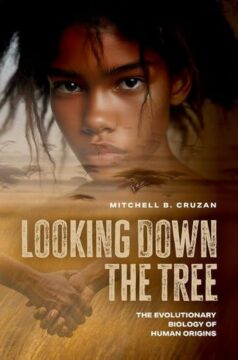 Looking Down the Tree, The Evolutionary Biology of Human Origins, Mitchell B. Cruzan, Oxford University Press, 2025
This book has an ambitious and praiseworthy agenda, to discuss a wide range of specifically human characteristics, in the context of the selection pressures operating on our ancestors once the forests of East Africa were replaced by savanna. The more open terrain favoured bipedalism, and bipedalism led on to a cascade of further changes. These, we are told, included loss of fur, bulbous breasts, female orgasm, monogamy, large penis size, cooperation, and exclusive homosexuality. Anatomical side-effects of bipedalism gave us hands capable of fine movements, which in turn favoured the development of large brains, and hence prolonged infancy and the development of cooperative social structures. This evolution took place under circumstances very different from those under which almost all of us live today, and we need to understand the constraints imposed by our evolutionary pathway if we are to understand ourselves as we are now. The book is well produced, and fully illustrated with drawings and diagrams.
The approach is laudably multidisciplinary. As the author puts it, his aim is
“To facilitate an understanding of the origin of human traits, I draw upon evidence and inferences from fossils, genomics, phylogenetics, coalescence theory, analyses of calcium isotopes, and the anatomy and physiology of our ancestors and other animals.”
Cruzan follows the account of humans having emerged in East Africa, with more than one out-of-Africa migration, but anatomically modern humans outside Africa having most of their genetic material from a group that left there around 70,000 years ago. As a narrative device, he follows a fictional woman (Launua) from childhood to her eventual death, pointing out the specific challenges she is presented with, and the evolved abilities with which she overcomes them. Much of the argument is controversial, but this is not necessarily a bad thing, and the style makes the material accessible to a wide audience. I would warn the reader, however, that there are questions about his heavy use of selection at the clan level, and the assumption that the individual clans would have been highly inbred. There is some evidence that by 34,000 years ago, admittedly halfway between the time under discussion in the present, anatomically modern humans had formed networks that avoided inbreeding. More details (paywall) here.
There are, unfortunately, drawbacks. There seems to be uncertainty about the target audience; is he writing for readers with some background in biology, or for a more general audience? This is apparent in the writing itself, and at times in the level of background knowledge assumed. For example, calcium isotope evidence is mentioned as evidence of prolonged nursing, but instead of an explanation of how this interesting effect arises, we are referred to a journal article that the general reader will find incomprehensible.
There are also some specific shortcomings, mainly in the introductory sections, which I discuss at the end of this review.
The book’s main argument begins with an explanation of mutation, especially in the functionless part of the genome, as a molecular clock. The ensuing discussion of molecular phylogenies very usefully emphasises that surviving species all have their tips on the same level, showing them at the same distance from their common ancestor, although extinct species are not. This pre-empts the common error of thinking that we are in some sense more evolved than other contemporary apes.
This brings us to the central narrative, the way in which change in one feature paves the way for change in others. Thus the loss of a tail in apes is plausibly explained as a consequence of larger body mass. (In the spirit of the book, I would have liked to see mention of apes’ ability to raise their arms above their heads, enabling hand-grasping as a replacement.)
A crucial development is bipedalism, related to the replacement of forest by more open savanna. Forward movement of the big toe in humans, compared with other apes, facilitates walking and then running. Some of the genes involved in the development of the foot also affect the hand, so that this change causesd the thumb to move forward as well. An opposable thumb then allows for finely adjustable movements, setting the stage for improved toolmaking, and hence for selection for intelligence.
An erect posture would reduce exposure to the sun, and avoid the hottest layer of air, closest to the ground. Thermoregulation will become important moving out of the forest onto the open ground, and the replacement of fur with our very fine body hairs enables us to sweat. Cooling depends on water’s high latent heat (not specific heat!) of evaporation, and thin skin then allows blood to flow to the cooled body surface. Thermoregulation also enables prolonged physical activity, making it possible to hunt down game.
We are given a good explanation of inclusive fitness, which is central to the overall argument. Fitness here is simply the ability to transmit one’s genetic material, and this is accomplished, not only by having offspring, but by improving the survival chances of relatives, who share some of their genetic material with you. Thus where there is inbreeding, selection will favour altruistic behaviour and clans who show this trait. Genome analysis shows that between 800,000 and 1 million years ago, our ancestral population went through a narrow bottleneck, as a result of severe drought connected with glaciation, being reduced at one stage to not many more than a thousand individuals. This the book advances as an explanation of behaviours favouring group survival, including, as discussed below, homosexuality. Contrast modern urban conditions, where the person you help is unlikely to be a close relative, reducing the genetic advantages of altruism.
However, I suspect that here and throughout, the author attaches too much importance to genetic determinism. There is a large literature on the evolution of altruism in humans, and we must also consider, for example, how game theory shows the advantages of provisional reciprocal altruism, even in the absence of genetic overlap.
The book also gives an interesting discussion of menopause. This may just be a byproduct of longevity, which now is presumably much more common than under evolutionary conditions. Humans ovulate monthly, which is quite often, and so will run out of eggs.1Is this true, under evolutionary conditions, when women would presumably have spent much of their fertile years being pregnant?] Nonetheless, postmenopausal women would from the outset have been increasing their own and the clan’s fitness through their work, and transmitted experience.
His appeal to inherited evolutionary constraints seems to me most questionable when he applies it to the details of human sexual behaviour. He explains homosexuality in terms of maximising total fitness by caring for relatives in inbred clans, describes the incidence of identifying as lesbian or gay as “between 3 and 16%, and this is very consistent for populations around the world,” and also applies this explanation to transitioning. I would not describe a fivefold variation as “very consistent,” would point out that transitioning as we see it in the 21st-century involves procedures that have only recently become available, and would suggest that each individual’s sexual behaviour is strongly influenced both by cultural norms, and by accidents of upbringing. However, this is a difficult area, and the author’s appeal for inclusion and acceptance need not rest on such arguments.
(While I was writing this review, a study (details here) appeared, showing fitness advantages to homosexual behaviour in a wide variety of primate species, especially under stressful conditions, but as a stage towards dominance or alliance-forming, and eventual access to more females. Another recent article says that human homosexuality has a complex polygenic architecture, which to my mind makes the author’s argument less paradoxical than I had first thought.)
To sum up, big brains and prolonged infancy mean that children require more care, which increases the contribution of cooperation to fitness and
“Consequently, monogamy, corporation, and the inclusion of homosexual individuals as helpers were favored to ensure the survival of the young and the entire clan.”
The author is not happy with the conventional explanation of the large size of breasts in women as driven by sexual preference, because there is no uniform push towards maximum size, and detailed preferences vary between individual males (and I would add, seem to depend on culture and even fashion; this might be an interesting research topic). The breast is also badly engineered, in that it gets in the way of the child’s breathing. Moreover, breasts, being fatty tissue, are energetically expensive. This, for Cruzan, is the whole point. He regards the fat layer in the female breast, and also in the female buttocks, as a mother-specific energy storage, insuring her against running out of available nutrition while giving suck. So once again, we have an indirect effect of large heads, continuing brain growth after birth, and hence a long period of dependency.
Next we learn about the importance of sexual selection, the role of female preferences, and the resultant development of display among males of many species. The female commits more resources, and more time, to the consequences of successful impregnation, so there is pressure on her to select only partners of high total selective fitness. But among humans the same applies to males, who also invest heavily in their offspring. This indirectly brings us back to breasts and buttocks. The large paternal investment in human offspring would push towards being attracted to partners with good breeding and parenting potential.
Why do men have such long penises when erect? Obviously, to deposit sperm near the cervix. So we should rethink the question; why do women have such long vaginas? Again, Cruzan attributes this to the mechanics of carrying a large-headed child to birth. The human penis is also unusually thick, compared with other great apes, and sperm production more generous than in gorillas, suggesting that not too far back in our evolutionary history females would couple with multiple males, leading to sperm competition and selection for the ability to remove a rival’s sperm. (This seems to run counter to the argument that our evolution favoured monogamy.)
There is some discussion of the difference between women, who ovulate monthly, but do not signal special times of sexual preparedness, and chimpanzees, where the females can come into heat at any time, and, when they do so, display pink genital swelling, advertising their availability. I was surprised that Cruzan does not mention one obvious reason for women not clearly signalling their time of maximum fertility. We are smart enough to have worked out that sex causes pregnancies, want sex a lot more often than we want babies, so that during our evolution effective “safe period” signaling would have depressed the birthrate, much as contraception is doing now.
Male nipples echo the construction of the female nipple, but have no function and are presumably a byproduct of development. However, the clitoris is an elaborate organ, with an even higher density of nerve endings than the penis, and expanding when aroused. In bonobos, the clitoris is exposed, and clitoral stimulation is an important part of female-to-female social interaction. In humans, when all goes well, it has great importance in cementing pair bonding and the stable monogamous relationships favoured in a species with large heads and long childhoods.
Among the anatomically modern humans emerging from Africa, we have a second bottleneck of 1000 individuals some 70,000 years ago. Hence the much greater genome variability in African populations, among whom further subgroups can be identified. This dispersal however did lead to contact and interbreeding with other kinds of human, such as Denisovan and Neanderthal. The dispersal was complete only within the last 3,000 years, with long-distance seagoing and the populating of the Polynesian islands and Madagascar. Interbreeding with Neanderthals would have speeded the development of light skins, more advantageous at high latitudes. European “pale skin, freckles, light-coloured hair, large bushy beards, and generally more body hair” have Neanderthal origin. (I would mention here interbreeding with Denisovans, conferring adaptations for life of the high Tibetan Plateau.)
We are given an account of contact, with some interchange of people, between Launua’s tribe, migrating out of north-east Africa because of deteriorating conditions, and what the reader will recognise as Neanderthals, pale skinned, who show them how to find shellfish, and give them jewellery made from the shells. Sounds idyllic but not entirely convincing.
Next comes a recap of what we know about the evolution of different varieties of human, and then explanation of how successive dilutions have left the anatomically modern humans that migrated out of Africa with around 3% Neanderthal DNA.
What happened to all the different species of human? We don’t know, but they would most probably have simply been outnumbered and assimilated. (Neanderthals, having developed in Eurasia, will have been under the greatest pressure during glacial maxima.) The diminutive hominins of Flores in Indonesia may be an example of island dwarfism.
In the final chapter, the tribe has found a good home in a river valley, and (probably telescoping history, but no matter) learned how to make food from pulverised seeds, Launua has noticed that where seeds have been spilled new plants will grow, and others follow her example.
We conclude with a well-diagrammed summary of the main argument, linking the open, hot, dry, and dusty conditions of the Savannah to bipedalism, sweating, thin skin, and loss of body hair. Bipedalism indirectly, by way of opposable thumbs, leads to manual dexterity, enabling toolmaking, while cooked food makes powerful jaw muscles unnecessary. So we have the conditions for increased brain size, which in turn leads on to prolonged infancy and cooperative social structure as well as to anatomical changes. There is a brief acknowledgement that the flipside of ingroup altruism is outgroup xenophobia, and speculation about future developments, as modern medicine enables people to survive and reproduce despite genetic disadvantages. Evolution will have done little to prepare us for a healthy old age, because during our evolution we rarely lived beyond 40.
The specific shortcomings that I noticed do not affect the book’s main argument, but having had the temerity to review I think I should point them out. I did not like the introductory discussion of what he refers to as “the scientific method,” with a link to the Oxford Dictionary. It is quite wrong to draw any inferences about how the world is, or how we should set about understanding it, by appeal to definitions. A better expression might be “the scientific attitude,” or “the nature of science,” the latter being a term actually used by educators in connection with exploration-based, rather than fact-based, curricula.
The author cites 20th-century flood geology as a theory that fails because it does not give any new useful insight into the data. This misses the point. As a scientific theory, it is blatantly absurd, invoking completely implausible processes and neglecting (literally) mountains of evidence. However, the overriding motivation has nothing to do with science, although the claim to be scientific is invoked as a way of making Young Earth creationism seem intellectually respectable. Any discussion of flood geology should also have mentioned the foundational text for the late 20th century revival of such creationism, Whitcomb and Morris’ The Genesis Flood, which by 2011 had sold over 300,000 copies, and given rise to Creation Ministries International, the Institute for Creation Research, and Answers in Genesis, owners of the Kentucky Creation Museum and Ark Encounter. This matters, given the enormous influence of creationism in Trump’s America, and its close connections in the US with Culture Wars and Christian Nationalist politics.
He tells us that “Darwin’s use of the term ‘evolution’ instead of the popular ‘transmutation’ of the day was a well-considered choice.” Wrong. Darwin made no such choice. He used the word “transmutation,” just once, in the first edition of Origin, but did not use the word “evolution” although there is a dramatic use of “evolved” at the close. He also used “transmutation” but not “evolution” in his 1837 Notebook B, where he first records his ideas of species change. He did use “evolution” repeatedly in later editions of Origin, in The Descent of Man (1871), and in his Autobiography, but the term had by then been popularised by others.
In this context, I am glad to see Chambers mentioned, as relevant to what ideas were in the air, but I’m surprised by the absence of any reference to Wallace.
Finally, one surprising misattribution. Citing a third-party, the author includes Stephen J Gould among those who regarded the clitoris as vestigial. On the contrary, Gould gives full credit to its importance, describing it as “the same organ” as the penis, from which it is differentiated during development, and comments scathingly on those who downplay its significance.
However, these matters are peripheral to the main argument of the book, and will, I hope, be remedied in a later edition.
***
Enjoying the content on 3QD? Help keep us going by donating now.
Footnotes
- 1Is this true, under evolutionary conditions, when women would presumably have spent much of their fertile years being pregnant?] ↩︎