by Brooks Riley
Enjoying the content on 3QD? Help keep us going by donating now.

by Ashutosh Jogalekar
 There has long been a temptation in science to imagine one system that can explain everything. For a while, that dream belonged to physics, whose practitioners, armed with a handful of equations, could describe the orbits of planets and the spin of electrons. In recent years, the torch has been seized by artificial intelligence. With enough data, we are told, the machine will learn the world. If this sounds like a passing of the crown, it has also become, in a curious way, a rivalry. Like the cinematic conflict between vampires and werewolves in the Underworld franchise, AI and physics have been cast as two immortal powers fighting for dominion over knowledge. AI enthusiasts claim that the laws of nature will simply fall out of sufficiently large data sets. Physicists counter that data without principle is merely glorified curve-fitting.
A recent experiment brought this tension into sharp relief. Researchers trained an AI model on the motions of the planets and found that it could predict their positions with exquisite precision. Yet when they looked inside the model, it had discovered no sign of Newton’s law of gravitation — no trace of the famous inverse-square relation that binds the solar system together. The machine had mastered the music of the spheres but not the score. It had memorized the universe, not understood it.
This distinction between reproducing a pattern and understanding its cause may sound philosophical, but it has real consequences. Nowhere is that clearer than in the difficult art of discovering new drugs.
Every effective drug is, at heart, a tiny piece of molecular architecture. Most are small organic molecules that perform their work by binding to a protein in the body, often one that is overactive or misshapen in disease. The drug’s role is to fit into a cavity in that protein, like a key slipping into a lock, and alter its function.
Finding such a key, however, is far from easy. A drug must not only fit snugly in its target but must also reach it, survive long enough to act, and leave the body without causing harm. These competing demands make drug discovery one of the most intricate intellectual endeavors humans have attempted. For centuries, we relied on accident and observation. Willow bark yielded aspirin; cinchona bark gave us quinine. Then, as chemistry, molecular biology, and computing matured in the latter half of the twentieth century, the process became more deliberate. Once we could see the structure of a protein – thanks to x-ray crystallography – we could begin to design molecules that might bind to it. Read more »
by David Greer
 The smallest spider I’ve ever seen is slowly descending from the little metal lampshade above my computer. She’s so tiny, a millimeter wide at most, I have to look twice to make sure she isn’t just a speck of dust. The only reason I can be certain that she’s not is that she’s dropping straight down instead of floating at random.
It’s become almost automatic to reach for the iPhone to obtain a visual record of a wildlife encounter out of the ordinary, and so I do. However, the spider’s size and the fact that she’s now spinning like a miniature dervish presents a challenge beyond my iPhone’s capabilities. You’ll just have to take my word for it that that’s her in the image to the right, the tiny golden blob to the left of the lamp stem.
Perhaps I shouldn’t make assumptions about the spider’s gender, but her size makes verification problematical. Ever since I fell in love with Charlotte’s Web I’ve been inclined to think of spiders as feminine in the absence of evidence to the contrary. I would no more call her an “it” than I would a human, and she doesn’t strike me as a probable “they.” So “she” it will have to be.
Having observed many swarms of aimlessly scrambling baby spiders fresh out of their communal egg sacs, I know that in the not distant future she’ll be many times her current size. And however small she may be today, a few clicks worth of research confirms that she’s a giant compared to some of her cousins. A full-grown Patu digua, quite possibly the smallest spider species on the planet, maxes out at around 0.37 millimeters, about four times the width of an average human hair (75 micrometers).
Accurately determining the size of the tiniest creatures on the planet can be a challenge using standard units of measurement. Read more »
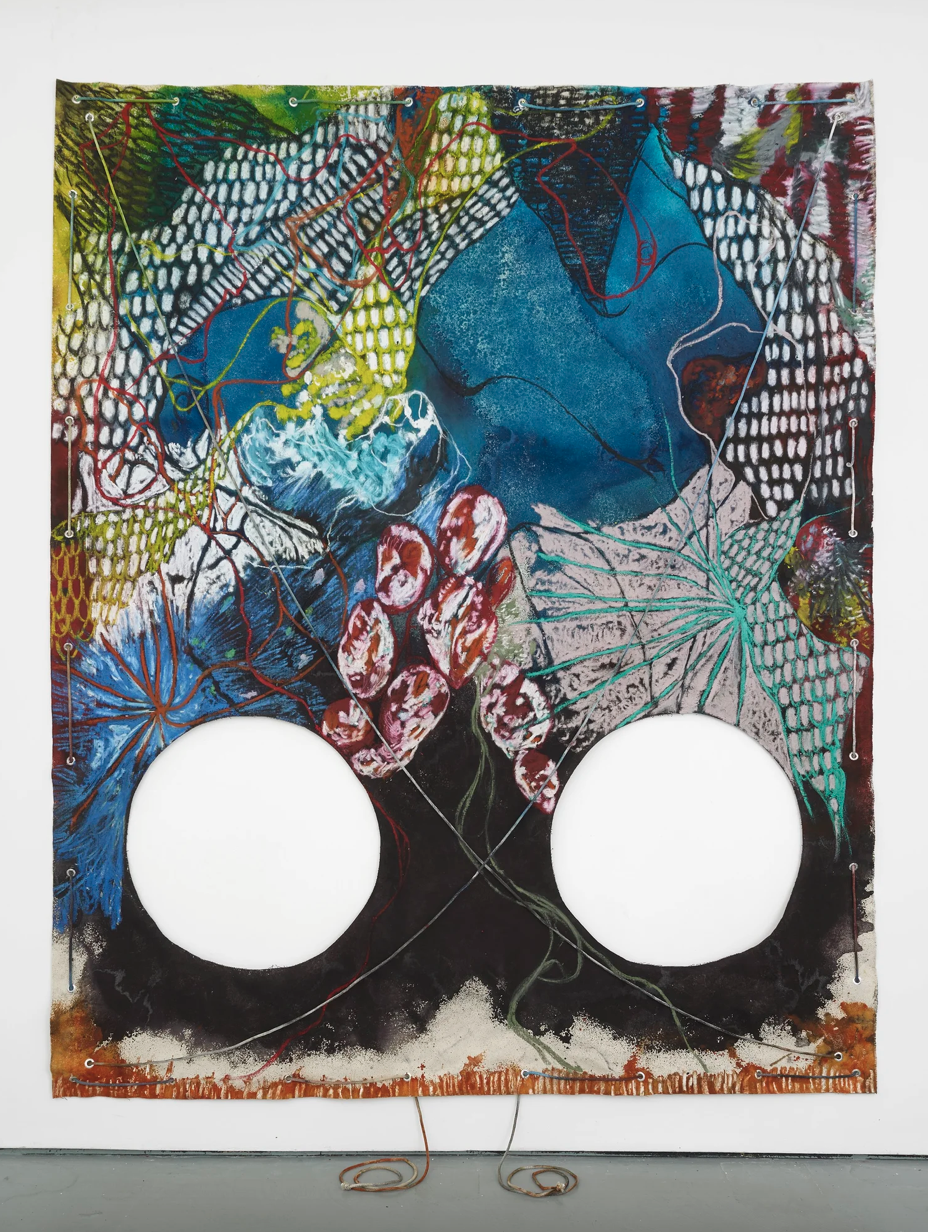 Naotaka Hiro. Untitled (Tide), 2024.
Canvas, fabric dye, oil pastel, rope, and grommets.
“… Several of the paintings feature something strange: two perfectly round openings in the surface of the work. The Japanese-born, Pasadena-based artist uses these holes to practice a highly intimate kind of artmaking. Collapsing the traditional, arms-length distance between the artwork and the artist, he slips his limbs into these openings to hold the surface close. He often wraps himself in unstretched canvas, creating a cocoon he paints from within (“Untitled (Green Door)”2021, “Untitled (Vector)” 2021). At other times, he lies on his back on the studio floor, his legs poking through a plywood panel so it hovers above him (“Untitled (Frequency)” 2021). He presses parts of his body against the surface as he works, and the strokes and shapes of his paintings and drawings are often the length of a hand, a forearm, or a torso. Each piece is a record of the artist’s position, movements, and sensations during artmaking, from aches and temperature shifts to the rise and fall of his chest with each passing breath. ” From Naotaka Hiro’s Pulp Fiction, UCLA School of the Arts and Architecture.
Enjoying the content on 3QD? Help keep us going by donating now.
by Sherman J. Clark
 In a previous essay, Beatrice 2.0, I argued that a love of beauty can guide our desires and help us flourish amid distraction and commodification. But what hinders us from letting beauty lead us in those ways? Beauty abounds—if we can see it. Not only in art, but in sports and music, in craftsmanship and science, in mathematics and everyday life. The trouble is not scarcity—or not merely scarcity—but our own habits of mind.
What hides beauty
We may be able to develop the capacity to see and cherish beauty. But that may first require us to confront a set of obstacles—internal obstacles, patterns of thought and feeling that make it hard to direct our desires where they would most nourish us. Some are what contemporary philosophers call intellectual vices—things that cloud our thinking. Some mirror what older traditions call sins or moral vices: habits of thought and action that mark us for judgment. We can think of these as barriers to flourishing, vices in the eudaimonist rather than moral sense. These are attitudes that keep us from attending to beauty. If we want a label for this sort of inquiry, it would be “neo-Aristotelian eudaimonist virtue ethics.” But elaborate philosophical labels won’t make us happy or guard us against exploitation and commodification. Beauty, however, might—if we can let it.
To that end, we can tentatively identify four internal obstacles—vices, if you will—that can prevent us from nurturing a love of beauty and letting that love help us thrive: impatience, laziness, arrogance, and, more obscure-sounding but perhaps most destructive of beauty, what Aristotle called micropsychia, which we can translate as smallness of soul.
Our impatience is profitable to those who want to keep us grasping at the next thing they can sell us; but it can prevent us from attending to what might matter most. The first few moments of a Bach fugue are lovely, but the transcendent order emerges when we hear it through, and then again, and begin to catch the patterns. Shakespeare’s language can seem strange and off-putting at first, but rereading can reward us with nearly shocking depth and beauty—if our impatience and lack of attention didn’t prevent us from making that effort.
Good and beautiful things often take not just time but also effort. Read more »
by Lei Wang

If not for COVID, I would have moved back to China after my MFA instead of staying in Iowa City. Instead of not seeing him for three years, I would have married my fiancé at the time, an Italian kung fu master in Shanghai who had the peculiar fate of teaching Chinese people their own lost esoteric spiritual practices. I would have then moved with him to an island off the coast of Portugal, where he now lives and teaches at a martial arts retreat center.
But because things happened the way they did, I am not on an island off the coast of Portugal, enjoying the best temperate weather in the world. I am not writing overlooking the Atlantic Ocean and considering the travails of America from the vantage of Europe. I am not married.
I am here, but also if I were there, I would still always be here, wherever I am. And then perhaps I would be dreaming of Iowa, of living five- to ten- minute walks from my friends, all artists of some sort, all expert cuddlers. Perhaps I would be bored and lonely in Portugal; there is only so much good weather one can take.
In a recent newsletter, the writer Suleika Jaouad writes of a What If thought experiment game she plays with a friend that imagines into the other lives they could have lived:
It usually starts when one of us says something like, Remember that guy who wore a lot of vests? and suddenly we’re spiraling: What if I married him and lived in a yurt in Montana, labeling mason jars of lentils in flowery live-laugh-love cursive? What if I had gotten that soulless business consulting job in Dubai and wore pantsuits the exact shade of despair and office lighting? What if I stayed in Vermont instead of moving back to New York City and became a homesteading influencer who films sourdough tutorials with my roommate, a potbelly pig named Meredith? What if I had five children and a timeshare in Sarasota and a minivan full of crushed graham crackers?
What if I hadn’t for some mysterious reason gone down a notoriously financially unrewarding delayed-returns path of writing and instead been a corporate consultant like many other achiever-type humanities majors? On the one hand: oof. On the other: who knows? What if I had simultaneously pursued writing with a career in therapy or even interior decorating? What if I had studied neuroscience and now had my dream alter-ego job, teaching empathy to robots (which sounded far-off a mere few years ago)? Who would I be? Read more »
Cast your bread on the waters:
for you shall find it after many days.
…………………………… —Ecclesiastes
Oh, the young don’t keep
and the old just go,
and the keeper of the sheep
casts a long, long shadow,
and your song won’t come
where your life won’t go,
so throw your bread on the water,
and beat your feet to the chimes,
and if you have a daughter.
and count your change to the dime.
and if you open up the borders
you’ll let it all fall in behind
Every book just speaks.
and every light just shines,
and every touch just feels,
and every look just finds,
and everywhere just is,
and every road’s a line
—when every deed is done
and you might be feeling so low
like a dream is over,
as if it didn’t grow
but still, the soil is good
and with what we know,
Throw your bread on the water
and beat your feet to the chimes
and if you have a daughter
and count your change to the dime,
and if you open up the borders
it’ll all fall in behind it’ll
fall in behind
poem/song by Jim Culleny, 1970
 1972, Jim Culleny
and Starship Productions
(at link, scroll to bottom)
Enjoying the content on 3QD? Help keep us going by donating now.
by Peter Topolewski
 Isn’t it time we talk about you?
You.
A collection in the realm of 4.5 x 10^27 atoms. A portion of your hydrogen and helium atoms originated in the Big Bang, 14 billion years ago. The heavier elements in you, the stuff of life, the carbon and nitrogen, they came from stars. From exploding stars, in fact. The dying blasts of stars in distant galaxies accounted for perhaps a smallish measure of your atoms. Most came from stars exploding in the Milky Way, and above all from a single super nova that preceded the existence of our own star, the Sun. Like all the others, it was a super nova without a name, one we’ll never know, but one we should be especially grateful for. It was amazing wasn’t it, generous, as Thomas Berry would say, giving itself away without asking?
It gave me you.
Extraordinary, those 4.5 trillion quadrillion atoms in you, from across the cosmos, they’re mostly empty space. Take away the space, and all of them together would be no larger than a single biological cell. As far as those atoms have traveled, as large as the universe has grown, there is, as Duane Elgin wrote, more smallness in you than there is bigness beyond you. On our cosmic scale, you are a giant.
In a photo I’m blessed to have, you’re five or six years old, standing near a farmhouse. Anyone who looked at it would say you’re little, but really you’re a giant. Who are you in that photo?
I could believe I came about randomly, through trial and error, but not you.
You are the atoms in that photo, but much more.
In another picture, you are in your twenties, alone on a chair in a living room, pensive and beautiful. All the atoms you contained when you were six and seven and eight years old, they’re gone, given over to the environment, replaced with others wholly new to you. In that frozen moment, your eyes are on a place only you can see, your mind on thoughts, hopes, concerns I cannot reach.
Who were you?
If you can be composed of other atoms and still be, you can be any atoms, can’t you? And if you can be any, can’t you be all?
Who are you?
You are atoms and more. Read more »
by Dilip D’Souza
The autumn equinox – well, autumn in the northern hemisphere – came and went a few weeks ago. I spent it, as I mentioned in my last column here, at the Hanle Dark Sky Reserve (HDSR) in north India. Four nights with some 40 other amateur astronomers, in the open at 14,000 feet, temperatures hovering just below freezing, photographing the splendid night sky.
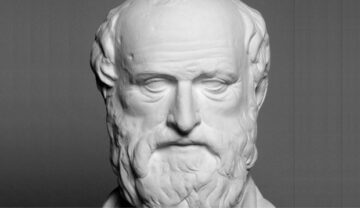
But on that equinox in particular, I was a fascinated spectator as a young PhD student in Physics from the Indian Institute of Science Education and Research (IISER), Pune, Sourabh, channeled his inner Eratosthenes. Maybe mine too.
That’s Eratosthenes the ancient Greek mathematician. But he was many other things too – a historian, an astronomer, a librarian, a musician and, perhaps most relevant to Sourabh on equinox day in Hanle, a geographer. To read about him is to think, this was a Renaissance Man before we knew the term. And at our homestay in Hanle, Sourabh set out to replicate this ancient Renaissance Man’s most famous experiment.
Which is … well, let’s see how Sourabh went about it.
September 22, the equinox: a bright, sunny day in Hanle. Shirtsleeve temperatures by mid-morning even though it had been near zero at night. Cloudless brilliant blue sky augurs well for more stargazing tonight, our last night here. But right now the sun dazzles, casting sharp shadows.
In one corner of the homestay’s yard is a pole stuck in the ground, about 3 feet tall. When we walk over, it is actually a length of grey PVC pipe and it isn’t clear why it stands here. Unless … maybe it’s meant for Eratosthenes-style experiments? It certainly fits the bill. It casts a shadow and it makes a near-right angle with the ground. In fact, the ground right around it is a small expanse of flat concrete, which will shortly prove its convenience. Read more »
by Carol A Westbrook
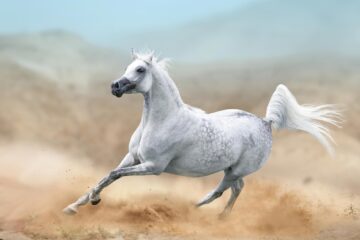
This is the story of a DNA mutation that profoundly changed the course of human history, and had a major impact on human activities, altering communication, transportation, agriculture, and warfare. This story is about the horse, and how came to be a domesticated, rideable animal due to this DNA mutation. This genetic change in the horse occurred unexpectedly late, about 4500 years ago, which is almost 5000 years later than the domestication of pigs, cattle, goats and sheep.
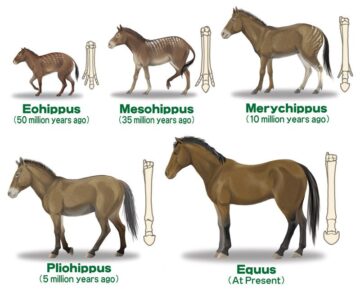
The earliest ancestors of horses, known as Eohippus, first appeared in North America about 55 million years ago, where they evolved into Equus, the modern horse ,by the time of the Pleistocene epoch. They spread from North America to Asia and Europe by crossing the Bering land bridge at a time when the oceans were much lower than they are today, that is during the last ice age. As Eohippus evolved into the horse as we know it today, it continued to be an important source of meat for the humans, and was hunted throughout the Pleistocene epoch (ice age).
The North American horse went extinct at the end of the Pleistocene epoch, about 10,000 years ago, along with most of North America’s large mammals. This period of extinction is known as the Pleistocene megafauna extinction event, and resulted in the loss of mammoths, mastodons saber-toothed cats, dire wolves, giant ground sloths and giant beavers. The cause of the extinction included climate change—the earth warmed up—over-hunting, change in flora resulting from climate change and the appearance of bison which competed directly with horses for food.
The horse disappeared from North America, but survived in Europe and Asia, particularly the Eurasian Steppes. Read more »
by Thomas Fernandes
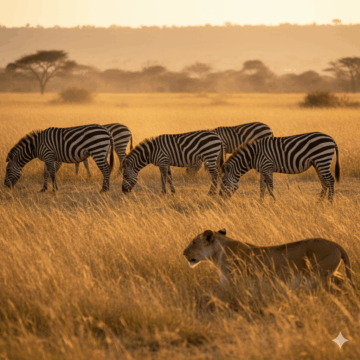 To be alive is to maintain a coherent structure in a variable environment. Entropy favors the dispersal of energy, like heat diffusing into the surroundings. Cells, like fridges, resist this drift only by expending energy. At the base of the food chain, energy is harvested from the sun; at the next layer, it is consumed and transferred, and so begins the game of predation. Yet predation need not always be aggressive or zero-sum. Mutualistic interactions abound. Species collaborate when it conserves energy. For example, whistling-thorn trees in Kenya trade food and shelter to ants for protection. Ants patrol the tree, fending off herbivores from insects to elephants. When an organism cannot provide a resource or service without risking its own survival, opportunities for cooperative exchange are limited. Beyond the cooperative, predation emerges in its more familiar, competitive form. At every level, the imperative is the same: accumulate enough energy to maintain and reproduce. How this energy is obtained, conserved, or defended produces the rich diversity of strategies observed in nature.
On the savanna after rain, the sequence of consumption illustrates this principle. Zebras arrive first, grazing vast quantities of coarse grass. Their hindgut fermentation extracts energy efficiently but incompletely, favoring volume over quality. Sixteen hours of grazing may be required to meet their energy needs. Gazelles arrive afterward, targeting smaller, more nutrient-rich shoots. Their rumen, a multi-chambered stomach, allows for regurgitation and thorough microbial digestion. The slower, more meticulous process extracts more energy per bite. Reproduction and survival hinge on the energy accumulated this way. Gestation and nursing occur only during seasons of peak grass growth and only when the gazelle has the metabolic green light of sufficient energy.
This extracted energy inevitably attracts predators. Predator-prey interactions extend far beyond the immediate chase. While roaming for prey, predators exhibit preferential roaming, patrolling region most likely to contain their favored prey and encountering them far above chance level. Even when encountering prey, predators decide to initiate the hunt with calculated strategies. Lions exploit cover, coordinating in groups to ambush large prey like buffalo. Cheetahs, mostly solitary, approach carefully to close the distance before committing to a sprint. Predators weigh energy costs, prey size, terrain, and detection before deciding to pursue. Selecting targets with high probabilities of success is critical.
Prey respond with equally finely tuned adaptations. Gazelles detect predators early through lateral eyes, motion-sensitive retinas, and vigilance. Zebras would stand their ground against a solitary, small cheetah but have evolved rotating ears to detect the more threatening, camouflaged lions’ ambush. Early detection and avoidance are ideal, but when impossible, prey rely on alternative strategies. Read more »
by David J. Lobina
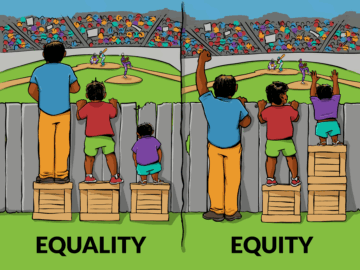
So yet another controversial topic from me, and thus another go at getting cancelled. A long series of pieces on the use and abuse of the term fascism by American commentators (here, here, and here), a dismissal of a dismal “academic” book on inclusion in linguistics (here), and an argument that universality trumps diversity in most respects (here) haven’t done the job, so perhaps a put-down of the current fad on all things equity will finally get me walking.
But isn’t equity an economic thing, a concern of business people, with little to do with equality per se? If anything, equity-qua-stocks would be related to inequality… That was the very reaction of a friend of mine, Italian and philosopher as he happens to be, when I told him I was writing about equality and equity. And no surprises there, for equity is not a common concept in political philosophy, where equality has been most discussed. In fact, the focus on equity is mostly a North American phenomenon, first originating within social justice movements and now very present in business circles too. And such is the soft power of the US (and this is stuff coming from the US) that this sort of social and political discourse can easily travel beyond those shores. But for my money it is really the fault of LinkedIn, that cesspool of naked self-promotion and half-baked ideas and advice.
Interestingly, the original version of the meme heading this post made a different point:
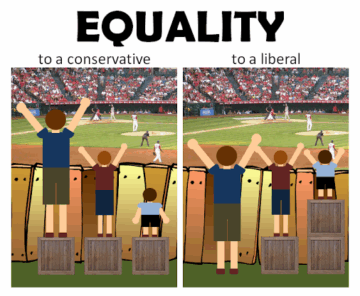
As the original graphic shows (see endnote 1 for more details), the aim was to differentiate between two different ideas of equality, at least from the perspective of what the terms conservative and liberal are taken to mean in North American political discourse (which, as I discussed here, doesn’t necessarily apply elsewhere, certainly not piecemeal). The intent behind the original graphic was not to contrast equality and equity, let alone was it a defence of equity over equality – the very opposite of what I shall argue for here, then. Read more »
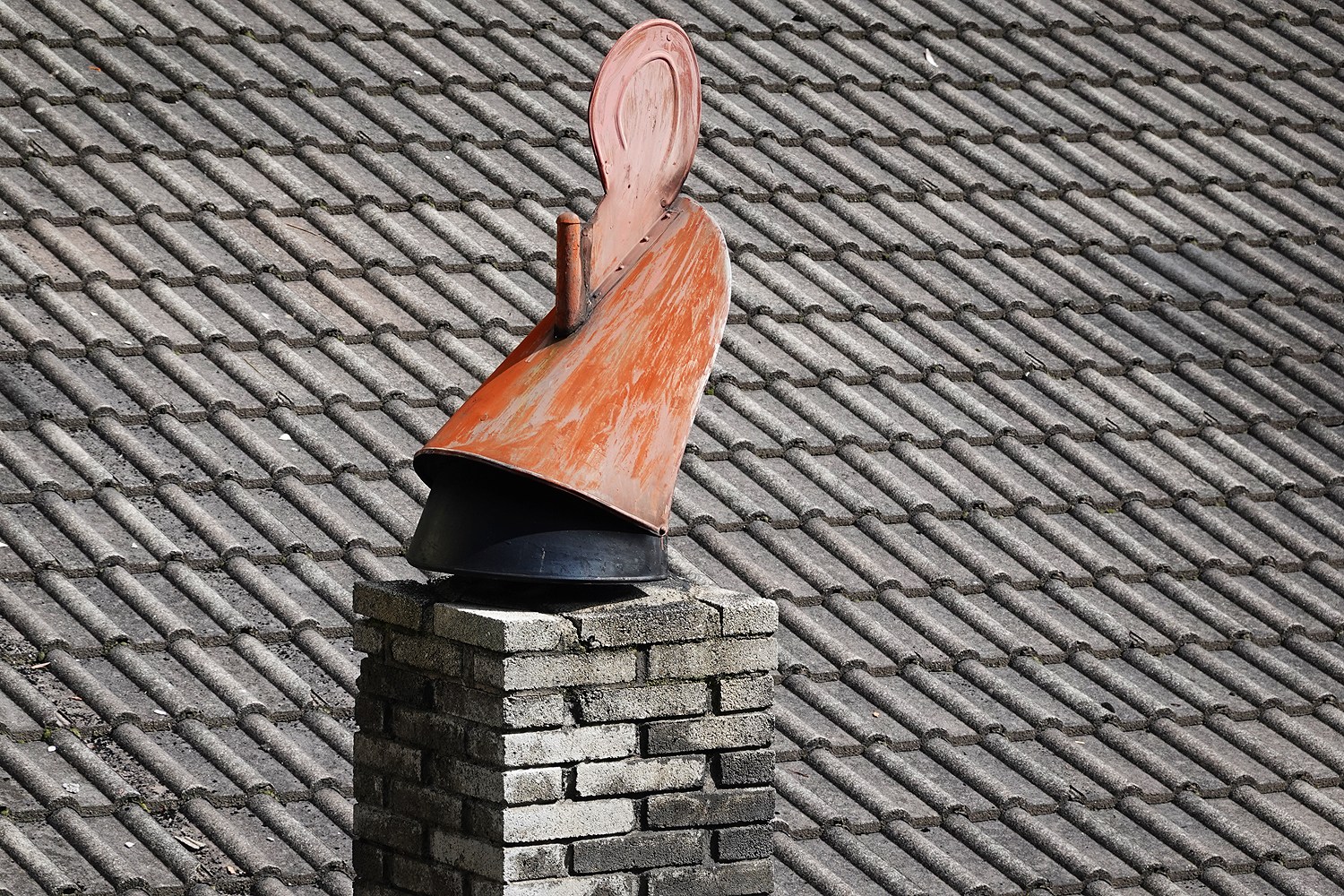
Wondering what this contraption on the roof of a neighbor’s house is, I showed this photo to GPT5 and here is what it said:
This is a chimney cowl — a device placed on top of a chimney to improve airflow and prevent downdrafts.
The specific type in your photo is a rotating, directional chimney cowl, sometimes called a “H-shaped” or “dragon” style cowl. The curious shape with the curved metal and the little vertical stub helps the wind create suction, drawing smoke up and out instead of letting it blow back into the house.
Besides preventing downdrafts, it also helps keep rain, birds, and debris from getting into the chimney.
This one seems to be an older, somewhat weathered model with a quirky design, which makes it look almost like a piece of abstract sculpture!
Enjoying the content on 3QD? Help keep us going by donating now.
by Mike Bendzela
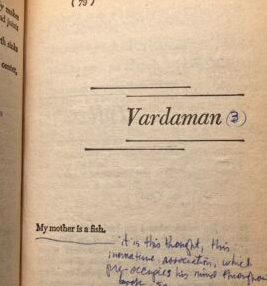
It sometimes wrenches my own credulity when I think about it: The sweeping and violent imaginings of a Southern fake war adventurer, college as well as high school drop-out, and binge-drinking, adulterous sometime-screenwriter, whose pissed-off wife once bonked him on the head with a croquet mallet, became encysted, like a wasp’s gall, in the head of a naive, Midwestern closet case as he was meandering through college for five years trying to find a major that suited him. While admittedly selective, this description is true, which I think is hilarious but which my partner, upon my reading it to him, thinks is “not very positive.” William Faulkner could never be accused of being positive, and that was his strength: He could stare down human malignity like no other, all the while maintaining a detached, unblinking vision that refused to look away. As one of his characters, Cash Bundren, says: “It’s like there was a fellow in every man that’s done a-past the sanity or insanity, that watches the sane and the insane doings of that man with the same horror and the same astonishment.”
I had to burrow my way through several sciences (geology, botany), arts (painting and drawing), performing listlessly in all of them, before finding myself in the early 1980s in a course called Early Twentieth-Century American Fiction, taught by a tall, passionate Black woman named Anna Robinson (about whom I can find nothing on the Internet), and thinking I should change my major to American Lit. She promptly shoved the novel As I Lay Dying under our noses. I bridled. What the hell is this? I fumed. Why do we get one character’s point of view on one page and another’s on the next? I seethed. Who are these people? Why do they talk so funny? Why do they think so funny? They do not even agree about what is going on. Over forty years later, I can still hear Professor Robinson quoting Addie Bundren’s line about her listless marriage from the middle of the novel — after she has died! — “And so I took Anse.” The time sequence is out of joint. Characters narrate scenes in which they are not present. What the hell, indeed. It was like hearing Thelonious Monk for the first time. Read more »
by Bill Murray
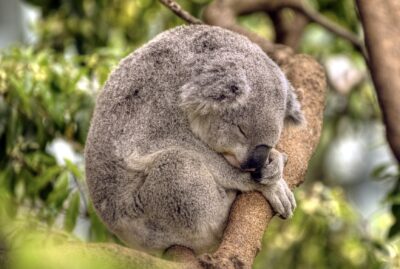
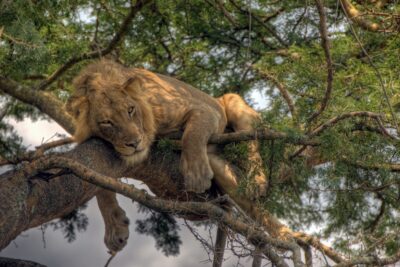 We humans think we’re so smart. But animals and plants, too, have far more wisdom and abilities than we give them credit for. This is the third in an occasional series of links to the remarkable world of non-human abilities. The first two are here and here.
Zebra finches pick singing coaches based on songs they hear as embryos. The songs that Australian zebra finches hear before they have hatched influence which birds they choose as singing instructors when growing up.
Hammerhead sharks close their gills, essentially holding their breath as they dive more than 2,600 feet from tropical surface waters into the ocean’s frigid depths multiple times every night to hunt for fish and squid.
 Giant Tarantulas keep tiny frogs as pets so that the frog can protect the spider’s eggs from insects and the spider can protect the frog from predators.
Bats remember favors and hold grudges; socially distance and go quiet when ill; and use vocal labels that reveal individual and kin identity. Male bats learn territorial songs in specific dialects from their fathers and, much like birds, sing these songs to defend territory and attract mates, which scientists characterize as culture.
Insects in general do not rely on steady flow of air but create controlled turbulence called a vortex at the top of their wings. By sweeping their wings at a sharp angle bees generate “horizontal mini-tornadoes” to carry them aloft.
Penguin huddles move and change shape during cold winds to minimize the heat loss each penguin experiences. Read more »
by Scott Samuelson
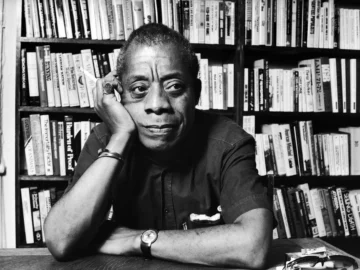
Though universities have traditionally been associated with educating students, I don’t think that it makes sense anymore. There’s too much at stake.
Education requires wonder, discipline, personal attention, liberal learning, standards, mentorship, transformation, reading. Let’s face it. These things don’t scale well, especially when it comes to generating the revenue universities need for their survival or economic growth. The jobs of not just professors, chairs, administrative assistants, provosts, and presidents are on the line—also deans, student life directors, recruitment officers, assessment coordinators, and usually associate and assistant versions of all those positions, among many others.
Maybe it was feasible for universities to aim for education when they received more public funding. But those days are over. Few people care about being an educated person, let alone about educating the populace at large. Plus, most people—even many in the university itself—don’t distinguish between being educated and being trained for a job.
But universities shouldn’t just focus on research and jettison teaching and learning altogether. The revenue stream of students is too vital.
Universities should attract students with what they really want: concerts, sporting events, gaming stations, food courts, swanky dorms, fewer requirements, and so on. (At the same time, it’s savvy to put fees on some of these goods to generate more revenue for the university.) But the university shouldn’t just be an expensive four-year resort experience. There needs to be a value-add that justifies public support and the increasing cost of tuition and room and board. The ostensible value of the university needs to involve credentialing students for successful entrance into the economy.
The beauty of a credential is twofold. First, money. Universities should drive home that a credential is a ticket to a well-paying job. Second, status. If disciplines like the arts and humanities have any value, it’s to equip students with moral and political vocabularies that socially elevate them above the uncredentialed. That way, even if by chance a plumber without a college diploma makes more money than a university graduate, the credentialed will have the consolation of looking down on the plumber. Read more »
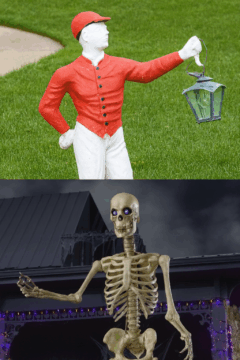 by Steve Szilagyi
You don’t need to be told that Halloween yard decorations have gotten tackier over the years. Complaining misses the point. Their jokey vulgarity is the point—as if America in 2025 were so buttoned-up that people need yet another occasion to act out their bad taste in public.
Front lawns have always been small stages where homeowners perform belonging. A generation ago, lawn jockeys did the job; now it’s perfect turf and pruned boxwoods, silent signals of order and disposable income. A good yard says: we’re respectable, we fit in.
So, what do the gravestones, twelve-foot skeletons, and dangling corpses say?
Holiday decorating is contagious. One house hangs Christmas lights, and by next year the whole block glitters. Studies even show that people who decorate for the holidays are seen as friendlier and more community-minded—more neighborly altogether.
David J. Skal writes about Halloween and its customs in his entertaining 2002 book; Death Makes a Holiday. There, he tells of a couple in Des Plaines, Illinois whose Halloween display grew to include a guillotine, a blood fountain, and forty life-size monsters, until traffic jams forced the city to shut it down. “We were just trying to do something fun for the neighborhood,” the wife said as she dismantled the blood fountain. Read more »
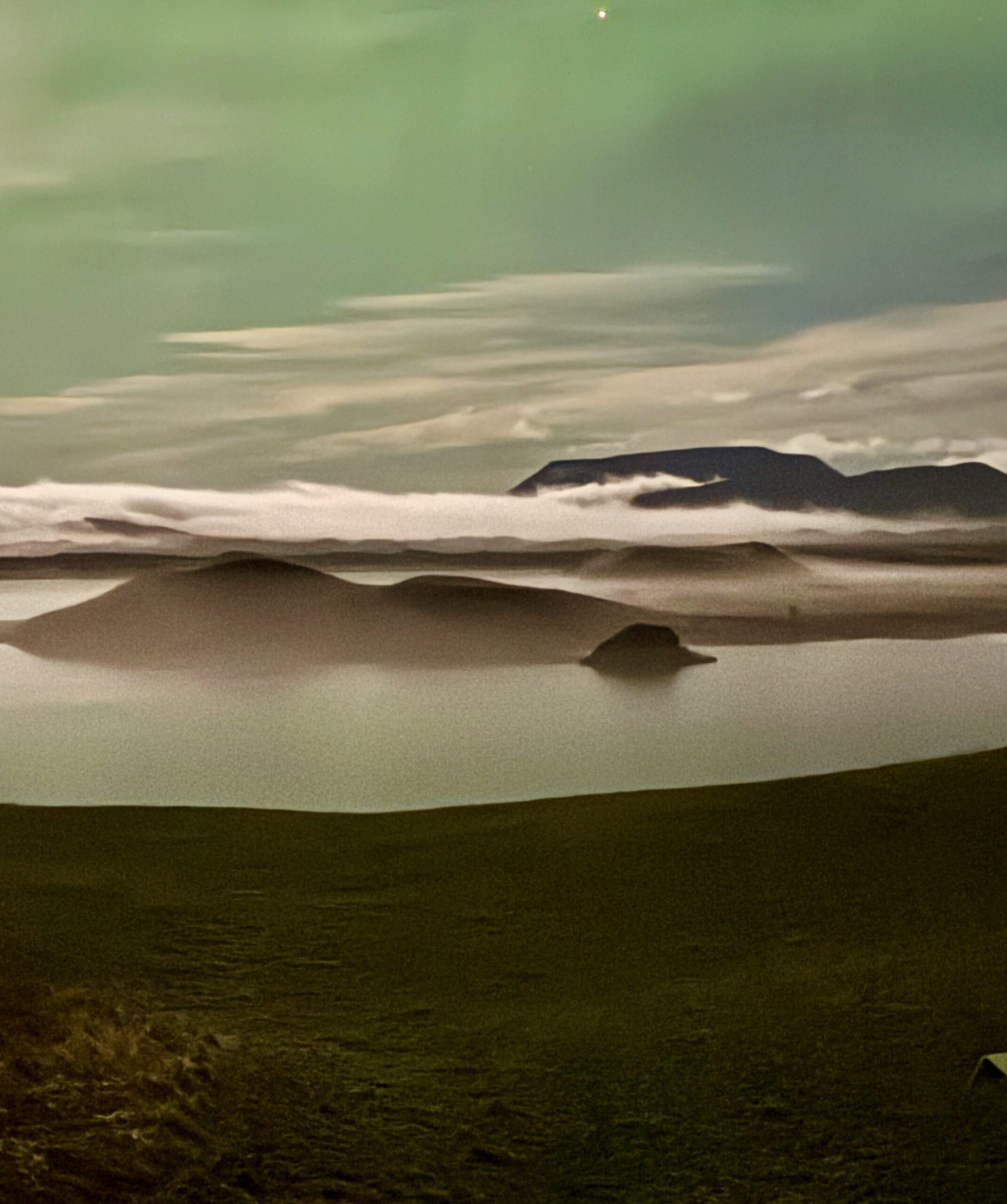 Jaffer Kolb. Lake Mývatn, October 13th, 12:08 am.
Digital photograph.
With permission.
Enjoying the content on 3QD? Help keep us going by donating now.
by Mark Harvey
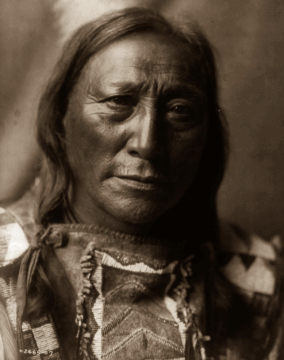
There was a time when the West was truly wild. I don’t mean the gun fights in saloons, the stampede of a thousand cattle, or stagecoach robberies on the high plains. But it wasn’t that long ago when every river from what is now Kansas to the Pacific Ocean ran its course without a dam or diversion, tens of millions of buffalo grazed on the rich grasslands, and beavers built thousands and thousands of ponds across the Rockies. It was but a blink of the eye since apex predators like Grizzly bears and Wolves ruled the land from north to south.
One man who witnessed a nearly virgin West was John K Townsend, the first trained naturalist to travel from St. Louis to what is today Oregon. In a book called Journey Across the Rocky Mountains to the Columbia River, Townsend shares images of a trip that began in 1834, not long after Louis and Clark first made their expedition. Even in bustling St. Louis, where Townsend was provisioning, there were foretokens of what was ahead in the untrammeled country he was to cross. He describes the sight of a hundred Saque Indians with shaved heads and painted in stripes of “fiery red and deep black, leaving only the scalping tuft, in which was interwoven a quantity of elk hair and eagle’s feathers.”
Just a month into the trip, Townsend encounters a trapper who tells the story of having his horse and rifle stolen by Otto Indians in the middle of winter while still far from any settlement. When Townsend asks the trapper how he survived without food on his journey home, the trapper says, “Why, set to trappin’ prairie squirrels with little nooses made out of the hairs of my head.”
About six weeks into the crossing, Townsend describes the various wolves slinking about the camp looking for scraps of food. By his narrative, he does not seem a bit afraid of them but describes the encounters as “amusing to see the wolves lurking like guilty things around these camps seeking for the fragments that may be left.” The contrast of this naturalist’s comfort around wild animals camped out in the true wilds with just a horse, compared to some of today’s self-styled “mountain men,” is stark. For if you turn on most any AM radio station in Montana, Wyoming, or Colorado today, you’ll hear angry men sealed in 6,000-pound pickup trucks on major highways, calling in to talk shows to express their fear and loathing of wolves. My how soft we’ve become. Read more »