
Magnolias and blue sky last week in Meran, South Tyrol.

Magnolias and blue sky last week in Meran, South Tyrol.
by Rafaël Newman
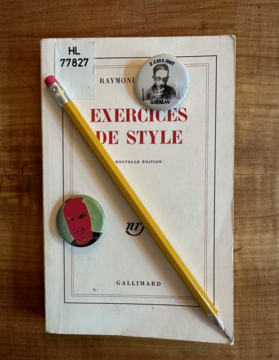 Notational
A Zurich-based translator answers an ad that reminds him of his youth and is sent several lapel pins, or buttons, bearing the likeness of a 20th-century French poet emblazoned with a motto. The creator of these buttons, a Chicago-based teacher, does not charge for his products, but asks only that they be worn. Their recipient is happy to comply.
The two men have not yet met in person; nevertheless, they discover a shared bond in their love of poetry and music, and begin to correspond. The second man eventually sends the first a new shipment of buttons (which he has been manufacturing together with his daughter), this time featuring the masked face of a contemporary Edinburgh-based artist and a new motto, once again free of charge. The first man agrees to wear these as well, especially since they give him the beribboned air of the dandy he once was.
The first man is then moved to distribute both series of buttons to people he meets during his travels, abroad and in his country of residence, on buses and at gatherings, and to photograph himself with these new recipients. He shares the photographs with the second man, as well as with the Edinburgh-based artist, who is, unlike the French writer, still alive. Read more »
by Bill Murray
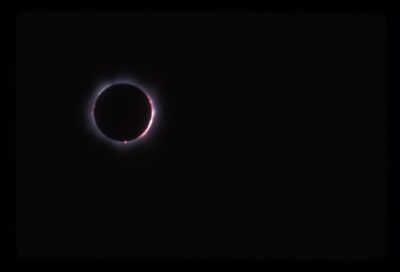
First a note on the April 8th North American eclipse: Many people have seen a partial eclipse of the sun and wondered what all the fuss is about. The sky looks out of whack, things go all shimmery, you can see reflections of the partially occluded sun on leaves, animals act up, the sky darkens, maybe, and then it’s done.
That is a partial eclipse. The experience inside the narrow band of earth where the sun is entirely covered, called “totality,” is nothing like a partial eclipse. Two weeks from today North America experiences the longest path of totality for any eclipse this century.
The band of totality will be about 115 miles wide. Lots of people have the chance to get underneath it. If you’re interested, don’t settle for partial; go and find totality.
The longest totality in the US will be four minutes and 24 seconds. By comparison, the longest totality anywhere in the US for the 2017 eclipse lasted only two minutes and 41 seconds. These may sound like just statistics, but nearly five minutes of totality is a big deal. People pursue even a minute of totality across continents.
Totality is utterly unique. It’s something else entirely. Totality pulses with raw, brute, human-diminishing power. Read more »
by Brooks Riley
Something odd happens when I look at the elder Pieter Bruegel’s paintings: I experience a jolt of vertigo, as though I’d stepped out on a ledge somewhere—not too high up, but high enough to initiate a physical reaction more like titillation than terror. I didn’t notice this right away: For a long time, I was too busy taking in all the business going on in those paintings: the crowds, the tussles and bustle of the marketplace, the hawkers, the wagons, the houses, the animals, and in some of his works a topography rather alien to his own very flat province of North Brabant in the Netherlands. A master of ‘everything everywhere all at once,’ Bruegel knew how to crowd a wooden panel.

In The Fight between Carnival and Lent, faced with a multitude of finely-rendered characters alive with attitude, it’s easy to be distracted from the shot itself—its acute angle, its distance from the action, its extended scope and high horizon achieved through elevation. This is a classic content-over-form dialectic that faces every viewer looking at a painting. What am I seeing? What am I supposed to see? Where am I seeing from?
In this case ‘where am I seeing from’ has everything to do with ‘what am I seeing’’: It’s the high oblique angle that enables the viewer to take in all those individuals spread out over the market square. (An AI command to make each character look up at the painter, might force the viewer to think about where Bruegel is situated as he paints, even if he’s up there only in his imagination. It’s like the fourth wall: you’re unaware of it until a character turns and speaks to you directly.)
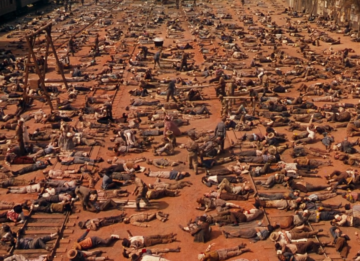 A cinematographer would recognize this as a crane shot, or its replacement, the drone shot. This crane or drone doesn’t move. It defines the POV (point of view) of the painter, and shows how far his perspective can reach and how much he can cram into the in-between, that 2D surface which expands vertically with every higher angle of his POV, as in this crane shot from Gone with the Wind. Read more »
by Jonathan Kujawa
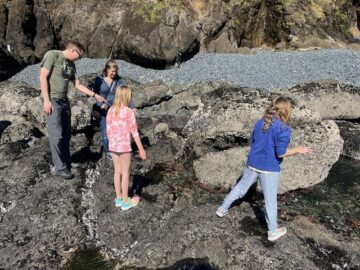
My nieces, Hannah and Sydney, came to visit for the weekend. Since they’re 8 and 9, the delightful Guardian Games in downtown Corvallis was a must-stop. Along with games galore, they have an amazing assortment of puzzles. They have puzzles with micro-sized pieces, puzzles with jumbo-sized pieces, puzzles with only a few pieces, and puzzles with a veritable googolplex of pieces.
The profusion of puzzles reminded me of a recent research paper in applied geometry. The authors are Madeleine Bonsma-Fisher, a mathematician and data scientist at the University of Toronto, and her partner Kent Bonsma-Fisher, a quantum computing and optics researcher.
 Like many of us, they assembled an inordinate number of puzzles during the COVID-19 restrictions. And like many puzzlers, they came to wonder:
How big a table do you really need if you want to assemble a puzzle?
Everyone knows you need extra room on the table to spread out the pieces. But how much extra room? Does the amount of space needed depend on the size of the pieces? Or if the puzzle has more or fewer pieces?
This is a frequent topic of discussion for puzzlers on the internet. A commonly cited rule of thumb is that the table should be twice the area of the finished puzzle.
But rules of thumb aren’t math. Fortunately, close readers of 3QD know of some math that could help here. Read more »

by Nils Peterson
Years ago I was listening to Robert Bly talk about poetry. It was at a conference on form and he was in the process of leaving Whitman and going on to Yeats as part of his own conscious public wrestling, not so much with the Muse as which Muse and where the Muse comes from. He paused for a moment and, to let his batteries charge, said – “Well, what do you think of this Nils?” He’d been talking about the formal aspect of Yeats, the rhythm and the rhyme and the kind of consciousness such usage requires of the reader and the writer. I, startled, could think of nothing else to say than that Yeats writes the kind of poem that you can wake up in the middle of the night and find that you know by heart without ever having made the effort to memorize it. I mentioned having been at a wedding where, unexpectedly, I was asked to recite some poetry. I was able after a minute of two or two with a pencil to come up with a fairly accurate version of “The Folly of Being Comforted.” Bly nodded, and went on his merry way, but I found myself troubled. So, at the end when he asked for comments, I found I had to add this anecdote.
 In the middle ’60s when I first was a new husband, a new teacher, and new father, I met my first indication of the changing consciousness of women in a freshman English class. I was teaching the Yeats poem “A Prayer for My Daughter.” I found it, and in many ways still do a marvelous poem and I spoke of it to my class with great enthusiasm saying that this is what I would wish for my daughter – that she would be “beautiful” but not “too beautiful” and “learned courtesy” for:
Hearts are not had as a gift but hearts are earned
by those that are not entirely beautiful….
I added that I’ve known enough of it in myself to think that,
An intellectual hatred is the worst.
While musing in front of the class, thinking of my own infant daughter’s destiny, it seemed as if I too could pray –
May her bridegroom bring her to a house
Where all’s accustomed, ceremonious…,
having had because of growing up as a chauffeur’s child on a great estate, some illusions about what that would be like.
One of my women students, tough, honest, told me – “You’re wrong. You shouldn’t say wish that on your daughter.” In fact, she went on to say that “I had no right to wish that on my daughter.”
I was set back on my heels, shocked. It had seemed to me the most unexceptionable of fatherly wishes, what, indeed, any father, would want. The class finished with a good argument. And Bly’s evening finished when, shortly after my story, Robert said, “Well, something must be happening here because I feel a lot of anger in my stomach and it’s time for bed.” And yes, the evening all of a sudden had become filled with a strange uncomfortable energy.
But the evening and my story are not quite over. Read more »
by Ashutosh Jogalekar
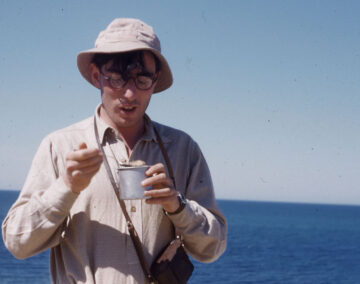
Every once in a while there is a person of consummate achievement in a field, a person who while widely known to workers in that field is virtually unknown outside it and whose achievements should be known much better. One such person in the field of chemistry was Jack Dunitz. Over his long life of 98 years Dunitz inspired chemists across varied branches of chemistry. Many of his papers inspired me when I was in college and graduate school, and if the mark of a good scientific paper is that you find yourself regularly quoting it without even realizing it, then Dunitz’s papers have few rivals.
Two rare qualities in particular made Dunitz stand out: simple thinking that extended across chemistry, and clarity of prose. He was the master of the semi-quantitative argument. Most scientists, especially in this day and age, are specialists who rarely venture outside their narrow areas of expertise. And it is even rarer to find scientists – in any field – who wrote with the clarity that Dunitz did. When he was later asked in an interview what led to his fondness for exceptionally clear prose, his answer was simple: “I was always interested in literature, and therefore in clear expression.” Which is as good a case for coupling scientific with literary training as I can think of.
Dunitz who was born in Glasgow and got his PhD there in 1947 had both the talent and the good fortune to have been trained by three of the best chemists and crystallographers of the 20th century: Linus Pauling, Dorothy Hodgkin and Leopold Ruzicka, all Nobel Laureates. In my personal opinion Dunitz himself could have easily qualified for a kind of lifetime achievement Nobel himself. While being a generalist, Dunitz’s speciality was the science and art of x-ray crystallography, and few could match his acumen in the application of this tool to structural chemistry. Read more »
by Jerry Cayford
The Vegetarian Fallacy was so dubbed by philosophy grad students in a well-oiled pub debate back in the 1980s. There is a fundamental conflict—so the argument went—between vegetarians and ecologists. The first principle of ecology—everything is connected to everything else (Barry Commoner’s first law)—is incompatible with the hands-off, “live and let live” ideal implicit in ethical vegetarianism. The ecologists took the match by arguing that, pragmatically, animals either have a symbiotic role in human life or else they compete with us for habitat, and those competitions go badly for the animals. In the long run, a moral stricture against eating animals will not benefit animals.
Now, pub debates are notoriously broad, and this one obviously was. A swirl of issues made appearances, tangential ones like pragmatism versus ethics, and central ones like holism versus atomism. In the end—philosophers being relatively convivial drinkers—all came to agree that pragmatism and ethics must be symbiotic as well, and that the practice of vegetarianism (beyond its ethical stance) could be more holistically approached and defended. Details, though, are fuzzy.
A fancy capitalized title like “Vegetarian Fallacy” may seem a bit grandiose, given the humble origins I just recounted. What justifies a grand title is when the bad thinking in a losing argument is also at work far beyond that one dispute. And that is my main thesis. So, although I will elaborate the two sides, it will be only a little bit. I am more interested in the mischief the Vegetarian Fallacy is perpetrating not in the academy but in wider political and cultural realms. Read more »
by Brooks Riley
by Tim Sommers
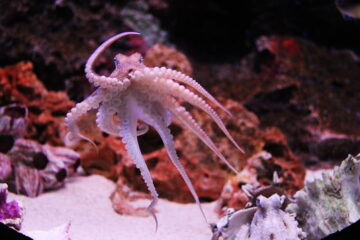
Does your dog feel pain? Or your cat? Surely, nonhuman great apes do. Dolphins feel pain, right? What about octopuses? (That’s right, “octopuses” not “octopi.”)They seem to be surprisingly intelligent and to exhibit pain-like behavior – even though the last common ancestor we shared was a worm 600 million years ago.
Given that all these animals (and us) experience pain, it seems exceedingly unlikely that there would only be a single kind of brain or neurological architecture or synapse that could provide the sole material basis for pain across all the possible beings that can feel pain. Octopuses, for example, have a separate small brain in each tentacle. This implies that pain, and other features of our psychology or mentality, can be “multiply realized.” That is, a single mental kind or property can be “realized,” or implemented (as the computer scientists prefer), in many different ways and supervene on many distinct kinds of physical things.
We don’t have direct access to the phenomenal properties of pain (what it feels like) in octopuses – or in fellow humans for that matter. I can’t feel your pain, in other words, much less my pet octopuses’. So, when we say an octopus feels pain like ours, what can we mean? What makes something an example (or token) of the mental instance (or type) “pain”? The dominant answer to that question in late twentieth century philosophy was called the “functionalism” answer (though many think functionalism goes all the way back to Aristotle).
Functionalism is the theory that what makes something pain does not depend on its internal constitution or phenomenal properties, but rather the role or function it plays in the overall system. Pain might be, for example, a warning or a signal of bodily damage. What does functionalism say about the quest for Artificial General Intelligence (AGI)? Read more »
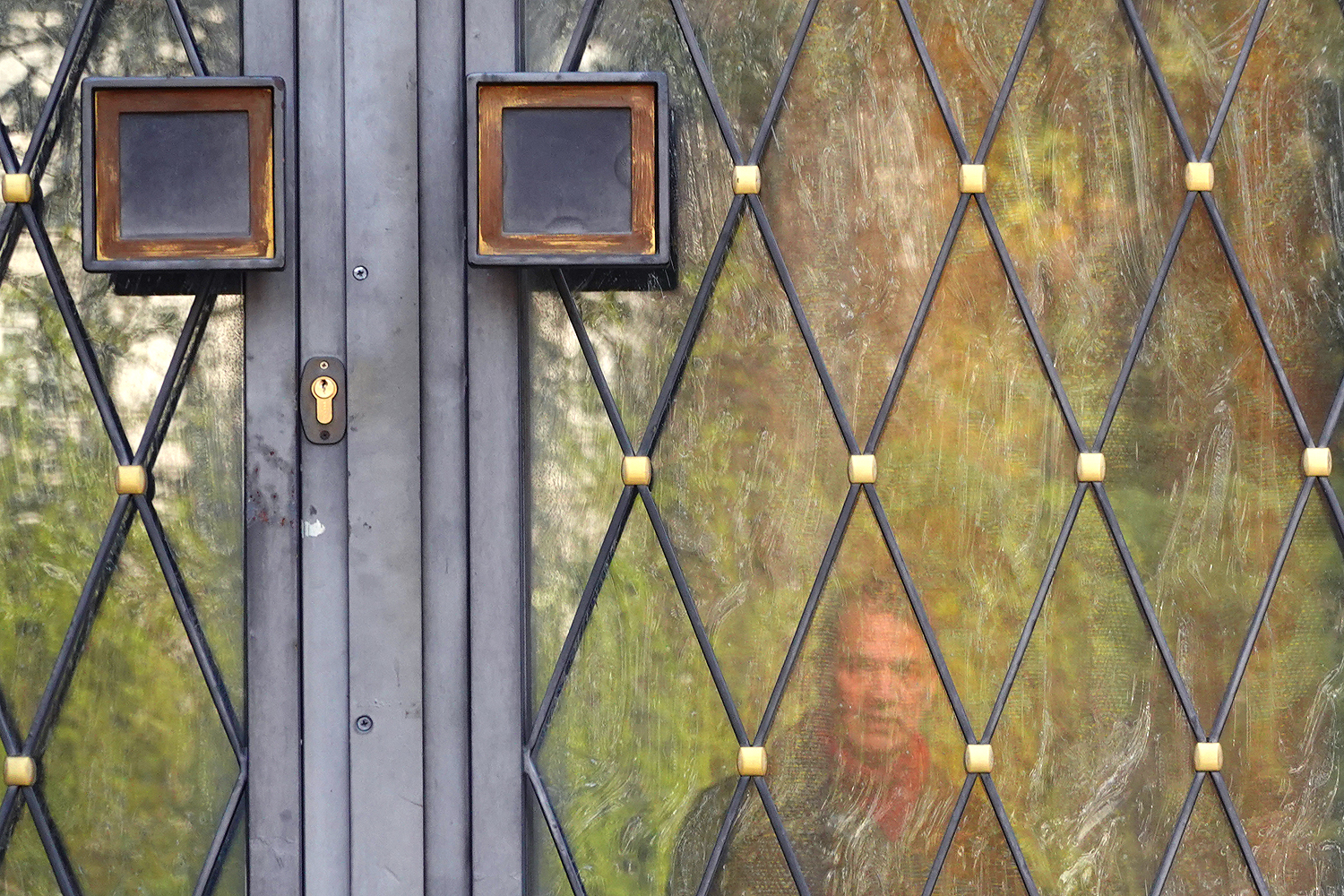
Self portrait by reflection in a glass door in Meran, South Tyrol.
by Ethan Seavey
 I’ve heard owls are signs of a big shift in your life; I also know that I only really look for owls during those times.
Exercise for me is short lived or long lived, short lived to match my attention or long lived to accommodate my frequent breaks for walking, exploring, writing, texting.
I’m running through the gulch and looking at the trees where the owl usually sits in the morning. It’s not morning really anymore. The sun is big in the sky and the owl is nowhere to be seen. I think to see the owl and to prove the shift in my life I’d need to wake up earlier.
After running out of the woods I follow the sidewalk to the water front and walk along that for a while. I see seagulls approach an old man who is bemused that they’ve identified him as a possible food source.
I walk down a pier for a while. It’s meant for fishing but it’s too early in the season for fishing so I don’t see anybody reeling in anything, and I’m looking for marvelous life-changing marlins. I watch a couple kiss on the other side of the pier. They point off into the distance at a warship.
As I run back to the woods, I have the thought that I don’t need to see an animal to decide I’m going through a life shift. That’s when I notice a globe in the water. Read more »
by Oliver Waters
 The Matrix films depict a future dystopia in which oppressive super-intelligent machines have imprisoned human beings inside an entirely simulated world in order to exploit them as a power source. The human protagonists of the films – Neo and Trinity – lead a thrilling rebellion to free as many people as possible. It’s rather obvious why they are the ‘good guys’ and the machines are evil: imprisoning people in a virtual cage is wrong.
This is despite the fact that life in the Matrix actually seems more enjoyable than the alternative. Inside, you partake in the heady optimistic era of 1990s America. Outside it, you must endure the dusty remnants of the great civilisational war between humans and machines. There isn’t even any sunshine, on account of the humans having ‘scorched the sky’ to prevent the machines from accessing solar power. The only ‘free’ human city exists deep underground, where there’s very little entertainment unless scantily clad festival raves are your thing.
This is why the notorious character Cypher decides to betray humanity to the machines in exchange for a charmed life in the simulation. As he rationalises while eating a juicy virtual steak: ‘ignorance is bliss’. The film pushes us to think of Cypher as a deeply mistaken jerk. But why exactly? Why is being trapped in the Matrix wrong even if it is seemingly more pleasurable than living in reality? Because it is assumed that the people stuck inside it possess the inherently human trait of curiosity. Deep down, they want to know how the world really works. By being trapped in a fantasy world, this basic need is being frustrated, even if they don’t know it. Their individual potentials as self-aware beings are being cruelly inhibited, and justice demands that they be freed.
If you haven’t seen the Matrix films by now – where on Earth have you been?
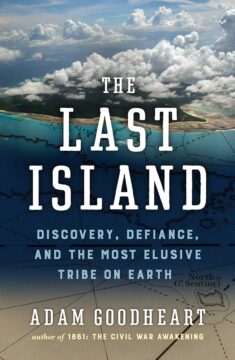
One plausible place is on North Sentinel Island, a tiny member of the Andaman Islands in the Bay of Bengal. It is remarkable for the fact that the people who live on it (the ‘Sentinelese’) are in almost zero contact with the rest of our global civilisation. There have been several attempts to connect with them over the centuries with varying degrees of failure, brought vividly to life in Adam Goodheart’s recent book The Last Island (2023). The Sentinelese exist today in total isolation – an arrangement enforced by the Indian government within whose sovereignty the island lies. Read more »
by Richard Farr
You might think London’s National Portrait Gallery is a temple of celebrity, and it’s true that many of the faces on these walls belong to mere royalty, or influential past Nabobs, or those more recently glossy with fame. But the people who draw me back again and again are the ones who get to be here only because they were freakishly good at something.
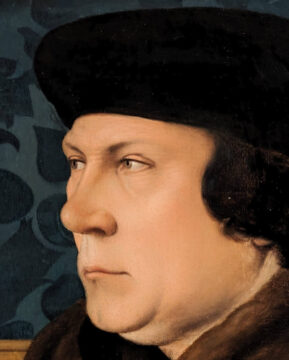 Poets. Dancers. Singers. Scientists. Generals. Explorers. Actors. Engineers. Diplomats. Reformers. Painters. Sailors. Builders. Climbers. Composers. In a pretty-good eighteenth-century copy of a portrait by Holbein the Younger, Thomas Cromwell is not so much a man as a slab of living, dangerous gristle. Henry James looks dangerous too, in a portrait by John Singer Sargent that more people would recognize as great if inverted snobbery hadn’t turned under-rating Sargent into a whole academic discipline. Humphrey Davy, painted in his forties, could not be more different. He looks about 14; thinking about science has made him glow with delight.
Thomas Gainsborough is all over the place to good effect next door, in the National Gallery, but his self-portrait here makes him look embalmed. It seems almost cruel to have placed him next to his contemporary Joshua Reynolds, whose own self-portrait demonstrates how far wit and brio can take you. A less successful Reynolds captures Samuel Johnson looking morose, or constipated; no greater contrast than with that prince among wits Laurence Sterne (Reynolds yet again), seen in full gloat after the publication of Tristram Shandy. Read more »
we all leave home eventually,
leave the dark comfort of wombs,
leave the home of childhood,
some earlier than others depending upon
the warmth or not of particular hearths.
inevitably some step out
and abandon silver spoons like Siddhartha
who was not comforted by comfort,
while some break from huts of sheer neglect.
eventually, some even leave
the cocoon of self,
cracking its cramped shell,
flying beyond its confines,
its imaginary limits
its walls of mirrors
its life sentence
its aloneness
Jim Culleny, 4/4/22
by Mary Hrovat
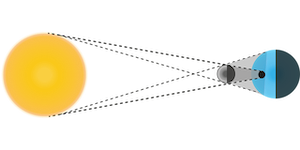 There are worse places to be a stargazer than south-central Indiana; it’s not cloudy all the time here. I’ve spent many lovely evenings outside looking at stars and planets, and I’ve been able to see a fair number of lunar eclipses, along with the occasional conjunction (when two or more planets appear very close together on the sky) and, rarely, an occultation (when a celestial body, typically the moon but sometimes a planet or asteroid, passes directly in front of a planet or star).
For example, I was lucky enough to have clear skies in March 1996 on the night comet Hyakutake made its closest approach to Earth; from a relatively dark site, it was visible near the North Star, its long faint tail sweeping the sky like a hand on a clock. I also got to see the conjunction of Jupiter and Saturn in December 2020, the closest such conjunction since 1623. There were also a number of clear evenings before the conjunction, so I could watch the two planets drawing closer to each other on the sky. A viewing party for comet Hale-Bopp, on a night in 1997 when the moon was full and Venus was visible in the western sky after sunset, was notable for clouds coming and going, but we got to see the comet and the planet, and the moon was remarkably pink through hazy clouds.
However, we do get a lot of overcast nights. Indianapolis, the closest city for which I can find data, receives 55% of available sunshine; annually, it sees 88 clear days, 99 partly cloudy days, and 179 cloudy days. As a result, I’ve missed a fair number of lunar eclipses, meteor showers, and other astronomical events over the decades. When I was an astronomy student in the 1980s, I remember standing on the balcony of the observatory with a classmate, wondering whether the clouds that had moved in were there to stay. The climate here fosters doubt about the possibility of clear skies. Read more »
by Mark Harvey
Mark Twain’s two rules for investing: 1) Don’t invest when you can’t afford to. 2) Don’t invest when you can.
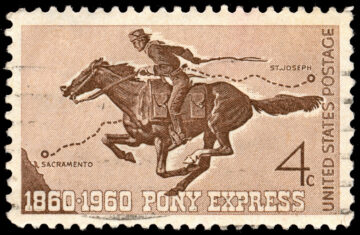
Hemorrhaging money and high burn rates on startups is not something new in American culture. We’ve been doing it for a couple hundred years. Take the pony express, for example. That celebrated mail delivery company–a huge part of western lore–only lasted about eighteen months. The idea was to deliver mail across the western side of the US from Missouri to California, where there was still no contiguous telegraph connection or railway connection. In some ways the pony express was a huge success, even if in only showing the vast amount of country wee brave men could cover on a horse in a short amount of time. I say wee because pony express riders were required to weigh less than 125 pounds, kind of like modern jockeys.
In just a few months, three business partners, William Russell, Alexander Majors, and Wiliam Waddell, established 184 stations, purchased about 400 horses, hired 80 riders, and set the thing into motion. On April 3, 1860, the first express rider left St. Joseph Missouri with a mail pouch containing 50 letters and five telegrams. Ten days later, the letters arrived in Sacramento, some 1,900 miles away. The express riders must have been ridiculously tough men, covering up to 100 miles in single rides using multiple horses staged along the route. Anyone who’s ever ridden just 30 miles in a day knows how tired it makes a person.
But the company didn’t last. For one thing, the continental-length telegraph system was completed in October of 1861 when the two major telegraph companies, the Overland and the Pacific, joined lines in Salt Lake City. You’d think that the messieurs who started the pony express and who were otherwise very successful businessmen would have seen this disruptive technology on the horizon. Maybe they did and they just wanted to open what was maybe the coolest startup on the face of the earth, even if it only lasted a year and a half. Read more »
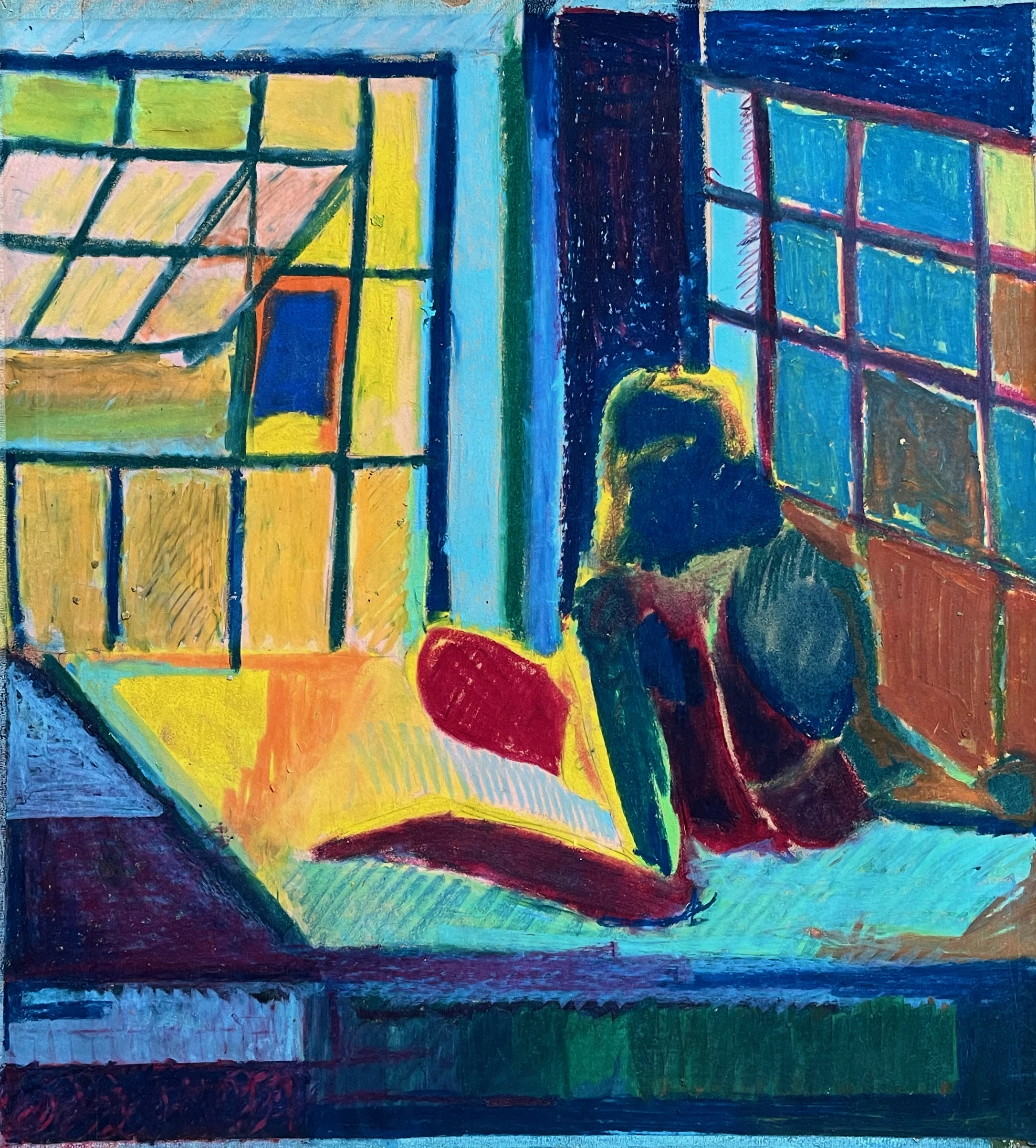 Sughra Raza. Figure in Environment, May 1974.
Pastel drawing on paper.
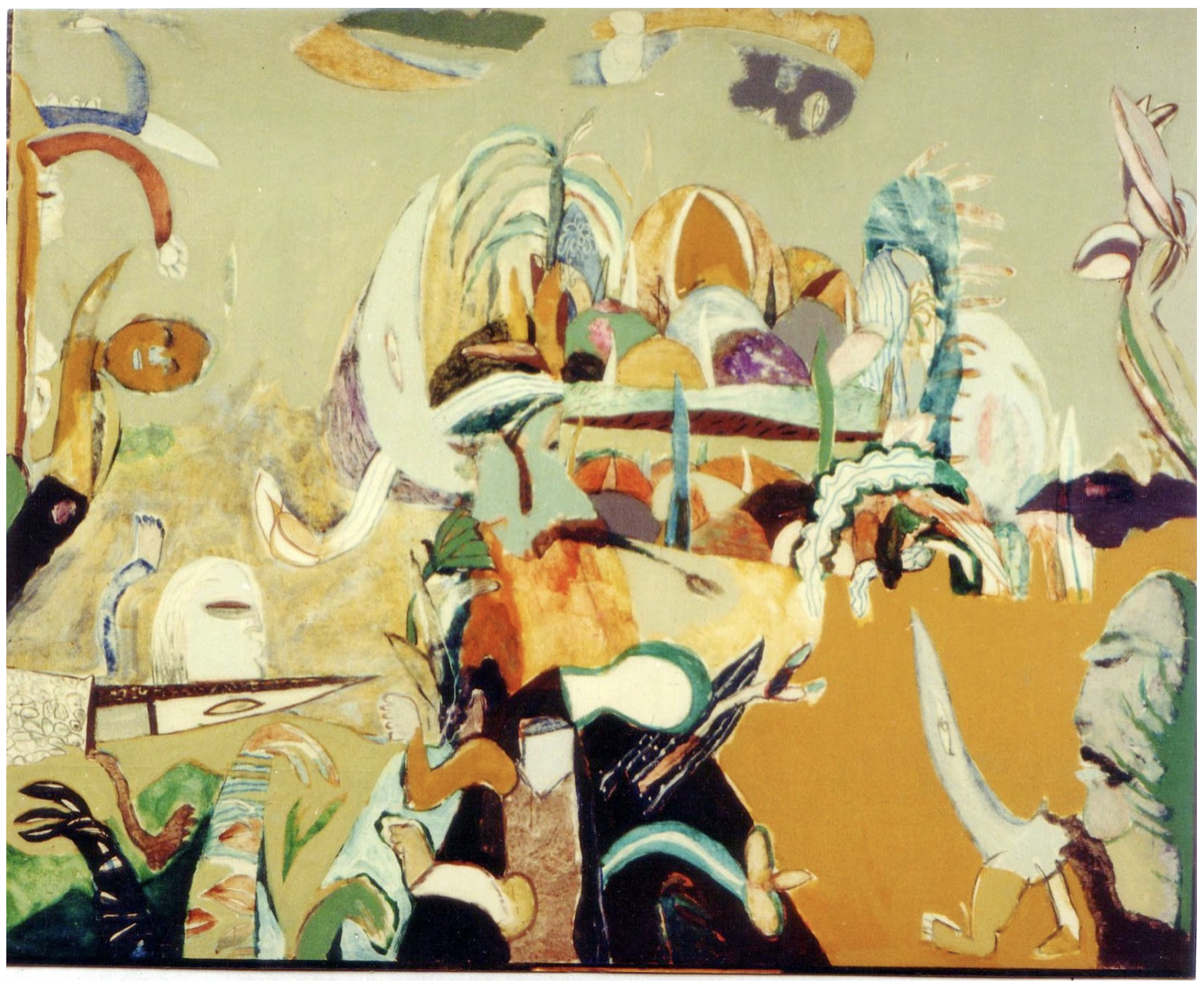 Dilara Begum Jolly. Untitled, ca 2014.