Overkill: The Increase in Extremely Violent Homicides

by Steven Gimbel and Gwydion Suilebhan

A new study has revealed a troubling development in the state of Maryland: while murder rates fluctuated between 2005 and 2017—first trending downward, then increasing for a few years—the homicides recorded during that period have grown steadily more violent the entire time.

According to “Increasing Injury Intensity among 6,500 Violent Deaths in the State of Maryland,” which is forthcoming in the Journal of the American College of Surgeons, researchers examined the intensity of deadly incidents over a 13-year period. Intensity was measured by the number of gunshots, stab wounds, and fractures exhibited by victims. Across all three causes of death, while the rate of homicides varied during the period, the percentage of high-violence crimes consistently increased.

Conducting the study was easier in Maryland than it might have been in other states. Maryland is unusual in that its Chief Medical Examiner is required to report on all murders, suicides, and unusual deaths, which means that researchers had access to a broad-based data set. State policy meant that researchers had access to information about victims who died under medical care and those who died at the scene of the crime. The state’s data set was geographically comprehensive, too, including cases from Baltimore’s urban center, the suburban areas around Baltimore and Washington, DC, and the rural areas in the eastern and western parts of the state. Read more »


This Mediated World

by Christopher Horner

Immediacy itself is essentially mediated —Hegel

Look at that desk in front of you right here, now. Isn’t it just there, a bare existence, a simple immediate thing right in front of you? The senses register its presence. This, at least, is a bare fact that you know.

But look again at the desk in front of you. What is it you are aware of? A desk: not a carpet or a parrot, its colour (brown), its shape (rectangular), all that is that negates what might have been (it isn’t grey, it isn’t circular, etc). Your awareness of the desk is mediated by concepts and you, a language user, can only make sense of the thing through those concepts, the universal terms that enable you to pick out this thing here, now. And you are aware of it now as you were 5 minutes ago, although the light has changed and you, a namable person, not a disembodied spirit, have shifted your position on your chair to look back at the clock on the wall.  Time, place, objects: everything is mediated: that is, nothing is simply ‘there’ in splendid isolation to be passively registered by your senses.[1]

Consider again the wooden desk. It was once part of a tree, like the ones outside your window. It became a bit of furniture though a long process of growth, cutting, shaping buying and selling until it got to you. You sit before it as it has a use – a use value – but it was made, not to give you a platform for your coffee or laptop, but in order to make a profit: it has an exchange value, and so had a price. It is a commodity, the product of an entire economic system, capitalism, that got it to you. Someone laboured to make it and someone else, probably, profited by its sale. It has a history, a backstory.
All of this is the case, but none of it simply appears to the senses. Capitalism itself isn’t a thing, but that doesn’t make it less real. The idea that all that there really is amounts to things you can bump into or drop on your foot is the ‘common sense’ that operates as the ideology of everyday life: “this is your world and these are the facts”. But really, nothing is like that: there are no isolated facts, but rather a complex, twisted web of mediations: connections and negations that transform over time. 

This doesn’t mean that the way things show up for us is somehow false, an illusion that masks a hidden essence. The essence of a thing is reflected in the way it appears, in the connections and negations with everything else, and in the way in which it develops over time. Read more »

A Baseball Melancholia

by Nils Peterson

I

This is how it felt. 

Yankee Stadium Gone – Impossible. It’s like going to your old hometown and finding your house – No! the neighborhood tarmacked over. Yes, we live in the world of Heraclitus, “Everything flows and nothing abides; everything gives way and nothing stays fixed.”  Flux is all.

The first time I went to Yankee Stadium, I lived in New Jersey and I went with Bunny Reid, a neighborhood friend who lived in a strange house filled mostly with aunts. It had a big, big yard, and in the fall we’d play football on the long open side yard. In the spring and summer we’d play catch with mitts too big for our hands or we’d throw a pink rubber ball against the side of a garage that had been a carriage house keeping careful track of balls and strikes. We were Yankee fans. His father wasn’t around much. I think he had something to do with the railroad, but he took us to see a real game at Yankee Stadium.

I guess we drove up there through the Tunnel or over the George Washington Bridge, but memory isn’t certain here, because it was wartime and gas rationed and difficult to find, the speed limit 45 as I recall. I think I would remember train or bus. The great players were off playing for Uncle Sam, so likely this is 1944 or maybe ’45 before VE and VJ Days. However we got there, I was thrilled at being in that marvelous, seemingly eternal Coliseum, the House That Ruth Built.

Bunny’s father got the tickets, gave me mine – and, all of a sudden they were gone, Bunny and his father were nowhere in sight. There I was, 10 years old, 11 at most, 50 miles from home, maybe 50 cents in my pocket for a hot dog and a drink. Maybe there was a moment of panic. Maybe not. I took my ticket, asked an usher where my seat was, and went to it. Read more »

Taste, Organic Unity, and Creative Tasting

by Dwight Furrow

Is there such a thing as tasting expertise that, if mastered, would help us enjoy a dish or a meal? It isn’t obvious such expertise has been identified.
The most prominent model of tasting expertise is derived from the practice of wine tasting and has been extended to the assessment of cheese, coffee, chocolate, beer, spirits, and a variety of other products. These products are notably complex and exhibit flavors and aromas that are difficult to detect yet important to the quality of the product. The aim of expert tasters is to break the taste object into its component flavors, aromas, and textures so each element can be clearly identified and named with the help of flavor wheels that sort these flavors into categories. The expertise required for such analytic tasting is one of discernment—identifying hidden aromas or flavors that untrained tasters might miss. Analytic tasting is useful for assessing products, identifying the origin of a product, or training one’s ability to discern flavors. However, analytic tasting pays only cursory attention to how flavors and textures are then knit together to form a coherent whole.

By contrast, typical diners when enjoying a dish or meal are less interested in identifying hidden aromas or flavors and more interested in whether the elements fit together coherently. The enjoyment of complex dishes, as well as several dishes served as part of a meal, involves tasting relations between multiple taste objects rather than discrete, individual taste objects. But what kind of relations are we tasting? Part/whole relations would be the obvious type. For a dish or meal to be aesthetically successful, ingredients and flavors must be perceived as being fully integrated parts of a coherent whole.

In aesthetics, this relationship between whole and parts has traditionally been understood in terms of organic unity. Read more »

Review: Breaking the Two-Party Doom Loop

by Jerry Cayford

It’s a book about how our political system fell into this downward spiral—a doom loop of toxic politics. It’s a story that requires thinking big—about the nature of political conflict, about broad changes in American society over many decades, and, most of all, about the failures of our political institutions. (2)

Where to begin fixing our dysfunctional society is about as contentious a question as there is. Lee Drutman’s 2020 book Breaking the Two-Party Doom Loop: The Case for Multiparty Democracy in America confronts it head-on. Chapter 1, “What the Framers Got Right and What They Got Wrong,” goes straight to the heart of the matter: what the Founding Fathers got wrong is political parties. They understood the threat of tyranny that parties (“factions”) posed, but they misunderstood the benefits and inevitability of parties. They structured our government to discourage parties, instead of to accommodate them. As Drutman explains, those structural weaknesses have finally caught up with us in today’s toxic partisanship.

Like the Founders, Drutman gets important things right and wrong. He says, “At its core, my argument can be distilled into two words: institutions matter” (4). Political parties are the institutions he defends and criticizes. What we need parties to provide are substantive choices, not coercive conformity or destabilizing toxicity. This focus on parties is one of the many, many things Drutman gets right in his well-written, informative, and important book. When he turns from diagnosis to solution, though, he gets one big thing wrong. Read more »

Monday, April 8, 2024

In The Air

by Richard Farr

I’m writing this 37,000 feet above Vestmannaeyjar, a chain of islands off Iceland’s south coast. Or so the screen tells me – I can’t see the view because I’m wedged into 38E, a middle seat at the back near the loos. The ambient noise and vibration are roughly what you’d experience with your back to the railing at Niagara. As if pleased with the roar, this part of the airframe wags intermittently, like the rear end of a hopeful dog. Objects made of metal have no right to be this flexible – especially not airtight objects that are essentially several thousand small tin trays tacked together. (Welded? Bolted? Riveted? What is a rivet anyway? How is it possible to reach my age with essentially no idea what a rivet is?) 

When I read Simon Winchester’s history of engineering, The Perfectionists, I must have missed the bit about rivets, but I did learn that the turbine blades in a jet engine have to be manufactured by advanced magi of the alchemical arts, who employ exotic alloys and mind-bogglingly fine tolerances to fight metal’s very natural desire to melt or shatter when spun at ferocious speeds inside a furnace. I try not to think about the fact that a manufacturing imperfection the size of a flea’s toenail could get me into a news story.

According to my watch we’re at 6,000 feet, but that’s only an indication of the lowered cabin pressure. It’s nothing, from a climber’s point of view, but presumably it explains why my head hurts, my hands look like a pair of lizard skin gloves, and half the passengers are farting. Read more »

Monday Poem

Stardust

—on a celestial photo

look to the spiral arc of stars
of which the nearest star and you are part

and see your milky way
and climb your finite climb

and run your finite run
and whirl and turn and wind

while they spin their finite spin
and glow their finite glow

and give you finite light
to tell you what they know

of the stuff you’re of and in,
both brief and infinite

Jim Culleny
9/4/15, 7:10 am
Photograph by Dave Lane

Third Places and American Libraries

by Mark Harvey

Don’t join the book burners. Don’t think you are going to conceal faults by concealing evidence that they ever existed. Don’t be afraid to go in your library and read every book…  —President Dwight Eisenhower, 1953

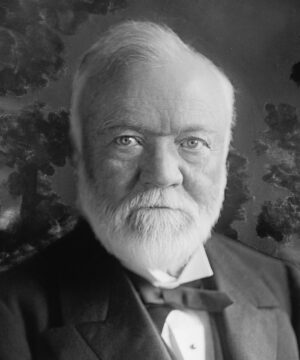
Andrew Carnegie

The other day I stopped in at one of those coworking spaces to see if it would be worth joining in an effort to increase my productivity. Productivity, in my case, is a fancy word to describe getting my taxes done on time, answering a few emails, staying atop some small businesses, and doing a little writing. I’m not exactly a threat to mainland China.

Unfortunately the place I visited had all the charm of a gulag in far east Russia, with poor lighting, and about four pale characters staring at their computer screens as if they could see the eternal void in the universe and had a longing to visit. No thanks.

It did get me thinking about “third places,” and libraries in particular. I believe the term, third place, was coined by the writer Ray Oldenburg in his book The Great Good Place. First places are our homes, second places are where we work, and third places are where we go to get relief from the first and second places. They include churches, libraries, pubs, cafes, parks, gyms, and clubs.

My second place is a beautiful ranch in Colorado, so I have little to complain about, but when it comes to the close work of being on a computer, I really value third places. Scholars have described Oldenburg’s third place as having eight features including neutrality, leveling qualities, accommodation, a low profile, and a sense of home. In short, it’s a place that is welcoming, not fancy, free of social hierarchies, free of dues, and imparts no obligation to be there. That perfectly describes American libraries, one of our greatest institutions. Read more »

Perceptions

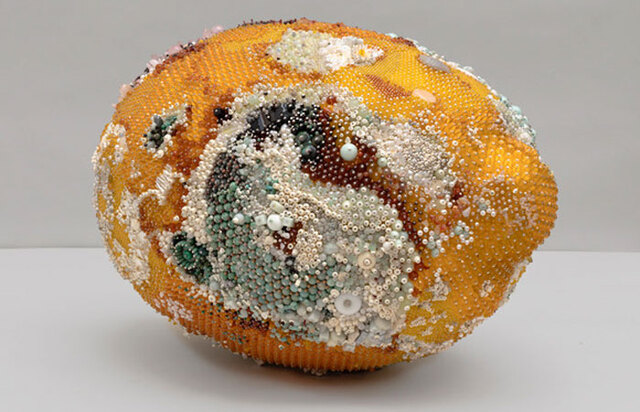
Kathleen Ryan. Bad Lemon (Creep), 2019.

Amazonite, aventurine, black onyx, Italian onyx, turquoise, labradorite, carnelian, ocean jasper, sesame jasper, serpentine, fluorite, Ching Hai jade, snow quartz, magnesite, agate, breccicated jasper, rhodonite, rhodochrosite, red agate, garnet, tree agate, rose quartz, amethyst, lilac stone, limestone, marble, mother of pearl, bone, freshwater pearl, glass, steel pins on coated polystyrene, 20 x 20 x 28 1/2 in

More here, here, and here.

Emily Dickinson’s Little Apocalypse

by Mike Bendzela

The term “Little Apocalypse” is borrowed from New Testament studies, referring to the Olivet Discourse in Jerusalem. This speech first appeared around the year 70 CE, in Chapter 13 of the original written gospel, the Gospel of Mark. After the scene of the cleansing of the temple, before the Last Supper and the arrest, one of the disciples draws attention to the massive stones of the temple, evoking from Jesus the promise that the temple would be destroyed. They sit “on the Mount of Olives opposite the temple” (hence “Olivet Discourse”), and the disciples ask Jesus to elaborate, thus prompting his long monologue predicting the End, when “Heaven and earth will pass away,” a view to be developed later in what might be called the “Big Apocalypse,” the Book of Revelation.

“Apocalypse” in its Greek sense means an “unveiling,” particularly when a visionary prophet or writer is vouchsafed a revelation of God’s plan. Emily Dickinson’s vision of the cosmic order in the poem “Safe in their Alabaster Chambers” is much briefer than Jesus’s Little Apocalypse but is no less striking. Her vision extends beyond traditional Christian boilerplate imagery to encompass something distinctly more up-to-date.

The poem’s first stanza discloses a portrait of the Christian dead lying in their tombs, awaiting the End of Days:

Safe in their Alabaster Chambers—
Untouched by Morning—
and untouched by noon—
Sleep the meek members of the Resurrection,
Rafter of Satin and Roof of Stone—

The utter stasis of the scene is housed in a single inverted sentence, in which the predicate comes first, with the sentence’s only verb–“sleep”–continually delayed by those “untouched” phrases. Then, finally, appears the subject, “the meek members of the Resurrection,” lying there inertly near the end of the sentence. The whole thing is capped off with a metaphor of a dwelling, the “Satin” interiors of their coffins represented as “Rafter” and the “Stone” tomb covering as “Roof.” Read more »

Close Reading Robert Bernard Hass

by Ed Simon

Demonstrating the utility of a critical practice that’s sometimes obscured more than its venerable history would warrant, my 3 Quarks Daily column will be partially devoted to the practice of traditional close readings of poems, passages, dialogue, and even art. If you’re interested in seeing close readings on particular works of literature or pop culture, please email me at [email protected]

A short lyric can be an ingenious device, a clever mechanism, an engine for generating multiple meanings – that’s the first axiom of my argument. The second axiom is that all truly great poetry is, at some level, about poetry itself (if not about the individual poem itself). Robert Bernard Hass’ “The Metaphysics of Presence,” which was published in the December 2023 issue of Poetry magazine, is an exemplary example of both of these aforementioned principles; a lyric that ironically draws attention to itself, to “Your hipster cynical voice” and to “clever puns,” but in the deferral between ultimate meaning and surfaces suggests a far more profound, if ineffable, lesson than the playfulness which the work itself initially implies.

The title of the work is consciously foreboding, with “The Metaphysics of Presence” sounding as if something that would be emblazoned on the spine of a door-stopper of continental philosophy. It’s not incidental, however, for that’s precisely and literally what Hass’ poem is concerned with, which is to say the relationship between what language represents and the thing-in-itself, between the sign and signified, the presence and the inevitable absence of words falling short of ultimate reality. To that end, “The Metaphysics of Presence” is a love poem. Hass even says so, writing in as straightforward a manner as is conceivable at the tenth line that “You’re in the presence of a love poem,” which is both accurate and not, and an example of a literal declaration in a poem that has fun with the incommensurability of literal declarations all while gesturing to something that lay beyond language. Read more »

Italian Americans, Gender Trouble, and The Sopranos

by Andrea Scrima

Americans are often smiled upon for their need to identify with their ancestors’ heritage; there’s something naïve and childlike about it, as though we were hoping to find a family somewhere, waiting with open arms for the long-lost child who has finally come home. We describe ourselves with the usual hyphenated ethnic adjectives, we say we’re one quarter this, half that, etc., but the truth is, we create fictional narratives to orient ourselves in a society too young to understand that the identities we claim often have little to do with the culture they purport to originate in. When I think about the cultural clichés we grew up with—the Italian mother leaning out of a tenement window, calling her son home to dinner in a 1960s television commercial; the way we gleefully mimicked her by crying out “Anthoneeeeeeeee!”—I recall the laughter and pantomime and how everyone understood what was meant. But what did it mean? That we were second generation, and thus not as “ethnic” as the old-world Italians portrayed—that we were not Anthony Martignetti racing home through the streets of the Italian north end of Boston on Wednesday, “Prince Spaghetti Day,” but were secure enough in our American identity to mock him? And that in spite of the fondness we felt for our cultural heritage, we’d been enlisted in the very racism that had been leveled at our parents, that had branded them as outsiders, and that had trapped them in a lower social status, a stigma that proved difficult to shed.

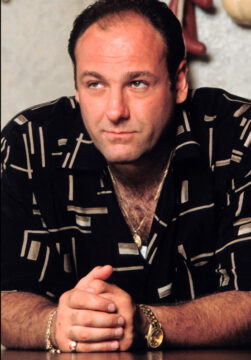
In an attempt to understand my relationship to the Italian-American identity, I recently began watching episodes of The Sopranos, which I avoided when it first aired twenty-five years ago. I was on a nine-month stay in New York at the time, living in a loft on the Brooklyn waterfront, and I remember the ads in the subways—the actors’ grim demeanors; the letter r in the name “Sopranos” drawn as a downwards-pointing gun. I’ve always been bored by the mobster clichés, by the romanticization of organized crime: as an entertainment genre, it’s relentlessly repetitive, relies on a repertoire of predictable tropes, and it has cemented the image of Italian Americans we all, to one degree or another, carry around with us. But the charisma of Tony Soprano, played by James Gandolfini, exerts an irresistible pull: I jettison my critical abilities and find myself binge-watching several seasons, regressing for weeks at a time, losing touch with what I was hoping to find.


One day, in the midst of this period, I hear myself talking about the show to a friend, hear the Staten Island accent creeping back in. What part of me is becoming reactivated, what pleasure is there? And what pain? Read more »

Here Comes the Sun

by Carol A Westbrook

Surya, Hindu god of the sun

The sun has always been an object of fascination and interest, appearing as it does as a bright, shining sphere crossing the daytime sky. On Monday, April 8, many of us will have had the opportunity to see the sun in all its glory as the moon crosses between it and the earth, briefly revealing its spectacular halo, the solar corona. Although we tend to take the sun for granted, an event like this makes us stop and think of how little we know about this celestial object.

Primitive peoples recognized that the sun was the source of all the earth’s heat and light; it was as important as the air we breathe and the water we drink. The sun was necessary to raise food crops and forage. Who could grow a garden in the shade? The sun marked the days and the seasons with a predictable regularity providing security and structure to their lives. The longest days, the shortest days, and the two equinoxes, had a special significance to their lives as they delineated the seasons, and they celebrated these days with feasting and sacrifice and prayers to their gods; and they raised large and impressively accurate monuments to mark these days. Stonehenge inf England is the best known of these monuments, but there are many others such as the pyramid at Chichen Itza in Mexico which casts a shadow in the shape of a serpent climbing the pyramid at the vernal and autumnal equinoxes. It is perhaps this disruption in this regularity and dependability that tend to make solar eclipses such memorable—and perhaps frightening–events. Read more »

Monday, April 1, 2024

The Trouble With Rights

by Martin Butler

Recently I read an article which included the idea that nature can have rights, something I have to admit I had not come across before, despite a keen awareness that nature needs protecting. I discovered that this is a well-established point of view – there is a lengthy Wikipedia page on the topic. I found this rather odd – it seemed a misplaced use of the concept of a right. But it made me reflect that in the modern world the possession of rights is one of the few ethical ideals that is taken seriously wherever you happen to be on the political spectrum, so it’s understandable why those who want to protect nature might adopt the language of rights.

From the right to bear arms to transgender rights, rights matter across the board, having an authority that religious commandments, the claims of ‘social justice’, and other varieties of moral prescription seem to lack. The idea that we have rights is an unquestioned certainty, but rights are also often a source of considerable conflict in the modern world. Which rights do we actually possess? Do animals have rights? How can conflicting rights, which are presented as fixed, be reconciled? Do some rights automatically trump other rights? If so, how could a hierarchy of rights be devised? The language of rights, it seems, very quickly leads to dogmatism and impasse. Jeremy Bentham certainly had no time for rights:

Natural rights is simply nonsense: natural and imprescriptible rights, rhetorical nonsense – nonsense on stilts.[1]

He wrote this in an essay entitled “Anarchical Fallacies; being an examination of the Declaration of Rights issued during the French Revolution”(1796). Interestingly, Bentham’s arguments have something in common with Karl Marx’s and Edmund Burke’s critiques of rights – and these two philosophers are at opposite ends of the political divide. Read more »

Joy in Repetition

by Derek Neal

I was listening to “My Turn Now” from Atlantic Starr’s 1980 album Radiant when my friend complained that “they just say the same thing over and over again.” This is true. The part of the song that elicited this comment was near the end, when the lead singer and the backup vocalists engage in a call and response:

(Baby, it’s my turn)
Oh, it is my turn now
It’s my turn now
(It’s my turn now)
(Baby, it’s my turn)
I want the world to know
That love is the love you sow
(It’s my turn now)

This is, of course, what music does. Words are repeated, phrases are repeated, melodies are repeated, and the song gets stuck in our heads and we repeat it to ourselves. Techno music, which is one of my favorite genres, is often criticized as being too repetitive, usually due to its ever-present bass drum; what some listeners fail to realize, however, is that once you hear the bass drum enough you stop hearing it. It acts as a sort of metronome, keeping time while melodies, harmonies, and rhythmic elements give shape to the music. When something is repeated, its meaning changes. I’ll say it again: when something is repeated, its meaning changes. Read more »