by Mark R. DeLong
 A few years ago I shared a draft of a sonnet sequence with a poet from the Northwest I had followed for a while. I asked him if he’d give the piece a once-over and provide some critique, and his reading was perceptive and useful for me. One comment drew my attention in particular: “I fall flat on ‘beauty,’ ” he wrote. “This is the one place in the poems the image turns outward into metaphor that cannot be touched — ‘beauty’s hidden folds’ is a no-thing” he wrote, pointing out at the last line of the second sonnet.
I thought about it, wondering about beauty and no-thingness, and thinking that beauty must be something more than an empty word or a placeholder for some substantial thing that is a “better” thing. Then, I admitted and still do admit that I don’t really know what beauty is, aside from maybe being something in the “eye of the beholder,” perhaps an evaporated no-thing, really.
Nell Painter discusses her “lying twentieth-century eyes” and how “[t]hinking like a historian misled me as an artist” not too far into her memoir Old in Art School (2018), a book I picked up when I was thrashing through the first year or so of my retirement. For I had toyed with making a turn like Painter, who wrapped up an eventful career teaching and researching history at Princeton and leaped into undergraduate study of art at Mason Gross School of the Arts at Rutgers and then an MFA at Rhode Island School of Design. She was finishing her sixties when she graduated with her MFA. Read more »



 Finish the book manuscript
 I’ve been a complainer since childhood. From the outside, people might suggest it’s a miserable disposition that’s neither useful nor pleasant, but, from the inside, I was just always noticing ways things could be improved and wondering why (and if) things had to be as they were. Why do we have dinner at six, when I’m hungry at four? So much didn’t make sense, and I was on a crusade to let those in power know about it. My parents handled it with a rule: No complaining without proposing a solution. It’s not a bad strategy, except then they were presented with many uninformed solutions as well. Their patience was astounding. I’ve since come to see the utility and delightful potential of the behaviour.

 Recently, following an assignment that required AI use, a student asked me whether it was true that every question she asks a chatbot uses up a whole bottle of water. Like so much information today, she received this claim via a social media video. The video apparently cited a newspaper article which cited a real study. She had also heard people all around her, both in real life and online, talking about the huge amounts of water these systems use. Of course, she could get more information by searching online, asking a chatbot, asking friends and teachers or listening to the many podcasts discussing the issue. In other words, my student has no shortage of information, but what she doesn’t have is a solid way to judge its accuracy, how much confidence a given claim deserves, nor which sources can be trusted. Though many students are now “digital natives,” in the sense that they have grown up with smartphones and tablets, it has been my experience that they are not skilled in navigating the bewildering and fast growing world of information available to us all.
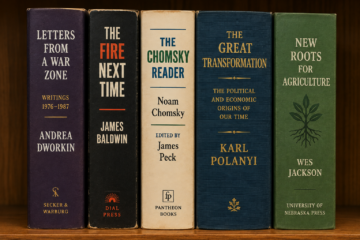 Many of the books that shaped my work as a professor, author, and activist came into my life during my first two years of graduate school (1988-90), the most exciting period of concentrated learning I’ve ever experienced. As I write in my new book,