
by Marie Snyder
 I’ve been a complainer since childhood. From the outside, people might suggest it’s a miserable disposition that’s neither useful nor pleasant, but, from the inside, I was just always noticing ways things could be improved and wondering why (and if) things had to be as they were. Why do we have dinner at six, when I’m hungry at four? So much didn’t make sense, and I was on a crusade to let those in power know about it. My parents handled it with a rule: No complaining without proposing a solution. It’s not a bad strategy, except then they were presented with many uninformed solutions as well. Their patience was astounding. I’ve since come to see the utility and delightful potential of the behaviour.
Complaining is what we do when we don’t have power or perceive ourselves to be without power. Even if we do it ourselves, we often hate to hear it from others for a few reasons. First, if we think people have power to try to change things, to actually say something to the boss, but they just lack the courage to use their power, it’s annoying or even enraging. It’s sometimes the irritation of almost — we could almost have this if only this person would actually do something instead of just whining about it! It feels like they could easily fix their bind, but they just won’t, as if we can all magically override those brain signals telling us it’s not safe to speak up. They might have more to lose than we realize. But sometimes the lack of courage is from an illusion that our way is the better way, and we’re not quite ready to test out that premise. It can reveal an annoying inflexibility to try it this way instead.
Secondly, if we think people don’t have power and it’s not possible to change the situation, then complaining is frivolous, a waste of breath, and maybe also a reminder that we’re all stuck with something we don’t like. We’re trying to forget how much this situation sucks and just accept the situation for what it is, head down, muscling through. However, whether we can change things or should have the serenity to accept them is a very complex consideration, often requiring conversations with others along the way.
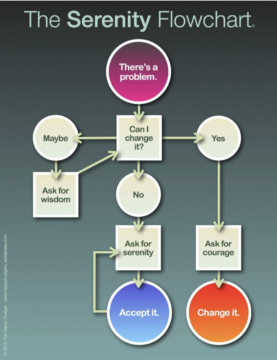
Epictetus said it first: “Examine it by those rules which you have, and first, and chiefly, by this: whether it concerns the things which are in our own control or those which are not; and, if it concerns anything not in our control, be prepared to say that it is nothing to you.” It was more clearly explained by Reinhold Niebuhr’s famous Serenity Prayer a century ago, but that “wisdom to know the difference” step is a doozy. We often need help to work through it.
A third reason we hate to hear complaining is because it can feel like someone’s dumping a burden on us and looking to be rescued. The only way to know is to ask, “Are you hoping to be heard, helped or hugged?” Complaining is often just about being heard and sharing our troubles with another human being, but complaining can be a roundabout way to ask for help. The indirectness can feel irritating, but it’s kind of brilliant. It offers an ask that isn’t overtly an ask, so that it’s easier for others to say ‘no’ without actually saying ‘no’ by just offering condolences. It offers a layer of plausible deniability for the complainer, but it also offers an out for the recipient, which can prevent feelings of guilt, although it isn’t always effective. The mere suggestion of need is a burden to any saviours around who can’t tolerate seeing others in an uncomfortable position and feel the need to act on their behalf to calm their own discomfort. However, is it reasonable to ask people to keep all difficulties to themselves so as not to provoke discomfort in others?
In an essay by philosophy professor Dr. Kathryn Norlock, she explores the anti-complaining positions of Aristotle and Kant who, “both maintain that complaining is effeminate and unworthy of the dignity of the man of virtue.” Aristotle thinks we should want to prevent our friends from sharing our pains:
“To perceive a friend’s being pained by one’s own misfortunes is itself a painful thing, for all avoid being a cause of pain to their friends. Hence those who are manly by nature are cautious of making friends share their grief.”
We might want to blame the neo-capitalist ethics of independence, but this idea has been passed down for millennia. “Manly” people don’t bother others with their problems.
Dignity is set up here as the opposite of complaining. We must appear to be intact and pain-free at all times; dignity is pretending to be unaffected, to be insensitive to pain. The hero doesn’t grimace or cry when being attacked, and neither should we. An alternative position comes from Glennon Doyle when she writes,
“The opposite of sensitive is not brave. It’s not brave to refuse to pay attention, to refuse to notice, to refuse to feel and know and imagine. The opposite of sensitive is insensitive, and that’s no badge of honor.”
Norlock explains the philosophers’ stance further: “complaint subordinates one’s moral person to one’s sensuous self.” It’s about rising above the lesser animal. A hole in that argument came while I was nursing my dying cat: If left to her devices, she would disappear into hiding spots. The animal instinct I witnessed was not to seek out others to share their pain, but to endure suffering alone. It may be a function of our more rational brain that we desire to share our pain and get help from the community. Maybe if we want to be more rational and more human, we should let people know we’re suffering. Our prefrontal cortex is made for connecting with others.
Norlock points out, “The position that whinging is never to be done relies on a view of the ideal individual man as self-sufficient and dependent upon no other person.” She uses Aristotle’s golden mean to rebut his own stance: the fact that there can be a problem if someone complains too little and problems go unnoticed, means that complaining isn’t a vice, but that it’s closer to a virtue between vices of excess (constant complaining) and deficit (subserviently accepting unnecessary hardships). More precisely, she explains, it’s less a virtue in itself, and more of a skill that supports the virtue of sociality. “Complaining offers important personal and interpersonal benefits” like relational solidarity and sympathetic bonding. It’s curious that the position that it’s noble and strong to never be a burden to anyone else misses how deeply we connect when we’re vulnerable or able to sit with another’s vulnerability, and it also neglects how much courage and steadfastness that quiet act requires. Compassion necessitates strength.
Norlock explains that in complaining, “the recognition of others provides us with options, sources of control, and assistance in integrating our self-narratives; the denial of recognition can leave us trapped within ourselves.” Kant worries about us infecting others with our pain, but maybe he needed to hear Carl Rogers’ lesson to “perceive the internal frame of reference of another with accuracy and with the emotional components and meanings which pertain thereto as if one were the person, but without ever losing the ‘as if’ condition” or, as Epictetus advised, “Do not be unwilling to … lament with him. But take care that you do not lament internally also.”
We don’t need psychiatric training to be able to sit with someone and listen without trying to fix
problems or without internally lamenting their situation. We can avoid the contagion of suffering by just listening while calming our own desire to soothe or control the situation. If it’s uncomfortable to see people in pain, remember that we do it whenever we watch movies that affect us, and we’re willing to just be there. However, perhaps it’s a matter of who we complain to: like Aristotle on anger, it’s acceptable in the right way (with the right person, to the right degree, at the right time, for the right purpose, and in the right way), so we can take greater care to avoid complaining to people who are already overburdened or otherwise unable to resist being infected.
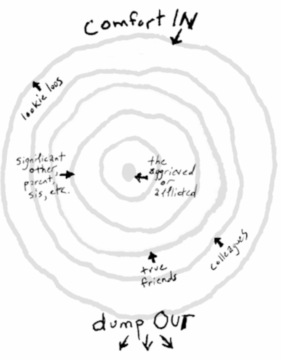
COMPLAIN TO SUPPORT THE VIRTUE OF SOCIALITY
It can be annoying to hear, so it might help if we acknowledge that complaining benefits society as a way to change or maintain norms, develop solidarity, connect more deeply, and enable emotional release. Norlock says, “The role of commiseration in regulating the interaffective realm seems the main function of much quotidian whinging.” If we’re annoyed at the boss, complaining to colleagues helps us determine if it’s reasonable to be bothered about this and to potentially amass allies. If it’s not something we can change, whinging is a means to share ourselves and work through the problem externally. We can learn strategies to change or to make peace with a difficulty by grumbling about it.
Sometimes the underlying question a complaint asks is, “Am I overreacting or coping poorly, or is this new policy as dumb as I think it is?” Any change can be uprooting and feel too difficult to manage, and it can take a while to sort out if change, itself, is the issue or is this change a problem. Overreacting comes when we spiral down to the worst possible consequences and just land there. The neighbour’s dog won’t stop barking, so I can’t do my assignment, and I’m going to fail out of school and never find a job! Whether a story is a comedy or tragedy depends on where it ends, so “And then what will you do?” can help us recognize our capacity to survive difficulties as we eventually come up with a viable way out. Alternatively, it can lead us to such an extremely dour consequence, dead in a ditch perhaps, that we can see how far we’ve come from the reality of our situation: that it’s hard to get going on this assignment. Another person hearing our misery can help us determine the severity of the situation.
If a problem is significant, then lamenting to one person after another can help to develop power through numbers. Even if nothing can be done, it’s empowering to have even a modicum of collective agreement in the face of an inane authority figure or system. And sometimes it’s how change begins. Decades ago I tried to keep my school from being closed and sold. As I complained my way through my colleagues, searching for support, over and over I was told, “Don’t bother; it’s a done deal.” People don’t want to join a failing cause. Luckily, just enough stepped up to help that we were successful.

Beyond trying to solve problems, complaints can be a way to connect. It’s expressing a preference in the negative. It might be seen as an inborn temperament that’s low on agreeability, but a negative perspective is often also searching for agreement. “I hate parties” can be an ice-breaker to find your people who also can’t stand the expectation to mingle. The motivation for sharing dislikes can be similar to sharing things we appreciate: it’s saying, here is a part of who I am. Sometimes it’s easier to know what we don’t like than to figure out the specifics of our ideal option. Complaints are judgments, and they can also point to a discriminating taste, “This wine is undrinkable,” which can be impressive or impressionable. Then there’s shit-talkers who enjoy complaining as a way of gossiping, which can be a way to make people laugh. So much of comedy is just complaining about people or the world. We laugh because it’s so relatable because we also hate that, and it’s easier to accept it when we’re all in this together.
However, sometimes people are looking for a landing spot for responsibility. They don’t want to have to do the thing, and complaining is a way to distract from the task at hand or try to offload it. Sometimes we’re accurately hearing a complaint as a request to fix things. They don’t want so much to be expected of them. It can be a plea for extra grace when competing on a level playing field feels impossible. It can also be a way to lower people’s expectations in case we do sub-standard work or can’t finish on time. How much sympathy we might have for people depends on what we believe they can do, and that’s a minefield to figure out if accommodating a limitation is actually enabling an avoidance.
This type of complaining can be a way to say, “I’m a good person and very hard working, but just look at what I’m up against!” There’s a sense of morality enmeshed with ability. They want the recognition that their lot is harder than most people might have to deal with, either with condolences or admiration. Often their perception doesn’t seem to match reality, but sometimes that’s because we don’t know their whole story. But also we might want to be pitied for our lot in life which acknowledges it’s hard, and there’s nothing we can do about it, so we have permission to submit work late or fall behind or lose our temper, ignoring the difficulties other people are also facing. If my life is the worst, then it gives me an excuse for my behaviour. It’s also more comfortable to believe that it’s harder for me than to acknowledge our personal limitations. Sometimes just having people know what a burden we’re carrying helps us to shoulder it and carry on.
Offering a solution to fix the complaint can be met with anger. The positioning as a victim of circumstances can be a way to shrug off any responsibility, so if they can’t work because of a barking dog, we get a litany of reasons why going to the library isn’t remotely an option! The background thinking might be, ‘There’s a reason I can’t do my essay (or get a date or keep a job…), and it has nothing to do with my own abilities; it’s entirely outside my will.’ But when we reject responsibility, we also reject any agency, and then get really stuck with no possible way out. It’s horrible to feel trapped like that, and it’s also really difficult to watch someone stuck in a hole that appears to be just a few inches deep and listen to them talk about it yet again. We both want the uncomfortable problem to end. People repeat themselves when they don’t feel heard.
As a check, connection, catharsis, or comedy, we might continue to complain because we’ve discovered that sometimes it works. It can be very effective. I’ve been in situations in which a baffling system is in place in some bureaucratic organization, and several emails pointing out the inconsistency or inefficiency can, on the rare occasion, rectify it. It’s gleefully vindicating! Like a slot machine, my complaining behaviour is on a variable ratio reinforcement schedule in which I’m rewarded after a random number of behaviours, so I keep on doing it. Maybe people who are quietly accepting and pleasant are not as equanimous as they appear; they just haven’t felt the satisfaction of this kind of accomplishment.
But some complaining is a problem, particularly when it’s about people, not systems. It’s especially a problem if the complaint is about who a person is and what they might do, not about a potentially harmful thing they actually did. Sometimes it’s a performative judgment that takes advantage of the perturbations of a culture to be admired for their watchfulness. The Drama does a great job of illustrating this. That’s a whole other level of complaining.
Aristotle and Kant call complaining womanly, but I wonder if the manly mode of complaint is more of an order or even a threat. Instead of “Why can’t this be different?”, it’s “This must change!” In one of my first times sharing a house with friends, one guy didn’t like how I put butter in the butter dish. Seriously. Instead of doing what we might call complaining, he said, “Don’t ever let me catch you doing that again!” We all ignored him until he gave up being the house dictator, so it had the same effect of a random complaint without a solution. The message was the same, “I don’t like this,” but the tone and word choice coded it as more masculine. A lower and louder voice can further turn a complaint into a command, but I don’t think that necessarily makes it better. I get why it might be more admirable, though. We look up to people who seem confident and dismiss people who seem ineffectual. My housemate was trying to take charge in the wrong place with the wrong person over the wrong issue, so it failed, but in the right circumstances, it can carry more weight to be demanding instead of questioning, to be someone people have to listen to instead of someone they can comfortably dismiss. But that misses the connective elements being communicated; it doesn’t support that virtue of sociality.
A command that’s ignored knocks the wind out of its sails, and can turn it into a plea. It takes that risk. A complaint is ignored more easily, but can gain power through repetition from one or many. The alternative to either is a request, which honours the possibility of being rejected or denied, acknowledging our powerlessness in the situation.

Enjoying the content on 3QD? Help keep us going by donating now.