
by Michael Liss
My Jefferson is a giant, but a giant trammeled in a net, and obliged (he thought) to keep repairing and strengthening the coils of that net. —Garry Wills, “Negro President”
Late in his life, uncertain in his health, but sure in his pride, rummaging through the immense library of his memories, his soaring successes, and his every-day regrets, Thomas Jefferson had cause to define the words, his words, that Americans so justly celebrated.
The Declaration of Independence, he wrote in an 1825 letter to Henry Lee, was not original in the sense of creating “new principles, or new arguments, never before thought of,” but was instead “intended to be an expression of the [A]merican mind.”
Such was his grasp of that moment in 1776, such was the reach of his ambitions half a century later, that he could claim his words conveyed just that, in “terms so plain and firm, as to command their assent.”
Maybe he was right. Maybe the place the Declaration has for itself in American historical iconography is unassailable—it, too, commands assent. Lincoln thought so, both in his public words (“[f]our score and seven years ago”) and his private correspondence, as here, in an April 1859 letter to Henry L. Pierce and others:
All honor to Jefferson—to the man who, in the concrete pressure of a struggle for national independence by a single people, had the coolness, forecast, and capacity to introduce into a merely revolutionary document, an abstract truth, applicable to all men and all times, and so embalm it there, that to-day, and in all coming days, it shall be a rebuke and a stumbling-block to the very harbingers of re-appearing tyranny and oppression.
Of course, politicians, and people, seek validation for themselves and their ideas in the unifying principles and heroes of the past. To say, “I’m with Tom” is to connect oneself to greatness. America, at its best, is a vision that is lit from within by great ideas. Do those ideas still retain their power when the vessel that holds them is a contradiction of the principles themselves?
Last month, I wrote about the renewal of the Jefferson-John Adams friendship. I had intended on doing a second essay about their philosophical differences on government, on the value of freedom over order, on collective action versus individual efforts, on the virtues of an agrarian lifestyle, and on the relative merit of a strong central government rather than one where authority is more diffuse. Those are still great topics, especially at a time when we have an open and fierce debate about basic American individual liberties and the power of the state to interfere with them.
Because of the nature of the Jefferson-Adams correspondence between 1813 and 1826, and because of Adams’ rare but purposeful discretion on the topic of slavery (he didn’t press Jefferson on it), I had planned to leave discussions about the moral and political position of Jefferson on slavery to a later essay, but then Bill Murray raised this on the 3 Quarks Daily website: “Eager to find out next month if Jefferson explains the teensy little matter of his 600-plus slaves.” Next month is here, and Bill was right. What about that? Was Jefferson really worthy of our esteem?
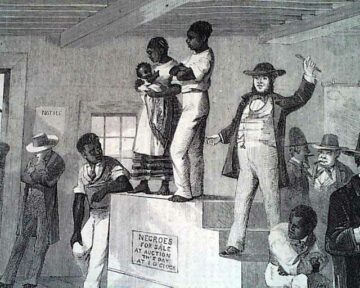
Yes, Jefferson was born into a slave-holding family, inherited slaves, kept hundreds of slaves. He bought and sold them, he took slaves with him when he went to Europe, he fathered several children by a slave, and, perhaps the most revealing, out of about 150, he freed only five (from the Hemings family) in his Will. The remainder were sold to create liquidity for his Estate and pay off debts.
It is said that he tried to manage his slaves with some humanity, preferring to keep families together, balancing his better instincts for a humane overseer against a perceived economic need for more “hands on” discipline. There is no question he built his little Monticello community with an idea of grace, of intellectual, architectural, and spiritual harmony. Visitors there (and there were literally thousands from the time Jefferson left Washington in 1809 to his death in 1826) did not report squalor in the slave quarters or overt brutality.
That’s what history has for us. It’s probably sanitized: Jefferson the benign creator, gentle, empathic, modeling “best practices” for the Virginia Plantation owner class. Jefferson the anguished, aware of the wrongness of slavery, forever seeking a better way. Jefferson, the bound giant, forced by economic reality to embrace the Peculiar Institution. Even Jefferson the compassionate, seeing the terrible risk in mass emancipation and, accordingly, deciding not to emancipate.
We don’t need to be cynical about this. Place Jefferson in the context of his time, the social values of that time, the realities of slave life, of sexual exploitation, of intrinsic brutality and degradation, and some may find that he emerges as the man of comparative moral excellence that he saw himself as being.
But we are also talking about Jefferson, the man who inspired the Revolutionary Generation, who Lincoln looked back to as the mooring post for all recognition of individual liberties. When we think about the Fourth of July, he is central to our emergence as a new nation. He put before the world an “expression of the American mind,” a “self-evident” truth “that all men are created equal, that they are endowed by their Creator with certain unalienable Rights, that among these are Life, Liberty and the pursuit of Happiness.”
Could there be better words? Is that man, that Jefferson, in the fullness of himself, the man we want to keep on a pedestal? Is the known universe of information about his personal conduct disqualifying?
I don’t think we are going to get that much more. Genetic testing might reveal a new family member. Perhaps some forgotten portfolio on a dusty library shelf might turn up another treasure trove of letters. These are possible, but the idea that something new would change the bigger picture seems increasingly unlikely. The story has been told. Instead, I think we are better off looking at what he did, and what he said, privately and publicly, beyond the apparently inoculating effect of his thunderous denunciation of both slavery and the slave trade in an early draft of the Declaration of Independence.
Let’s look at Jefferson at different stages of his political and personal life and hope to gain greater insights into the man.
It’s worth starting with the good: He made genuine attempts to insert bans on slave trade and gradual emancipation in his drafts for the Virginia Constitution in 1776. So, too, after the United States had received huge tracts of land west of the Appalachian Mountains in the Treaty of Paris (1783), he tried to include a ban on slavery that would be effective there after 1800. The younger Jefferson was still animated by a desire to limit slavery and acted on it.
The 1780s also brought one of his most interesting intellectual efforts, “Notes on the State of Virginia,” initially published anonymously in 1781, then rolled out over the next few years for a wider audience. “Notes” is his only published-for-attribution book; he’s writing for a very specific audience; and, in describing Virginia, he is also revealing a considerable amount about himself. There is more than a little irony here.
Let’s dig in. Here is Jefferson on the degrading aspects of slavery:
There must doubtless be an unhappy influence on the manners of our people produced by the existence of slavery among us. The whole commerce between master and slave is a perpetual exercise of the most boisterous passions, the most unremitting despotism on the one part, and degrading submissions on the other.
Then, on the threats to society that the continued existence of slavery promoted:
And can the liberties of a nation be thought secure when we have removed their only firm basis, a conviction in the minds of the people that these liberties are of the gift of God? That they are not to be violated but with his wrath.
One can’t help noticing Jefferson’s acknowledgement of the depth of the nation’s civic sin. His invocation of the “wrath of God” is later used by Lincoln in his Second Inaugural:
Yet, if God wills that it continue until all the wealth piled by the bondsman’s two hundred and fifty years of unrequited toil shall be sunk and until every drop of blood drawn with the lash shall be paid by another drawn with the sword…
How do we end this cycle of despotism and degradation? In “Notes,” Jefferson references an Act with a big idea:
To emancipate all slaves born after passing the act. The bill reported by the revisors does not itself contain this proposition; but an amendment containing it was prepared, to be offered to the legislature whenever the bill should be taken up, and further directing, that they should continue with their parents to a certain age, then be brought up, at the public expence, to tillage, arts or sciences, according to their geniusses, till the females should be eighteen, and the males twenty-one years of age, when they should be colonized to such place as the circumstances of the time should render most proper, sending them out with arms, implements of houshold and of the handicraft arts, feeds, pairs of the useful domestic animals, &c. to declare them a free and independant people, and extend to them our alliance and protection, till they shall have acquired strength; and to send vessels at the same time to other parts of the world for an equal number of white inhabitants; to induce whom to migrate hither, proper encouragements were to be proposed.
With that good intention (if not entirely practical prospects), Jefferson raises a question that again contains its own irony:
It will probably be asked, Why not retain and incorporate the blacks into the state, and thus save the expense of supplying, by importation of white settlers, the vacancies they will leave? Deep rooted prejudices entertained by the whites; ten thousand recollections, by the blacks, of the injuries they have sustained; new provocations; the real distinctions which nature has made; and many other circumstances, will divide us into parties, and produce convulsions which will probably never end but in the extermination of the one or the other race.
Uncomfortable yet? This is the 1780s Jefferson, a widower, a man in his 40’s, of considerable experience and reputation, who wrote this from abroad when he was serving as Minister to France. Adjusting for language (there’s some repulsive passages that reflect age-old prejudices), what you are getting is what his mature mind thinks: Slavery is morally wrong. It debases both the slave and the enslaver. It should be legislated out of existence—gradually, of course. There is an obligation to educate slaves and prepare them for freedom. And they need to leave, because relations between ex-slaves and whites will never be good enough to support coexistence, or even avert a war of extermination.
What? Leave? Race-wars? What happened to the gallant advocate of universal rights who fought until the end to have his language on slavery included in the final draft of the Declaration? He’s still there, but realities are changing. His proposals will be too radical for some, too timid for others, and they are crafted for public consumption, but they are not so far out of the mainstream that they wouldn’t be considered.
There are at least two ways to look at this. The first is as Jefferson might have seen it—a bold, creative, risk-taking humanitarian effort. The second is less flattering—it’s deliberately impractical and becomes more impractical with each passing year, as the slave population continues to grow. Because it’s impractical, because it can’t be implemented, it serves merely to delay, and perhaps to delay permanently.
Let’s withhold judgment on whether we think the 1780s’ version of Jefferson was mostly engaged in insincere virtue-signaling. What about the time Jefferson was President? For all his protestations about preferring limited government, he clearly wanted the job and played hardball politics to get it. He was 58 when he took office, older than Washington had been. Did he use his office to try to ameliorate the sufferings of the slaves? Outside of encouraging and signing the bill to end the slave trade (something anticipated by the Constitution itself), very little. That leads us to an interesting question—did he have any responsibility to do so? Do you think less of him because, when he had power, he chose not to use it?
There’s some sadness to Jefferson’s life after the White House. In some respects, he became a celebrated irrelevant. He was consumed with the financial challenges of keeping up his plantation. While he maintained good health, he became less pliant in his thinking, clung to old political instincts. States’ rights (more accurately, the rights of Virginia) became more important to him. He replayed in his head (and in conversation and letters) the contests of the past. He opposed what he saw as the old Federalist playbook—concentration of authority, intrusions on his ideal of a diffuse, agrarian society. He despised Justice Marshall and rejected judicial review. The federal government, he felt, was one of limited authority Constitutionally and should respect those limits.
For these issues, he kept up an active correspondence, but, in one key area, he had changed—he was no longer the advocate for the slave he once had been. The public in general did not know this and he was often approached to take or lead a public stand. He demurred, always, claiming he’d made a promise to himself to withdraw on the subject and defer to the efforts of the younger generation.
The Missouri Crisis of 1819-20 showed this in a stark light. The situation was admittedly a difficult one. The masterstroke of Jefferson’s first term, the Louisiana Purchase, brought 832,000 acres of largely undeveloped land to the country, and a great many people planning on how to use that land. A seminal question, both socio-economically and politically, was the obvious one—would the new territories be slave or free. Southerners noted with alarm that, as early as 1804, the states north of the Mason-Dixon Line had abolished slavery. They assumed (with what they thought was good reason) that those states would push for a prohibition on slavery generally through the new territories. Serious debates tied up the Congress for months, and both sides realized that they were dealing with possibly existential questions not merely of slavery, but also of political power. In the end, aided by a virtuoso performance by Henry Clay, emerged the Missouri Compromise, which admitted Missouri as a slave state and Maine as a free one and also included a provision that outlawed slavery above the 36º 30′ latitude line in the remainder of the Louisiana Territory.
Jefferson was outraged. The historian Richard Ellis makes the point that the Revolutionary generation had made a tacit bargain—the two sides, North and South, would stop talking about slavery, and the North would maintain that silence, leaving the South to handle it. Raising the issue, even when by the next generation, breached that agreement. Ellis says, “What most rankled Jefferson about the debate over the Missouri Question was that it was occurring at all.”
But Jefferson was also being a little disingenuous. The Revolutionary generation’s tacit bargain did not, and could not, leave the South the sole voice as to where slavery might go. Nor did it determine, forever, which political party would have a semi-permanent hold on power.
Nevertheless, he waded in, showing a little less discretion than at other times. There’s a fascinating exchange of letters between Jefferson and John Holmes, a young Congressman from Massachusetts who was the author of a pamphlet supporting the Compromise. Jefferson answers kindly but bluntly, and his arguments are worth examining.
First, don’t talk about slavery, and certainly don’t talk about where it can go:
This momentous question, like a fire bell in the night, awakened and filled me with terror. I considered it at once as the knell of the Union. It is hushed, indeed, for the moment. But this is a reprieve only, not a final sentence.
A reminder of Jefferson’s bona-fides:
[T]here is not a man on earth who would sacrifice more than I would to relieve us from this heavy reproach, in any practicable way.
Ah, watch that qualifier at the end. “Practicable” Jefferson has gone from proposing a program of emancipation and resettlement to relying on its impracticability as a reason to do nothing.
Jefferson’s real fear, which should be self-evident:
But as it is, we have the wolf by the ears, and we can neither hold him, nor safely let him go. Justice is in one scale, and self-preservation in the other.
This might be unpleasant to read, but it’s likely an accurate reflection of Jefferson’s inner thoughts.
On the impact of restrictions on slavery from potential “Free States”:
[T]he passage of slaves from one state to another, would not make a slave of a single human being who would not be so without it, so their diffusion over a greater surface would make them individually happier, and proportionally facilitate the accomplishment of their emancipation, by dividing the burthen on a greater number of coadjutors.
This, as applied to the new territories, is the “dispersal” argument, and I find it absurd. Readers should apply their own judgments—do you agree with the concept; do you see it as a Trojan Horse for the unlimited expansion of slavery; do you find Jefferson more deluded than disingenuous?
What Congress should do:
An abstinence too, from this act of power, would remove the jealousy excited by the undertaking of Congress to regulate the condition of the different descriptions of men composing a state. This certainly is the exclusive right of every state, which nothing in the Constitution has taken from them and given to the general government.
This is dynamite. It goes to the heart of how we experience being governed. It reflects Jefferson’s core rejection of a centralized power, his powerful attraction to an agrarian life away from the corruption of cities, where the father/husband/patriarch rules his family, his “staff,” and his acreage with sagacity and compassion, free of government interference.
It is, whether Jefferson acknowledges it or not, a rejection of what the Constitution and the body of law built from it do say. It’s also remarkably self-absorbed. Congress (and the Chief Executive) should not in any way be discussing, much less acting upon an issue that has national consequences. It’s not the first time Jefferson has advocated for States’ Rights (his anonymous authorship of the 1798 Kentucky Resolutions in opposition to the Alien and Sedition Acts includes a nullification justification), but, because this is so much about slavery, it seems to be making a procedural argument on what is clearly a moral and political issue.
Jefferson became obsessed—not just over the matter of the expansion of slavery, but over the expression of federal power and even federal involvement in almost every way. In 1825, he suggests sending to the Virginia Assembly a “Solemn Declaration and Protest,” specifically in opposition to internal improvements, but, more generally, on resistance to federal legislation. He didn’t quite call for dissolution, but came very close. His friend (and political guru) James Madison talked him out of it, but didn’t change his mind. He increasingly lent his name to the fringiest States’ Rights arguments and the fringiest States’ Rights arguers (like John Randolph of Roanoke), dignifying their cause with his illustrious name.
So, what about that “teensy little matter of his 600-plus slaves”? What about Jefferson—is he deserving of our esteem?
Per Gary Wills:
That system ruled the South. It cowed and silenced the North. … Jefferson felt he had no choice but to defend the evil. There was no large-scale political career open to southerners who refused to defend it. That is the tragedy of Jefferson, and of the nation. We may admit that he was trapped in the system—which is all the more reason for deploring the trap.
More on Jefferson and Adams next week.