
by Jim Hanas
Almost thirty years ago, in what would now be called a quarter-life crisis, I felt called to Greenville, Mississippi. It’s not too far from Memphis, beyond the casinos, which were new then and also called to me from time to time. I had been introduced to Walker Percy at the used bookstore where I worked. The Moviegoer, with its moody twenty-nine-year-old protagonist, hit me at the right time in life and set me on the Southern Route of mid-century male ennui. (As opposed to the Northern Route through Roth, Bellow, and Updike, of whom I remain woefully innocent, despite living in New York for more than twenty-five years.) I devoured all of Percy’s works. Like Binx—the protagonist of The Moviegoer—I realized a search was possible, the first step of which was a pilgrimage to Greenville, where Percy grew up. “The search,” as Binx tells us early in the novel, “is what anyone would undertake if he were not sunk in the everydayness of his own life.”
According to Percy’s taxonomy of “existential modes”—borrowed liberally from Kierkegaard and articulated in his 1956 essay “The Man on the Train”—I had moved from alienation to rotation, from the immersive grayness of modern life (what Kierkegaard would call despair) to the pursuit of the new. Through friends, introductions were made. I wrote a letter to Shelby Foote—who grew up with Percy in Greenville—and he left me a voicemail, telling me (in that drawl Ken Burns made famous) that “the whole town had whittled away to nothing and the young people don’t have much fun anymore.”
I had breakfast with Percy’s nephew, who was pleasant but as confused as I was about what I was after. I also saw the aftermath of a fatal car crash and nearly fell in love with my local guide, a twice-divorced mother of two with thick ankles and a sweet singing voice. (Actually, depending on how familiar he was with his uncle’s work, his nephew—who was probably the age I am now—might have understood what I was after better than I did.)
This all now seems incredibly apt as I move on to Percy’s third “mode,” repetition, three decades later. You can’t go home again, but you will inevitably try, just to sneak up on the strangeness of life.
Diagnosing and overcoming alienation was the central concern of Percy’s work, and the project was urgent. He ended up in Greenville in the first place—under the care of his father’s cousin, the poet Will Percy, to whom The Moviegoer is dedicated—after his father committed suicide, a fate met by a male Percy in each of the preceding generations. As it did for Camus, suicide remains an existential possibility in Percy’s philosophical writings, which constituted most of his published work before the appearance of The Moviegoer in 1961. Eleven of the fifteen essays in The Message in the Bottle—the 1975 collection of his philosophical work—appeared before The Moviegoer, and in them you can see him laying the groundwork for the novel, going so far as to offer critiques of the mid-century alienation novels Point of No Return and The Man in the Gray Flannel Suit, seemingly trying to chart a course between and beyond them.
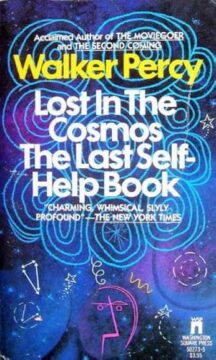
After The Moviegoer, Percy wrote five novels, two duologies—one like The Moviegoer, the other more like Vonnegut—and his most overtly religious novel, Lancelot. The book I now find most thrilling, however, is 1983’s Lost in the Cosmos: The Last Self-Help Book, and for two reasons.
First, I’m a fan of the philosophy in philosophical novels. (Foote was not. They fought like crazy about it in their letters, when they were not arguing about Foote’s modernist atheism and Percy’s scandalous conversion to Catholicism.) Second, I have my doubts about the continued usefulness of the novel as a discrete form. As David Shields has articulated, the novelistic form often feels to me like an intrusive apparatus that conceals more than it reveals. The novel arose from a synthesis of letters, diary entries, news clippings, and vernacular forms, and to these it might be meant to return. You know, like Either/Or.
If Percy borrowed theory from Kierkegaard before The Moviegoer, in Lost in the Cosmos, he explores the possibilities of Kierkegaardian form. If Kierkegaard had lived through the 1970s, would he have written a parody of a self-help book with hilarious descriptions of the tragicomic ills of the age, complete with quizzes, diagrams, and vignettes disguised as thought experiments, meant to bring the modern reader face to face with his alienation? Do we even need to ask?
Believers are often the cruelest satirists of worldly concerns, simply because they do not share them. Percy belongs to that lineage, which runs from Kierkegaard and Dostoevsky through G.K. Chesterton and Evelyn Waugh.
The first half of the book is simply hilarious. It thoroughly explores why travel is always disappointing and, in my favorite pages, why studio audiences always cheer when their hometown is mentioned, which I’ve never been able to experience the same way again. In a chapter subtitled “How the Self, Which Usually Experiences Itself as Living Nowhere, is Surprised to Find that it Lives Somewhere,” the reader is asked to select why “Chicagoans in Burbank, California, applaud at the mention of the word Chicago,” where Percy’s preferred answer is clearly:
c) Because a person, particularly a passive audience member who finds himself in Burbank, California, finds himself so dislocated, so detached from a particular coordinate in space and time, so ghostly, that the very mention of such a coordinate is enough to startle him into action.
This ghostliness and unfamiliarity with oneself is the driving theme of the book, which is stated in one of several alternative subtitles as the problem of “Why it is possible to learn more in ten minutes about the Crab Nebula in Taurus, which is 6,000 light years away, than you presently know about yourself, even though you’ve been stuck with yourself all your life.”
Percy has a specific, and somewhat technical, answer. In a long central section, he lays out his semiotic theory, present in the pre-Moviegoer essays, which is a sort of synthesis of Peirce and Sartre. In short, he argues that the advent of language—like the monolith in 2001: A Space Odyssey—changed everything and opened a new, irreducible dimension that is subjective rather than objective, triadic rather than dyadic, where humans have not only an environment but “a world” in the Heideggerian sense. Percy trained as a doctor, and this view of language marks his conversion from physician to phenomenologist. (I had a similar experience as an undergraduate trying to make myself at home. I rapidly cycled through majors, from political science to psychology, before being introduced to Merleau-Ponty and settling, at last, on philosophy.)
The practical upshot of this, for Percy, is that—as sign-givers—we are almost too free. Since we can be anything by consuming signs, we end up feeling like nothing. In one chapter he sets out to explain “How the Self Tries to Inform Itself by Possessing Things which do not Look like the Things They’re Used as,” which should elicit a nervous giggle from any Brooklynite or fan of HGTV. Percy’s preferred choice is:
d) Because the self in the twentieth century is a voracious nought which expands like the feeding vacuole of an amoeba seeking to nourish and inform its own nothingness by ingesting new objects in the world but, like a vacuole, only succeeds in emptying them out.
Ouch.
According to Percy, while this restless rotation is an irreducible hazard of language, it is made more acute by the contemporary insistence that this irreducibility of meaning will at some point be reduced to mechanical explanations. It’s like we are living in a building that has been condemned, the eviction date forever postponed.
Percy’s solution, like Kierkegaard’s, is religion or—as I would prefer—a reliance on a power greater than oneself. He considers all others thoroughly in Lost in the Cosmos—including science and art, which he finds temporary and flawed—and acknowledges the difficulties of conversion in an age of such hypocrisy, but finds no other alternative for grounding the restless self. This is not a sentimental claim, but a structural one. (Percy might be the least sentimental believer I’ve ever encountered.) As sign-givers who devour the world through their restless rotation, something that is not itself a sign must be enlisted, or the search, once begun, will go on forever.
At the end of The Moviegoer, Binx settles down. He grows up, we might say. How does this differ from the resolution of The Man in the Gray Flannel Suit, of which Percy was critical? Tom Rath exits the rat race for a life centered around his family. For Percy, this resolution suggests that rotation alone can solve alienation. Rath finds his “authentic” self. While the endings are superficially similar—Binx gets married and plans to go to medical school—it is unclear if the search has come to an end. “As for my search,” Binx tells us in the epilogue, “I have not the inclination to say much on the subject.” At the risk of emptying it out like the latest coffee table, Binx declines further description. “Reticence, therefore, hardly having a place in a document of this kind,” he writes, “it seems as good a time as any to make an end.”
Enjoying the content on 3QD? Help keep us going by donating now.