
by Angela Starita
The state of the world, it’s understood, has led to poor sleep habits and hours of doom scrolling. My own sleep is regularly ruined by my before-bed routine of doing puzzles and then watching YouTube videos or listening to podcasts, sometimes for hours. But my nighttime media consumption is rarely news–no suspects running across rooftops or deep dives on Supreme Court decisions. Instead, I’ve constructed a pre-sleep universe of private nostalgia to stanch a stream of saliva that wakes me at three, prompted by a boring list of fears, personal and universal, questions about mistakes made and life’s purpose. (The mighty limbic systems of doom scrollers is beyond my imagination.)
The most effective, most comforting, of my pre-bed listening comes from an app called LibriVox, where volunteers read books “in the public domain,” that is, books more than 80 years out of copyright. The site is driven by the premise that books should be available and free to all, with the inflated tag line “acoustical liberation of books in the public domain.”
On the face of it, the available selection is predictable: lots of Dickens and Austen, dozens of Sherlock Holmes and Agatha Christie mysteries. The choices are made by the readers who record themselves, then upload the recordings to the site. Each episode begins with a reader announcing their name and sometimes the title of the book and publisher. Occasionally, the books are read like radio plays with the readers introducing themselves at the start. Robert Louis Stevenson’s Kidnapped, for one, is read by a large group (friends? aspiring voice actors?) who each adopt a nom de lisant, among them Shrimpfish, Gary O., and, to underscore the olde timey nature of reading a book for a phone app, Mr. Beeswax Candle.
When you peruse LibriVox’s catalog, you’ll also find dozens of titles from the 19-teens and ’20s that combine religion, self-help, and finance, 11 titles by William Walker Atkinson alone. I’ve learned that Wilkinson and other authors in the LibriVox catalog like Wallace D. Wattles and Ella Wheeler Wilcox were part of a movement called New Thought with roots in early 19th century thought and most widely popular as part of the Third Great Awakening of the turn of the 20th century. Its tenets are vague enough to heal a ton of psychic wounds of that era of industrial growth: you’re no one’s victim and you can control your fate using your mind alone. No surprise that its best-known exponents were based in Chicago, but thanks to the rise of publishing not to mention free libraries, these books had an enormous impact on pastors around the country like Father Divine and Norman Vincent Peale, who both used radio to reach tens of thousands.
Wallace Wattles’ The Science of Being Great (1910), for one, hits the expected notes of self-reliance, the optimistic belief that circumstances of birth are not limitations. I can only find one photo of him looking like a cartoon American Gothic, a portrait of him as silly and dated as his name. But he wrote with surprising vigor. He’s not selling anything he doesn’t believe himself. What’s more, you can see immediately the attraction of his argument: not only does he grant his audience complete power over their fate, he counters the prevailing idea of eugenics, repeatedly telling his listeners that the shapes of their skulls means nothing to the acquisition of greatness. What’s key really is focus, not to mention gratitude.
I’m really drawn in and begin to think, you know, I really should be more upbeat. But then I tune into the first chapters of his 1910 book, The Science of Getting Rich, read expertly by one Daniel Sanchez (his is the second of three recordings of the book you can listen to on LibriVox), and am disappointed to discover that my Wallace is a common hustler, just one of many New Thoughters who embraced what today’s adherents call the Prosperity Gospel. The idea is an old one: God favors the faithful with wealth and health. If you get sick, it’s your own doing, you and all your gripes that would keep any self-respecting positive aura at bay. I doubt the idea that your sickness is your own boo-hoo fault started with Wattles, but it’s certainly still thriving. (When a friend was diagnosed with breast cancer, her father, a successful lawyer used to controlling his odds, called a family meeting to glean what exactly my friend had done to cause the calamity. His goal was to prevent cancer in his other daughters.)
Despite being let down, I’m still willing to subject myself—and my husband who is trapped in our car during a 2-hour trip—to the rest of the book in no small part thanks to Sanchez who reads the thing with heroic equanimity. The written form of The Science of Getting Rich is filled with heretical claims stressed with italics and random capitalization, but Sanchez is determined to be dignified. When Wattles describes some primordial goo that he calls Original Substance—it’s like a metaphysical Play Doh that materializes into the stuff you want—Sanchez doesn’t stoop to ironic inflection, and I’m sure that if he were writing this essay, he’d not resort to pitiful jibes like “metaphysical Play Doh.” I want to know what he really thinks: Is he looking to get rich? Has he used Wattles’ method (which boils down to think big, be grateful, and take action) and now wants to share the good word? Is he fascinated by this hundred-year-old book because it’s so similar to self-help rhetoric of our time? He’s an effective reader because, while he reads with at a good pace and clearly, he never imposes himself, consciously or otherwise, on the text. It’s surprisingly hard to come by a reader like Sanchez.
I’ve often been excited to start listening to a book in the LibriVox catalog only to shut it off after a minute because of some distracting quality of the reader’s voice. Sometimes it’s the person’s volume or lousy reading chops, but most of the time the problem is the flatness of delivery. What’s worse are those who try to act by using exaggerated inflections and accents. (Had I kept listening, the number of God-awful Scottish accents in Kidnapped would have driven me to leave my bed, make coffee, and find a few documentaries about serial killers.)
On the point of accents, though, it’s worth noting that a fair number of the readers aren’t native English speakers and are probably using the app to improve their pronunciation. Sometimes this makes for more engaging listening. Dmitri, who reads a few chapters of Hard Times, never exaggerates or stumbles; instead his slight accent gives his voice a lightness that is almost always missing from American readers.
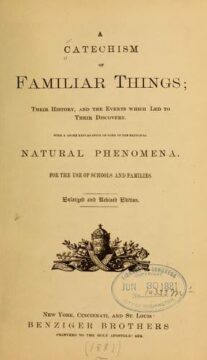
My favorite of all the LibriVox titles I’ve sampled is unquestionably the site’s recordings of chapters from an 1881 book titled A Catechism of Familiar Things. The book’s author is listed as the Benzinger Brothers, but I discovered that that’s the name of the book’s publisher, a firm based in Brooklyn that catered to a Catholic audience. The introduction notes that the book is “a reprint of a successful English publication, [that] has been so enlarged as to be to all intents and purposes new. It has been carefully revised by a Reverend gentleman, who for some time filled the chair of Physics and Chemistry in one of our colleges.” The original from 1851 is by Emily Elizabeth Willement, a woman who wrote books about ornithology and botany for children. I’ve not found a copy of the original text, but I’m guessing that it was Willement who came up with its concept and format since the book purports to explain in simple terms the origins of our material lives. All of it. The chapters are grouped into categories of things: Chapter 1: Dew, Water, Rain, Snow, Hail, Atmosphere, Wind, Lightning, Thunder, Electricity, Twilight, and the Aurora Borealis; Chapter 2: Corn, Barley, Pearl Barley, Oats, Rye, Potatoes, Tea, Coffee, and Chocolate; Chapter 3: Calico, Cotton, Cloth, Wool, Baize, Linen, Flax, Hemp, Diaper, Holland, Canvas, and Flannel; and so on. Often a paragraph will start with a question by an unnamed interlocuter.
Of what form is the tree that bears those large nuts called coconuts?
It is tall and straight without branches and generally about 30 or 40 feet high. At the top are 12 leaves, 10 feet long and half a foot broad. Above the leaves grows a large excrescence in the form of a cabbage excellent to eat but taking it off kills the tree. The cocoa is a species of palm.
Is not the Indian liquor called “toddy” produced from the cocoa tree?
Yes. Between the leaves and the top arise several shoots about the thickness of a man’s arm which when cut distill a white sweet and agreeable liquor.”
A few paragraphs in and the problem with the enterprise becomes immediately clear: to explain any one thing, you’ll need to explain dozens of other concepts. To solve this, Willament and her American editor provide their explanation and then insert definitions for any words that the reader might not know. Here they are on vapor:
Vapor is water combined with a still greater quantity of caloric that is an imponderable and subtle form of matter which causes the sensation of heat and, which driving asunder the particles of the water, renders it aeroform.
Imponderable: without sensible weight
Subtle: thin, not dense or compact
Particle: a small portion of matter
Aeroform: have the form of air
I’ve listened to A Catechism of Ordinary Things dozens if not hundreds of times. I started when my husband, a troubled sleeper, was out of town, and I could take up all the physical and acoustical space I wanted. At first, I found the thing maddening and would listen more to hear just how feebly she’d try to explain, say, sulfur or mahogany. Though I told myself I was using this for sleep, I had momentarily hoped that I would in fact learn a few things about calico and isinglass. On top of that, chapters weren’t read by one person but a whole gang of readers of different abilities. But I eventually settled in and, thanks in large part to my favorite Catechism reader, Jonathan Horniblow, began listening with much more patience and a growing curiosity about the readers. (Horniblow is British and, thanks to a Google search, I gather he’s a voice actor looking for work at the BBC.) Why choose this odd book to spend hours recording with its eddies of interminable questions? Maybe like me, he slowly began to feel some admiration for Willament, who like Wattles with his Original Substance, was so determined to find the root of all things.
My husband claims that I am prejudiced against American readers, and while I usually give them lower marks than their British colleagues, I’ve long been a fan of another Catechism reader named Kara Schallenberg. Undoubtedly American, she’s never betrayed a clear regional accent. I’ve imagined her to be a well-organized grade school teacher, clear, never pandering. There’s an open-ended quality to her voice—not upspeak at all, but a sense that she can handle disagreement with civility. She too was a victim of my prying internet searches, my refusal to just let these people read in peace. Shallenberg, I learned, died in 2023. She lived in Oregon, had thick blond hair, and was sick with pulmonary arterial hypertension. To find meaning in life as her mobility diminished, she knitted and read books for Librivox. Her son logged on to her blog a few days after her death to urge us to “keep listening to her stories, enjoying life, reading to children, growing good food, eating less meat, and creating things for your loved ones.”