
by Jonathan Kujawa

Lots of people enjoy a good puzzle. Take Sudoku puzzles. Like many good puzzles, the rules of Sudoku are simple. The challenge is to figure out the implications of each possible move and to use those implications to reason our way to the solution. You probably know how this goes: you try to put a 5 in one box, but that leads to problems down the road when that choice forces you into a situation that violates the rules. The only way out is to relent and admit that 5 must go into a different box.
At its heart, mathematics is a vast Sudoku puzzle. Through reasoning, clever observations, and following the implications wherever they go, we learn new things about the mathematical universe. For example, if xn + yn = zn has a solution where n, x, y, z are integers and n > 2, then certain geometric shapes called elliptic curves must have a unique associated function with special properties that make it a “modular form” [1]. Hard work by Andrew Wiles and many others showed that the relevant elliptic curves cannot be associated to a modular form; hence, we must relent and admit that Fermat’s equation has no solutions.
Mathematicians love nothing better than solving a math problem by conjuring new knowledge out of thin air using nothing but creative reasoning. That creativity and use of the human mind are sadly missing from much of our math education.
The problems of puzzles are very near the problems of life. —Erno Rubik
I was recently reminded of the puzzle-like nature of mathematics. In conjunction with the annual Teachers of Teachers of Math conference hosted by my university, my department hosted a celebration of the life and career of our colleague, Gary Musser. Gary was a long-time faculty member in our department who, sadly, passed away this year. I had the pleasure of chatting with Gary and his wife, Irene, when I first arrived at Oregon State. Although Gary retired several decades ago, he and Irene continued to have a deep interest in the department, in mathematics, and in teaching mathematics. In their honor, the department gives the Gary Musser Award each year to support outstanding prospective elementary or middle school teachers.
Why an award for prospective teachers? Well, while Gary’s PhD thesis was on a highly theoretical and advanced area of mathematics, his professional energies were focused on an even harder problem: how to train school teachers to be effective at teaching children mathematics. This problem is doubly hard. After all, young children need a good educational experience in math, and at the same time, the teachers of young children are often not “math people” themselves. Gary understood the importance of solving this problem. He spent his career having a profound effect on how mathematics is taught in Oregon and across the United States.
One of Gary’s strongest-held beliefs was in the importance of puzzles. Specifically, creative reasoning puzzles that tied into mathematics. By connecting teachers and, by extension, their students with the puzzling nature of mathematics, Gary was convinced he could unlock an understanding and a love of the subject. Gary, Blake Peterson, and William Burger wrote a seminal textbook entitled Mathematics for Elementary Teachers. Blake told us that Gary insisted that puzzles be at the forefront in their text. Gary was a wizard at finding (or inventing) puzzles that caught the imagination while also revealing an important pedagogical point. During the memorial, Blake and his co-presenter, Mike Shaughnessy, shared the following puzzle:
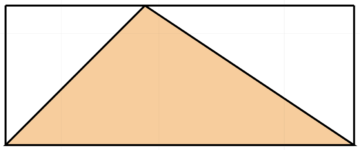
You might think there is not enough information to solve the puzzle. I promise there is. You might try to calculate using the Pythagorean theorem, the formulas for the areas of rectangles and triangles, and various other geometric machinations. But those fancy tools are unnecessary. With a single insight, the puzzle almost solves itself. Here’s a hint [2].
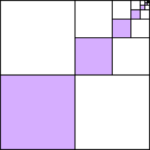
Blake and Mike then shared a puzzle which appears even harder at first glance, but likewise yields to a bit of cleverness. In the picture on the right, what proportion of the big square is contained in the purple squares? On this problem, the mathematicians are at a disadvantage. If you have taken calculus, you will be tempted to turn this problem into an infinite series and use high-powered techniques to compute that series. The secret is to be patient, think deeply, and look for an insight that cuts straight through to the solution [3].
There is another type of puzzle that is devilish fun. Again, it seems like you haven’t been given enough information, and yet it is possible to answer the question with careful thought. They are sometimes called I Don’t Know puzzles because they typically involve a scenario where the characters say “I don’t know” some number of times, thereby revealing information that eventually leads to the solution. Here’s one:
Irene and Gary are told that integers 𝑥 and 𝑦 have been chosen such that 1 < 𝑥 < 𝑦 and 𝑥 + 𝑦 < 100. Irene is given the value 𝑥 + 𝑦, and Gary is given the value 𝑥 ⋅ 𝑦. They then have the following conversation.
- Gary: “I cannot determine the two numbers.”
- Irene: “I knew that.”
- Gary: “Now I can determine them.”
- Irene: “So can I.”
Given that the above statements are true, what are the two numbers?
While it seems impossible to figure out x and y, the key is to realize that a tidbit of information is revealed at each stage of the conversation. First, Gary admits knowing 𝑥 ⋅ 𝑦 doesn’t tell him x and y. This reveals that x and y cannot be prime numbers (because if 𝑥 ⋅ 𝑦 equaled the product of two prime numbers, there is only one way to factor into primes, and that factorization would reveal x and y to Gary). This then eliminates a whole bunch of possibilities.
Likewise, when Irene says that she knew Gary wouldn’t know x and y from just knowing their product, she is revealing the fact that her sum also told her that x and y could not possibly be prime numbers. That is, Irene knew that you couldn’t write her number as the sum of two prime numbers. That also eliminates a bunch of possibilities.
Gary can then take his number, write down all possible pairs of x and y that satisfy the initial setup of the puzzle, take those that equal the product 𝑥 ⋅ 𝑦 he knows, look at the sums of those pairs, and remove those that could be written as the sum of two primes. When Gary tells us that, after he is done, he knows x and y, he reveals that only a single pair was left. Lastly, Irene reveals that she, too, was able to narrow it down to a single pair once she knew that Gary could solve the problem.
With all that information, we can systematically go through the possible x’s and y’s to see when the above sequence of events could happen. Checking all the possibilities takes some effort (or a bit of computer programming), but in the end you will discover that there is only one scenario where Gary can get to exactly one solution, and then Irene can, in turn, get to exactly one solution. That is when x=4 and y=13.
A more challenging version of this problem can be found here. There are fourteen “I don’t know the numbers” in a row until finally someone says they know! This puzzle definitely requires a computer or some other source of superhuman patience.
Yet another kind is the Induction Puzzle. In these, you start with the easiest possibility and reason your way sequentially through the possible scenarios, eliminating them one by one until only one remains. As usual, every tidbit of information can and should be used as you eliminate possibilities, including the fact that you have already eliminated the easier scenarios. Once only one remains, it must be the solution. These puzzles embody the quote:
Exclude the impossible, and what is left, however improbable, must be the truth. —Arthur Conan Doyle
A classic example of an induction puzzle is the Problem of the Hats:
The Queen called the three clever men to her court to decide who would become the new head advisor. She placed a hat on each of their heads, such that each man could see all of the other hats, but none could see their own. Each hat was either white or blue. The Queen gave her word that at least one of them was wearing a blue hat. The men were forbidden to speak to each other. The Queen declared that whichever man stood up first and correctly announced the color of his own hat would become the new advisor. After a long wait, one of the men stood up and correctly announced the answer.
How many blue hats were there?
The Queen said there was 1, 2, or 3 blue hats. The men, of course, don’t know which is the case, but we can compare what we know against what would have happened in each scenario and see what we learn.
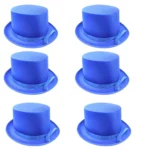
In a scenario where there was one blue hat, the man wearing it would see that the others were wearing two white hats, realize their hat must be blue, and answer quickly. Since nobody answered quickly, that must not be what happened. On the other hand, if there were two blue hats, each man with a blue hat would look across and see one blue hat and one white hat. Since the men are clever, they would realize that if they had a white hat, then there would be only one blue hat. Like us, they deduce that if they were in a scenario with a single blue-hatted person, the man with the blue hat would quickly jump up with the answer. But since nobody answered quickly, our clever friend would deduce after a few moments that they had a blue hat, stand up, and declare they had a blue hat. However, we were told there was a long pause. Since the scenarios with one or two blue hats lead to a short or medium pause, the fact that there was a long pause means there must be three blue hats. That is, our clever men waited sufficiently long to ensure they weren’t in the one- or two-blue-hat scenarios, then one stood up to say all three are wearing a blue hat.
In both the I Don’t Know puzzles and the Induction Puzzles, part of the trick is to remember that all characters are equally clever and knowledgeable; that they have a theory of mind and so also are aware that everyone else is also clever and knowledgeable; and that any form of (non)communication is a possible source of information. It is also important to remember that, unlike normal people, the characters in these puzzles are infinitely patient and willing to work through a potentially enormous number of cases!
And, like in math, you can often get initial insights by thinking about an easier version of the puzzle. For example, in the Hat Puzzle, if you first consider the same puzzle with only two clever men, you will find it is much easier to analyze the possible scenarios.
Conversely, like in math, most of these puzzles can be generalized. With more characters, more hats, more combinations, the general shape of the puzzle might remain the same, but the difficulty explodes. 3Blue1Brown has a great video on one of these uber-complicated puzzles.
In Gary’s case, the goal was to spark the imagination of elementary students and their teachers. His puzzles are meant to trigger conversation and thinking, not hair-pulling! If you’d like to see the sorts of puzzles Gary and his coauthors thought worthy of young students making their first explorations into mathematics, I recommend paging through their book.
Or, if you’d like to try your hand at a variety of Sudoku-esque games, I highly recommend this daily collection of fun puzzles.
The question marks stand for mysteries unsolved, riddles unanswered, puzzles of any kind. So we use it as our trademark. We investigate any kind of mystery. —The Three Investigators
***
[1] A reminder that the integers are 0, 1, -1, 2, -2, 3, -3, ….
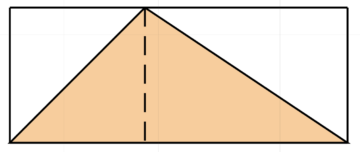
[2] Here’s a hint to Gary’s puzzle. Consider what happens if you drop a line straight down from the top corner of the triangle:
[3] The key insight is that the square is cut into four squares. Three of them form an L-shape: two are white, and one is purple. Looking at those three squares, you see that the L-shaped region is 2/3 white and 1/3 purple. The remaining square is likewise cut into four squares, and it, too, has an L-shaped region which is 2/3 white and 1/3 purple. Since every purple region comes with a pair of equal-sized white regions, the total amount of white must be twice the total amount of purple. That is, 1/3 of the square is purple, and 2/3 of the square is white.
Enjoying the content on 3QD? Help keep us going by donating now.