
by Carlota Figueroa
Have you ever heard of a particle’s spin before? If you have, I bet that the first time you were introduced to this concept you were told to imagine a ball that spins on its axis and to take this as an analogy for what a particle’s spin really is. Now, if you’ve taken more advanced courses in quantum physics you were probably told something similar, but with a little addition to the end: “A particle’s spin is like a ball that spins… except that it isn’t a ball and that it doesn’t spin.” Yeah, not very helpful, I know. Spin is one of those buzzwords that get thrown around whenever someone starts to speak about any (and I really mean any) topic to do with quantum physics, from quantum computers to quantum entanglement and teleportation, and for good reason too: most of the coolest concepts in this area have spin as one of their building blocks. Personally, I think it’s great that these topics are being popularised. But it is a disservice to everyone taking an interest to be told about how we can make information travel almost instantly or how new generation computers will reach unimaginable levels of efficiency without explaining to them exactly what it is that makes this possible. I hope that by the time you finish reading you have a slightly better idea of what spin is, and of everything it makes possible.
The reason why the ball analogy is so popular is that spin actually is an intrinsic angular momentum characteristic of a particle. Roughly speaking, when you speak about angular momentum, you are describing the rotation of an object, and it depends on several variables, including the origin, the velocity of rotation and the moment of inertia of that object (this is simply a value that tells you how difficult it is for you to change that object’s existing rotation). Therefore, when we talk about spin, it kind of makes sense to talk about a ball that turns on its axis. However, intrinsic means there is nothing physically rotating for us to watch: no way to read a particle’s spin off its motion. A ball, by contrast, visibly turns fast or slow, clockwise or counterclockwise, and you can make it rotate however your heart desires. Its angular momentum can therefore take any value: it is continuous. Spin is the complete opposite: encoded within the particle, and only ever taking specific values.
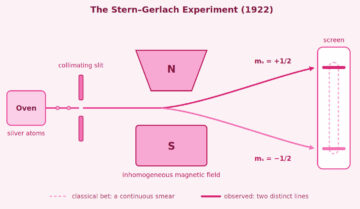
This is where the million-dollar question comes up: if there is nothing actually rotating for us to look at, how do we know spin exists? Thanks to our friends Otto Stern and Walther Gerlach, in 1922 we finally got our answer. Their experiment used silver atoms, which are electrically neutral (a charged particle would get deflected so violently by a magnetic field that we would be incapable of appreciating this subtle quantum effect), but which still behave like tiny magnets: thanks to its single outermost electron, each silver atom is effectively a miniature compass needle flying through space.
Now, a compass needle in a uniform magnetic field (meaning, one with the same strength everywhere) only twists to align itself (it doesn’t actually go anywhere) so Stern and Gerlach deliberately built an inhomogeneous field (meaning, stronger in some places than others). In a field like this, a tiny magnet gets pulled upwards or downwards, and how hard it gets pulled depends on the direction its needle is pointing. Here is where classical physics places its bet: the atoms come flying out of a hot oven, so their needles should be pointing in every direction at random, some straight up, some straight down, most somewhere in between. Therefore, the plate at the end of the apparatus should show a continuous smear, a vertical stripe painted by every possible amount of deflection. This should make sense intuitively: if a needle is free to point any way it likes, the force on it can take any value between the two extremes. You can probably infer from the fact that I’m writing this article that this wasn’t what happened… at all. What Gerlach found on the glass plate was that the atoms had split into two distinct lines and nothing in between: half deflected upwards, half downwards, as if every compass needle in the beam had been forced to choose between exactly two settings.
You can imagine the surprise on our friends’ faces: had they discovered that the classical laws of physics upon which the discipline had been built until that moment were suddenly wrong? Honestly, that would’ve been a huge problem. However, luckily for us, they had discovered something much more awe-inducing: that particles possessed an intrinsic angular momentum (similar to the ordinary angular momentum of a ball spinning on its axis) which could only take a specific set of values. Now looking back we know that spin had to exist and had to be quantized: the Stern–Gerlach experiment had answered a question no one had thought to ask yet. Credit to the experimental physicists, five years ahead of the theorists!
A natural question to ask ourselves is whether Stern and Gerlach really knew what they were searching for: had anyone ever postulated the existence of something like an intrinsic angular momentum? The answer to that is yes, kind of. In the early 20th century, many scientists pondered why atoms were more stable when certain numbers of electrons filled up their shells. If you think back to your high school chemistry class, I am sure you were taught about Bohr’s model of an atom: you have a central nucleus made up of protons and neutrons around which electrons orbit in different shells. This is not exactly true: electrons are quantum particles, so they cannot simultaneously have a well-defined position and momentum (hello, Heisenberg!), and the shells are really clouds of probability, meaning regions where an electron is likely to be found, never pinpointed. However, Bohr’s shell model is useful enough to explain the next point, so we will go back to it: I just didn’t want to lie to you. As we mentioned before, atoms are most stable for certain shell configurations: 2, 8, 18 electrons and so on. By “so on”, I mean following a pattern of 2n² (n can be any natural number, so 1,2,3, etc). This shell number is actually one of the relevant quantum numbers we use to label an electron and for an unperturbed atom, the energy of each electron depends on the shell it is located in, giving rise to energy layers. In theory, each electron in the same layer should have the same energy.
Nevertheless, this is only a first approximation and actually somewhat far from the truth, and magnetic fields are to blame again. The anomalous Zeeman effect showed that when a magnetic field is applied to an atom, the energies of the electrons all became slightly different to each other. In fact, the most surprising phenomenon was that the energy levels seemed to split evenly into a higher and lower level: this meant that half of the electrons on a shell were found at a distinctly higher energy level than the other half. This was something that Bohr’s model could not explain. At the end of the day, what did a magnetic field have to do with what energy level an electron was found in? After thinking for some time, Pauli postulated that this splitting in the spectral lines (i.e. the difference in the energies of the electrons) must have been caused by another 2-valued quantum number that differentiated half of the electrons from the other half when you applied a magnetic field. Although he didn’t call it that yet, what he was talking about was the spin, well, about the projection of the spin.
The fact that this new quantum number (which Pauli deliberately didn’t name, he just asserted that this was a new label to be attributed to particles) could only take two values is crucial. These two values are +1/2 and −1/2: the only two projections an electron’s spin can take (the spin itself is fixed at 1/2, a permanent property of the electron, like its charge). Particles with half-integer spin (like electrons) are called fermions. From all of this, Pauli distilled his famous Exclusion Principle. Atoms take up space: however small, they cannot be compressed into a point, and their shells refuse to collapse into one another. There must be something underlying an atom’s structure that prevents all electrons from coexisting in the same shell. As you might have guessed, that something is a consequence of the Exclusion Principle, which is directly linked to spin. In modern language, we can describe Pauli’s idea as follows:
“two or more identical particles with half-integer spin cannot simultaneously occupy the same quantum state within a system that obeys the laws of quantum mechanics.”
This means that you cannot have two electrons with the exact same quantum numbers coexisting with each other. A particle’s quantum numbers define its state, and for an electron we have four: its principal quantum number n (the level it lives in), its orbital angular momentum l (which ranges from 0 to n−1), the magnetic quantum number mₗ (which ranges from −l to l) and then the spin projection mₛ. This first splitting of the energy levels under the anomalous Zeeman effect is a consequence of the two different values of mₛ, but we can see further splitting depending on the values of the other quantum numbers. All in all, if you do the math, you can see that according to Pauli’s Exclusion Principle, in the first energy level corresponding to n=1, we can only fit 2 electrons, in the second 8 electrons and so on. I hope you can now see how spin is not some mysterious concoction that physicists came up with to act smarter than everyone else, but rather an undeniable truth of the world we live in.
To finish off this article and at the risk of letting the little mathematician that lives inside me break out, I want to tell you about the mathematical structure that hides under the concept of spin. Fermions aren’t the only particles that have spin: we also have bosons with integer spin (generally speaking, spin equal to 0 or 1, a spin-1 particle, for example, has projections −1, 0 and 1). These are actually the more intuitive particles to understand, geometrically speaking. Since the math is about to get a little muddy, picture a particle’s spin as a little arrow. Rotate a boson’s arrow 360º about any axis and it comes back pointing exactly where it started. I tell you this as a little fun fact because I don’t have the time to go into a proper description of Lie algebras, but this is a consequence of integer spin being accurately represented by the group of orthogonal rotations SO(3). I know, a lot of weird language all of a sudden, but stick to the intuitive idea. This is the group that describes the geometry of the world we see every day: when you turn around 360º about your own axis, you end up in the position you started in.
Well, surprise, half-integer spin doesn’t work like this, so the group SO(3) is not an accurate representation of spin as a whole. With integer spin, only the final direction matters: the rotation is independent of the journey. As you may have been able to tell from this article, spin is not an easy subject to deal with, and half-integer spin is another beast altogether. Actually, the Exclusion Principle only applies to fermions: we can have as many bosons coexisting in the same quantum state as our heart desires. Well, when we rotate half-integer spin, we don’t only care about the direction we point in, but we also have to pay attention to whether it took us an odd number or an even number of turns to get there. If it took us an odd number of turns, something extraordinary happens: the arrow points exactly the way it did at the beginning, but its quantum label comes back carrying the opposite sign. Only after another 360º (a full 720º journey) does everything, arrow and label, return to the original position. This structure is described by the Lie group SU(2), which wraps twice around the group SO(3). What you should remember from this very technical explanation is that we don’t need quantum physics to describe the geometry of the world we live in, but quantum objects are inherently more complex than we are used to, and behave in very strange ways.
Now, if you want to visualise this, you can check out this video of Dirac’s belt trick. Or, even better, you can try it out for yourself. First, you need to grab a belt, trap one end under a heavy book, and hold the buckle in your hand. Give the buckle one full 360º turn and take on this challenge: remove the twist you just made without ever rotating the buckle again. You can do anything you want to the belt as long as the buckle always keeps pointing the way it points. Spoiler alert: this is impossible. Now give the buckle a second full turn in the same direction (720º in total, your belt may look like a mess, but I promise it’s worth it) and try again: sweep the middle of the belt around the buckle end, moving it but never turning it. Surprise! Both twists dissolve into nothing. The belt works as a diary of the rotation: every little slice of the belt records an orientation, so the belt remembers the journey the buckle took, not just the destination, similar to half-integer spin. It cannot tell the difference between an even number of turns and no turns at all (those tangles can always be smoothed away) but an odd number of turns leaves a mark that cannot be undone. That is the leathery essence of SU(2).

I admit I dangled quantum computers, entanglement and teleportation at you mostly to convince you to keep reading. I promise you will get your article on all of these in the near future. I owe you, after all. However, I wanted to give spin the 15 minutes of fame that it deserves: it is the cornerstone of these technologies and yet we take it for granted, as if we had always known of its existence and structure. And remember, if someone ever asks you what spin is and you don’t remember everything I have told you in this article, you can always tell them what every renowned physicist has embedded in their minds: “it is like a ball that spins, except that it isn’t a ball and that it doesn’t spin.”