by Michael Liss
Our Government is made up of the people. You are the Government. I am only your hired servant. I am the Chief Executive of the greatest nation in the world, the highest honor that can ever come to a man on earth. But I am the servant of the people of the United States. They are not my servants. I can’t order you around, or send you to labor camps, or have your heads cut off if you don’t agree with me politically. We don’t believe in that. —Harry S. Truman, “Whistle-Stop” speech, San Antonio, Texas, September 28, 1948
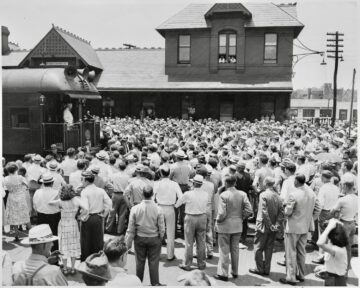
He was going to lose and lose big. “Dewey Defeats Truman” seemed more a certainty than what later became a meme. Trailing badly in political polls, dismissed by savvy media figures, beset by multiple crises, both foreign and domestic, he was written off by elected officials even in his own party, who feared he would take down the entire ticket. Perhaps the only person who, in the summer of 1948, actually believed Harry Truman could win in November was Harry Truman.
Why he believed this is hard to say, but why his doubters doubted makes perfect sense: Truman was widely seen as a mediocrity, a product of a corrupt local political machine, undereducated (the first President since McKinley not to have a college degree), a former haberdasher, and even a bankrupt. Perhaps above all, Truman was a commoner, and commoners did not become Presidents, at least not in the 20th Century.
It was an accident that Truman was in this situation. He was FDR’s third Vice President in four terms. Roosevelt’s first, John Nance Gardner, served two terms before the two men had a falling out. Gardner’s replacement, Henry Wallace, was brilliant, accomplished, eloquent, and ultimately what can only be described as a flake. Roosevelt, showing that ice-in-the-veins quality of which he was capable, had others deliver the message to Wallace that he wanted a change. FDR had a favorite choice as well: James Byrnes, whom he had appointed to the Supreme Court in 1941, then convinced to return to the Executive Branch to help with the war effort. But Byrnes had some liabilities—he was perceived as anti-labor, and, while Senator, had helped spearhead Southern opposition to a federal anti-lynching law. For these reasons, FDR considered but ultimately rejected Speaker Sam Rayburn (Texas), and finally turned to Truman. Read more »

 A little over a year ago I published
  Eddie Rodolfo Aparicio. White Dove Let US Fly, 2024.
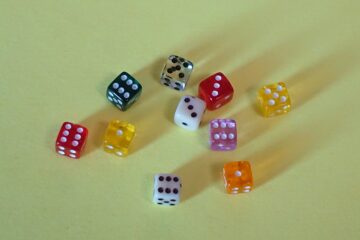 “You are aware”, I ask a pair of students celebrating their fourth successful die roll in a row, “that you are ruining this experiment?” They laugh obligingly. In four pairs, a small group of students is spending a few minutes rolling dice, awarding themselves 12 euros for every 5 or 6 and ‘losing’ 3 euros for every other outcome. I’m trying to set them up for the concept of expected value, first reminding them how to calculate their average winnings over several rounds, and then moving on to show how we calculate the expected average without recourse to experiment. It would be nice, of course, for their experimental average to be recognizably close to this number. Not least since this particular lesson is being observed by the Berlin board of education, and the outcome will determine whether or not I can get a teaching permit as a foreigner.



 Notational

 A cinematographer would recognize this as a crane shot, or its replacement, the drone shot. This crane or drone doesn’t move. It defines the POV (point of view) of the painter, and shows how far his perspective can reach and how much he can cram into the in-between, that 2D surface which expands vertically with every higher angle of his POV, as in this crane shot from Gone with the Wind.
 Like many of us, they assembled an inordinate number of puzzles during the COVID-19 restrictions. And like many puzzlers, they came to wonder:
 In the middle ’60s when I first was a new husband, a new teacher, and new father, I met my first indication of the changing consciousness of women in a freshman English class. I was teaching the Yeats poem “A Prayer for My Daughter.” I found it, and in many ways still do a marvelous poem and I spoke of it to my class with great enthusiasm saying that this is what I would wish for my daughter – that she would be “beautiful” but not “too beautiful” and “learned courtesy” for:
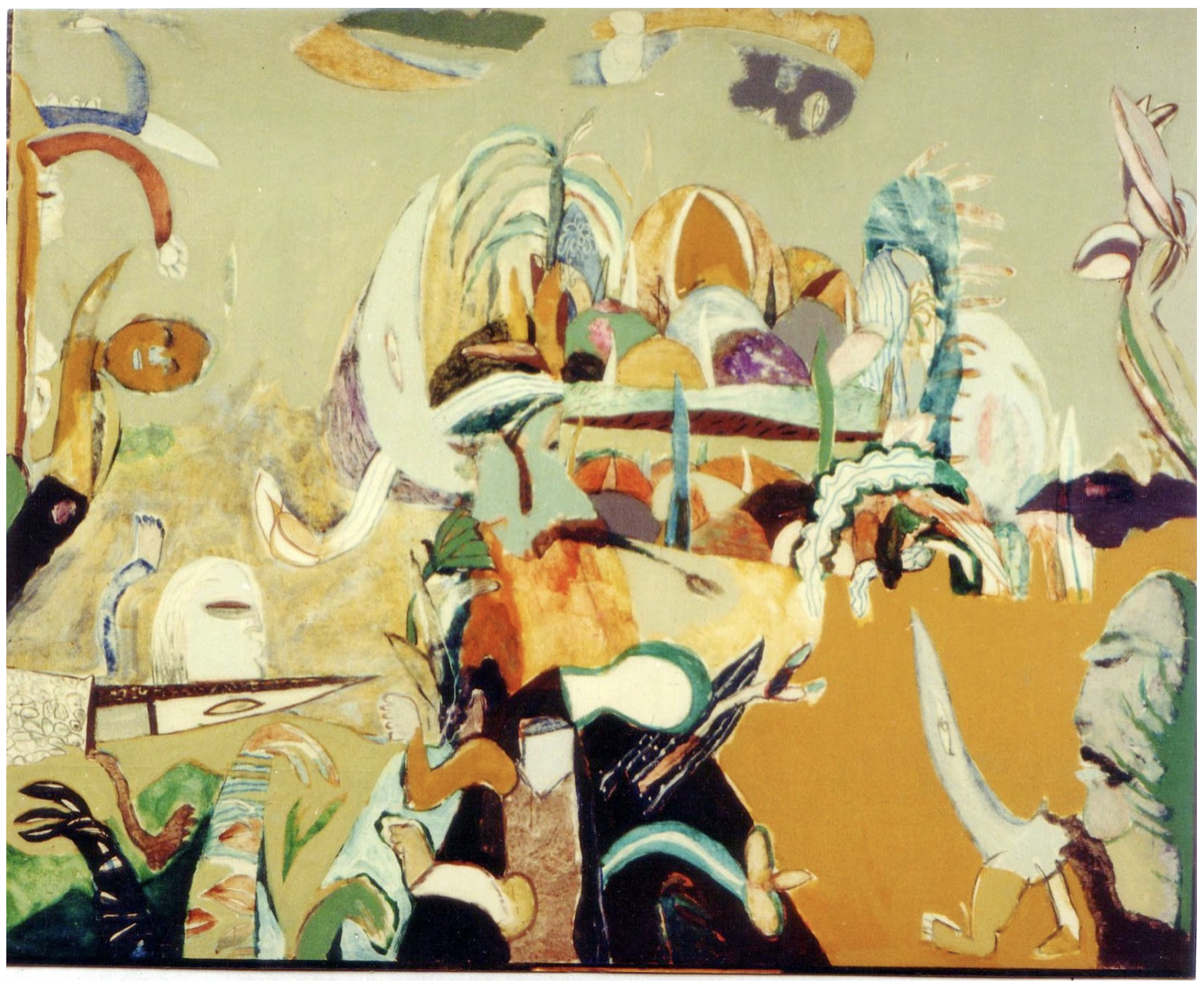 Dilara Begum Jolly. Untitled, ca 2014.