by Marie Snyder
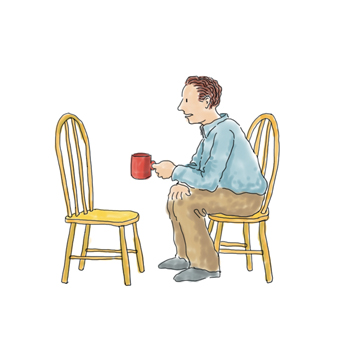 Over thirty years ago I was in an on-again-off-again relationship that I just couldn’t shake. After months of different types of therapies, I lucked into a therapist who walked me through a version of the Gestalt exercise of talking to a chair, which ended my longing for this guy on a dime.
The exercise had me reimagine many ways he had enraged me, bringing all that to the surface. Then it raised any guilt I had around my own actions towards him, sadness around missing him, and finally ended with celebrating what I learned from him. It took just an hour, and I left feeling completely finished, excised of any clinging or craving, and able to effortlessly say “No thanks!” to his next late-night phone calls. Pairing words and actions with emotions in a contained and structured time and space, that gives some order to the chaos, might do next to nothing — but it might help to move through a difficult transition. I was so impressed with this power hour that I went to grad school to study ritual work. Gestalt psychotherapy is a far cry from cultural anthropology, but I perceived a connection to rites of passage that help neophytes transition from one state to another.
I recognize the cringe-factor in all of this, but it’s worked for thousands of years to take children into adulthood, and we’ve kept at it when marrying and burying, so there’s likely something useful in the process. And it feels like we need something transformative more than ever. Read more »
 I was asked recently to speak at the University of Toronto about poetry in translation, a topic close to my heart for a number of reasons. I happened at the time to be working on a text concerned, not with translating poetry, but with lyric expression in its most practical form: that is, as a commodity with a material history, as an object that can be traded, one with an exchange value as well as a use value (however the latter might be defined, or experienced).
 Once again the world faces death and destruction, and once again it asks questions. The horrific assaults by Hamas on October 7 last year and the widespread bombing by the Israeli government in Gaza raise old questions of morality, law, history and national identity. We have been here before, and if history is any sad reminder, we will undoubtedly be here again. That is all the more reason to grapple with these questions.

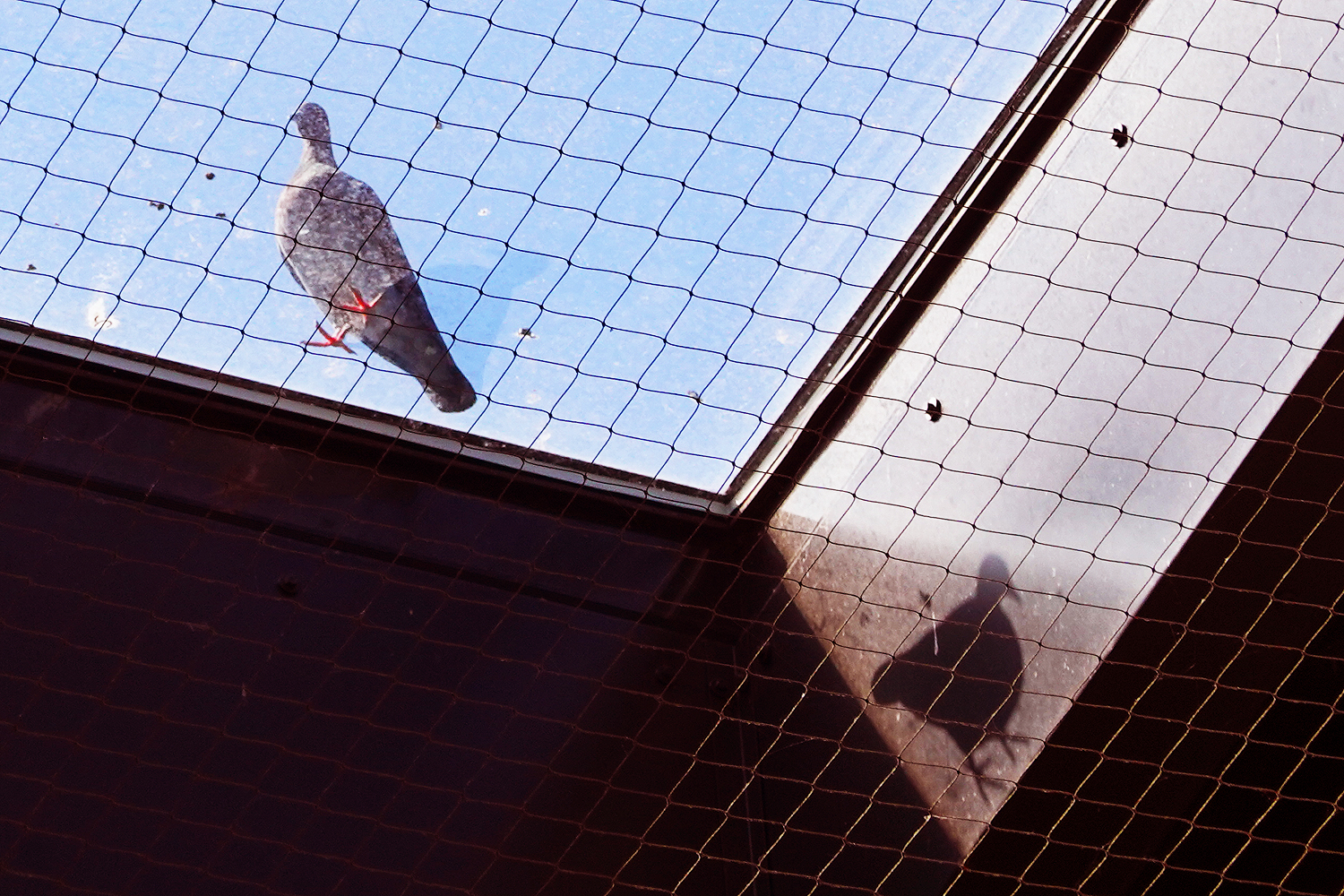
 Sughra Raza. Light Play in The Living Room, November 2023.
 One of nature’s most endearing parlor tricks is the ripple effect. Drop a pebble into a lake and little waves will move out in concentric circles from the point of entry. It’s fun to watch, and lovely too, delivering a tiny aesthetic punch every time we see it. It’s also the well-worn metaphor for a certain kind of cause-and-effect, in which the effect part just keeps going and going. This metaphor is a perfect fit for one of the worst allisions in US maritime history, leading to the collapse of Baltimore’s Francis Scott Key Bridge after it was hit by the container ship MV Dali on the morning of March 26, 2024.

 No matter where you go, Aristotle believes, the rich will be few and the poor many. Yet, to be an oligarch means more than to simply be part of the few, it means to govern as rich. Oligarchs claim political power precisely because of their wealth.

 An abstract paradox discussed by Yale economist Martin Shubik has a logical skeleton that can, perhaps surprisingly, be shrouded in human flesh in various ways. First Shubik’s seductive theoretical game: We imagine an auctioneer with plans to auction off a dollar bill subject to a rule that bidders must adhere to. As would be the case in any standard auction, the dollar goes to the highest bidder, but in this case the second highest bidder must pay his or her last bid as well. That is, the auction is not a zero-sum game. Assuming the minimum bid is a nickel, the bidder who offers 5 cents can profit 95 cents if the no other bidder steps forward.