
by Priya Malhotra
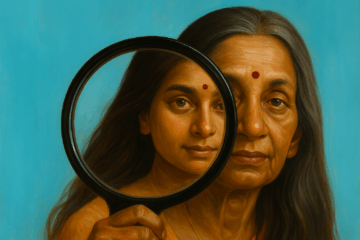
When I typically envisioned a woman in her seventies, I—like many of us—pictured someone wrinkled and bent—not just physically, but also mentally and emotionally. I imagined someone dimmed, only to fade further with time. A woman well past the best years of her life, wearied by disappointments, melancholy with regrets for cherished things that never came to fruition, and weighed down by the realization that those longings would likely never be fulfilled. She was someone who tucked those yearnings away, lest they resurface as reminders of everything she had lost. Old age, I believed, was a time of decline—the deterioration of one’s faculties, the shedding of one’s dreams, a slow march toward the inevitable.
But then I moved to India and witnessed how my cousin Rashmi (name changed for privacy) lived—and aged—and every depressing notion I had about growing old was upended.
At 71, Rashmi radiates a resplendent glow that’s nothing short of infectious. Her hair is fully grey and she wears it with grace. Her skin bears the spots and textures of age, her body sags in places—but her spirit sings. The way she moves through life with joy and poise is more inspiring than I can describe.
“Aging is a gift,” she tells me. “So many people don’t get to that point. It’s not afforded to everybody. Aging can be great—but there’s a caveat. You need to be in good health.”
It’s not Botox or anti-aging creams that keep her youthful. It’s her innate, almost childlike sense of wonder. And like a child, she delights in the infinite delights of the world. She’ll bubble with enthusiasm over intricately embroidered linen table mats or latticework crafted in a dusty Delhi storefront. She’s equally enraptured by the grandeur of a centuries-old dome or a Caravaggio masterpiece. In her eyes, the world is even more magical now than it was thirty years ago.
“Then, I took it all for granted,” she says. “Now I don’t. Youth gives you a sense of immortality—you think you’ll always have time to enjoy life’s enchantments. But as you get older, there’s this wonderful urgency to enjoy them now.” Read more »


 One argument for the existence of a creator /designer of the universe that is popular in public and academic circles is the fine-tuning argument. It is argued that if one or more of nature’s physical constants as mathematically accounted for in subatomic physics had varied just by an infinitesimal amount, life would not exist in the universe. Some claim, for example, with an infinitesimal difference in certain physical constants the Big Bang would have collapsed upon itself before life could form or elements like carbon essential for life would never have formed. The specific settings that make life possible seem to be set to almost incomprehensible infinitesimal precision. It would be incredibly lucky to have these settings be the result of pure chance. The best explanation for life is not physics alone but the existence of a creator/designer who intentionally fine-tuned physical laws and fundamental constants of physics to make life physically possible in the universe. In other words, the best explanation for the existence of life in general and ourselves in particular, is not chance but a theistic version of a designer of the universe.
 Sughra Raza. Scattered Color. Italy, 2012.



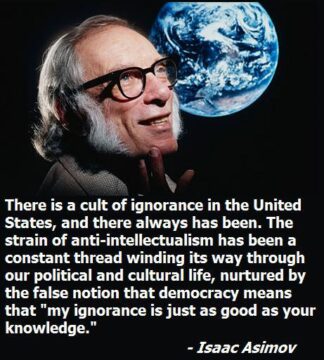



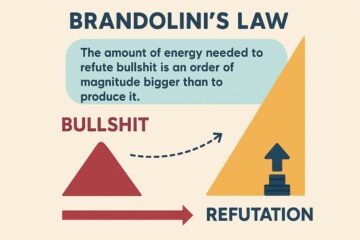 As atrocious, appalling, and abhorrent as Trump’s countless spirit-sapping outrages are, I’d like to move a little beyond adumbrating them and instead suggest a few ideas that make them even more pernicious than they first seem. Underlying the outrages are his cruelty, narcissism and ignorance, made worse by the fact that he listens to no one other than his worst enablers. On rare occasions, these are the commentators on Fox News who are generally indistinguishable from the sycophants in his cabinet, A Parliament of Whores,” to use the title of P.J. O’Rourke’s hilarious book. (No offense intended toward sex workers.) Stalin is reputed to have said that a single death is a tragedy, a million deaths is a statistic. Paraphrasing it, I note that a single mistake, insult, or consciously false statement by a politician is, of course, a serious offense, but 25,000 of them is a statistic. Continuing with a variant of another comment often attributed to Stalin, I can imagine Trump asking, “How many divisions do CNN and the NY Times have.”


 Sughra Raza. Seeing is Believing. Vahrner See, Südtirol, October 2013.