Tributaries of the Hidden Curriculum

by TJ Price

Saying “I don’t know” is one of the great joys of my adult life. I revel in the phrase. I freely and openly admit honest ignorance, in the service of learning more, hungrily, with an avid—and, perhaps, slightly obsessive—need. It was not always this way.

For most of my early life, in fact, I was uncomfortable saying it. It was as if I would be admitting to a lack of some critical function, for which I could be judged and dismissed—or, worse, taught—accordingly. Confronted with the new or unfamiliar, I might fake familiarity, bluffing my way through or fleeing from proof of my ignorance, but the dread of challenge to my knowledge dogged my every step. This was perhaps the first flickers of so-called “imposter syndrome”—I was terrified that every moment could prove the moment when everyone discovered I was a fraud, all along. That I wasn’t as smart as they thought I was, which would then prove to me that I wasn’t as smart as I thought I was.

Idyll:

Despite this fear of inadequacy, I have secretly always wanted to be a professional student. I had dreams of vaulted ceilings and cloistered libraries. Of chalkboards and dust and long hours turning pages. The actual schools I did attend held no real value to me—I had ideals of education, from the very beginning, which eluded me and continue to elude, I think, most in this country. These ideals may have been touched by a young romanticism, but the core of them remains the same— 

Credo:

I believe education should not be a gauntlet, should not be cheerless. It should be gentle, inquisitive. It should be sets of questions to which answers are hard-won, but not in the way of contest or grade. I still, to this day, believe fully that one of the great evils in the world is that there is something that every single person is curious about, and that—often enough, for one reason or another—they just don’t get to follow that thread. Instead of being encouraging, there is a rigor involved, a stern hand-slap, a sharp return to inculcation by rote.

Hypothesis:

Education is less an instilling of foreign elements, treating knowledge as immigrant to our brain, but more a revealing—a guided perambulation via neuronal paths—lighting associations one by one as we go.  Read more »
Poem by Jim Culleny

Approaching the Cold Solstice
with J. Kepler

we’re falling deeply in
—in as deeply as we get
before we spin again along an ellipse’s rim
to a more congenial spot for blood and breath

what the astronomical survival odds
(our outer limits) are, who knows?
but time is short by late report

listening now to ersatz jazz
I shift Pandora’s voice,
I move on, linking new music to my
thinking by simply clicking
thanks to all the tricks our technos know
which is obviously permanent
and, like serious snow, is sticking

in this marvelous, magnetic, angular hour
when sun and earth seek a new relation,
and we anticipate the warm benefits
that will return in little over half a year,
as they will not be then for globe-mates
in our southern hemisphere—

Yes, there will be foxglove and hydrangea when
Kepler’s laws provide sun’s heat again.

by Jim Culleny
12/21/14

Enjoying the content on 3QD? Help keep us going by donating now.

Sunday, November 16, 2025

The Monkey’s Paw: Markets And Misaligned Proxies

by Jochen Szangolies

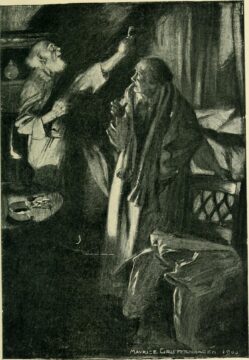
Illustration for W. W. Jacobs’ short story The Monkeys Paw, by Maurice Greiffenhagen. Image Credit: Public domain.

It was while watching the unveiling video of 1X Technologies’ home robot assistant Neo that I was hit with a revelation of a fundamental truth of our current moment in time: the world is a lot as if my ten year old sci-fi nerd self had had many of his wishes fulfilled, but by a cursed monkey’s paw. You want robots? You got it, but they’re creepy, kind of useless, probably spying on you and nevertheless will displace human workers from their jobs. You want AI? You got it, but it frequently makes stuff up, traps people in parasocial relationships while isolating them from the real world, floods the social sphere with misinformation and bad art, threatens the environment and funnels power to the people least fit to wield it.

A widespread narrative is that today, we have it better than at any previous time in human history: we live longer, are healthier and wealthier, better educated, have access to more and better nutrition, and are less likely to die from war or through homicide than ever. At the same time, however, we are faced with widespread ecosystem collapse, having just blown past the first catastrophic climate tipping point leading to near-certain die-off of coral reefs around the planet, the 1.5°C-goal may already have been eclipsed with global warming hitting a possible inflection point, depression and other mental health issues are on the rise even in the richest countries, income inequality is increasing as the richest snatch up an ever bigger piece of the pie, and wildlife populations have declined by a staggering 73% in the past 50 years. As a result, we seem to have very wildly divergent perceptions of our current reality: in one, we’re essentially living better than kings in the past; while in the other, we’re about to drive off a cliff with the wholesale destruction of our living environment.

So what gives? Who’s right—the Pinkerish peddlers of Panglossian optimism or the Monbiotesque negative Nancies decrying the despoliations of the neoliberal order? And how can there be two so vastly contradictory narratives, each of which claims a mountain of charts, data, and analysis in its favor? Read more »

Those Not Busy Being Born Are Busy Kicking The Bucket

by Bonnie McCune

To me, the most surprising fact of old age life so far has been the decline in my own condition. Physical and mental. There is no way I can reach the heights I used to, i.e., even jogging a mile or two. It’s sufficient to WALK a mile or two. I’ll never be able to jog like that again. Or perhaps I’m just being chicken because I’m afraid of falling down.

This shouldn’t have come as a shock. After all I’ve lived for years with friends and family who have gone through the process of getting old, but we’re so accustomed to gradually getting better when we practice an activity, I was taken aback when I realized this. Whether it’s learning the times-tables in third grade, or how to function at a cocktail party with its wealth of unwritten, unspoken social rules, we’re accustomed to getting familiar, comfortable, and more successful with each venture.

Not slower, confused, and achy. Not when we hit old age. Instead, one day we try to recall the name of a neighbor and come up blank. Or we start to leap out of bed, only to pause semi-paralyzed on the edge because a muscle has seized up. These are the harbingers. This is reality.

There are compensations. As we age, we can face with equanimity talk about serious illnesses because we don’t have the potential to live long any way. Given the diagnosis of a life span of one to three years for a serious illness, a friend of mine didn’t even blink. At 83, he only has so much life expectancy. He’s learning to live in the moment all the time. Great practice for meditation, by the way, where we’re urged to aim toward this mental attitude. Read more »

Friday, November 14, 2025

Remembering the South Bronx

by Laurie Sheck

1.
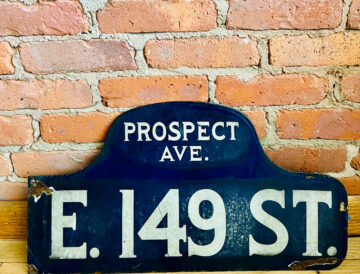
In the summer of 1977 in New York City—summer of the famous city-wide blackout, its fires and looting—my parents stole a street sign. The sign marked the location of my father’s housewares store which overnight had been turned into a hollow shell of blackened ash and charred brick. Looted and burned. 

The sign was a remembrance of a place they had loved.

The store was in the South Bronx, which at that time was the highest crime district of NYC. 149 St. and Prospect Ave. From earliest childhood, I spent many hours there dusting shelves, sticking price tags onto merchandise, and performing a variety of other minor tasks. The store and the neighborhood were a large part of my childhood world, of my introduction to what a world even is. My father and his older brother left school in the 9th and 10th grades to support their family. His brother had died young. Now, with the blackout of July 13, overnight the neighborhood was decimated. The store was gone.

2.
Even before the blackout, the South Bronx was notorious for its empty lots and abandoned buildings, its street gangs and drugs. Of course back then, as a child, I was unaware of the statistics. I didn’t know that roughly 20 percent of the buildings stood empty, abandoned by landlords unwilling or unable to maintain them. Unemployment was nearly double the rate of the city as a whole. Fewer than half of heads of households were said to be employed. The median income was $4,600, substantially below the median for the city. One study showed the median household size as 5.0, whereas the median household size for the city overall was 2.2. Families were crowded into tiny spaces. About half of the households were headed by women.

In 1977, the Women’s City Club of New York City issued an extensive report on the area, With Love and Affection: A Study of Building Abandonment. In addition to gathering numerous statistics, the report described the relentless deterioration of the neighborhood dating back to the late 1960’s. The blackout intensified what was already there: “block after block of empty buildings, some open and vandalized, some sealed, standing among rubble-strewn lots on which other buildings have already been demolished. In the midst of this desolation there is an occasional building where people are still trying to live.” It went on, “The streets and sidewalks…are littered with rubbish, with shattered glass out of the gaping doors and windows.” A New York Times article from 1975 bore the headline “To Most Americans, The South Bronx Would be Another Country.”

And yet, even as my memories resonate with much of what the WCC report described, I also remember bustling streets, restaurants, families. Read more »

Incentivising War Crimes: The High Cost of International Humanitarianism

by Thomas R. Wells

Wars have never been the concern only of their combatants. Other states pay close attention to the geo-political implications and opportunities created by armed conflict, and interfere directly or indirectly when their cynical calculations suggest that would advance their interests.  For example, various countries – the UAE, Iran, Egypt, Turkey, Saudi Arabia, Russia and Qatar – have been involving themselves in Sudan’s ghastly civil war, apparently looking to pick up geopolitical advantages – especially gaining access to Red Sea ports that would allow them to threaten international shipping via the Suez Canal, or to prevent other states from doing so. When extended to material support to favoured factions this increases the resources of the combatants, increasing the ambition of their respective war goals and so extending the war by reducing the scope for a mutually acceptable peace deal.

Such amoral realpolitik in international relations is as old as war itself, together with its unfortunate consequences for human lives. What is somewhat more recent is the rise of international moral concern for the lives of civilians threatened by war, expressed through the increased influence of civil society. At least since the Greeks’ 1820s war of independence, states have also been interfering in other people’s wars out of humanitarian concerns to reduce civilian suffering.

The problem is that although each individual humanitarian intervention may be sincerely morally motivated – and even sometimes succeed in its goal of reducing suffering – the practise of morally motivated interference would seem actually to increase the amount of civilian suffering due to war. It makes civil wars more likely to start and harder to end, while incentivising crimes against civilians. Read more »

Thursday, November 13, 2025

The Literature of Driving

by Derek Neal

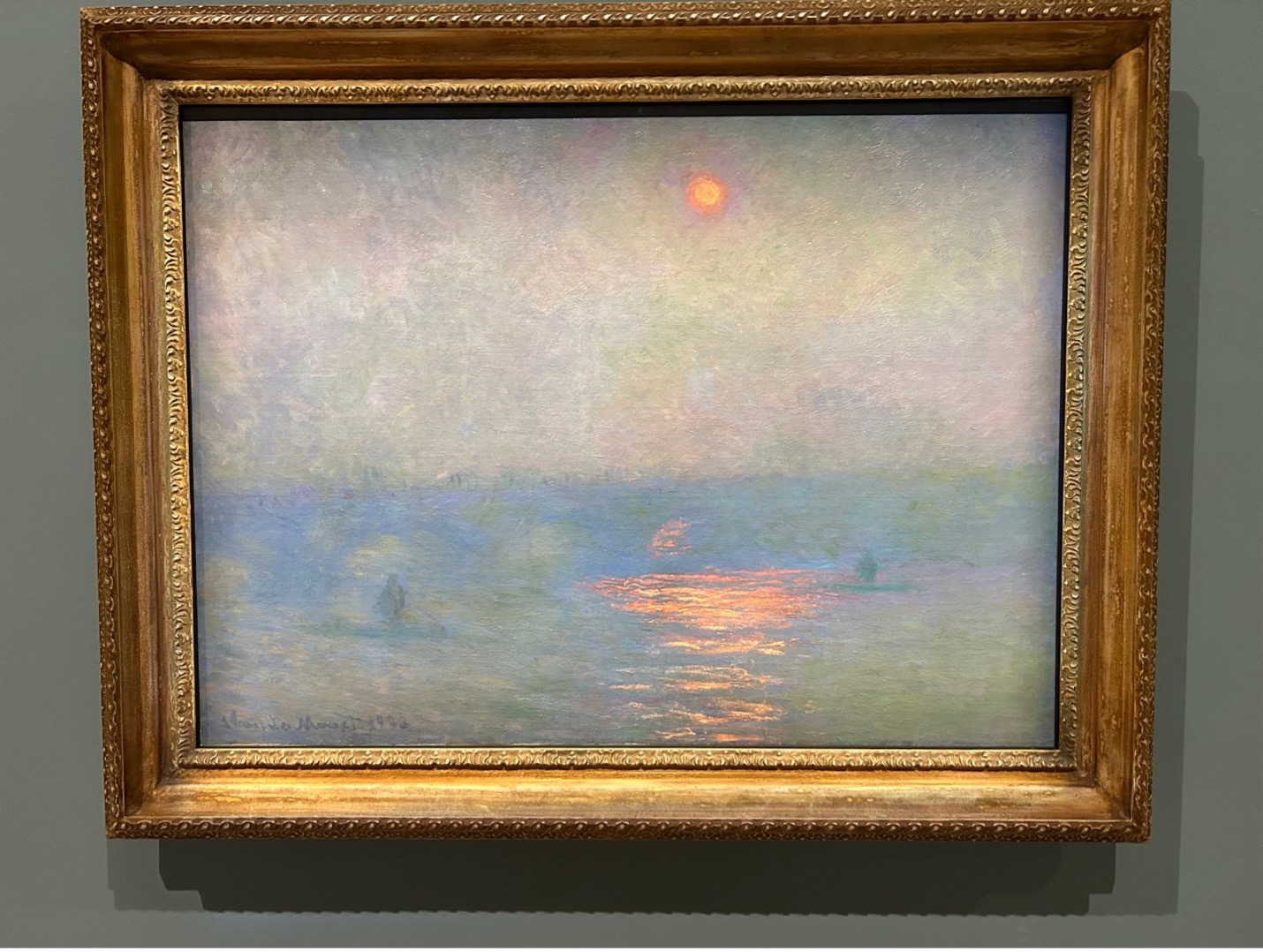
Waterloo Bridge: Effect of Sunlight in the Fog

The mornings have become dark. These weeks are always strange, the end of October, just before the clock falls back and the mornings brighten again. For now I get ready in a sort of hinterland; it’s not night, but it’s not day either. The sky is a sheet of gray. I back out of the driveway, turn onto the main road. In the fog, the streetlights appear as beacons. Their brightness shocks me, and I remember a Monet painting I saw once in New York, a scene not of waterlilies or his garden, but the sun as a bright orange disk in the London fog. The wall text mentioned how Monet thought London was beautiful because of the fog, not despite it. This morning, the fog acts as a filter, casting a dull grayness everywhere but allowing the greens and reds of the streetlights to pass through. The road is relatively empty, I slip through a yellow light, leave the other cars behind, and I’m out on the open road, cruising downhill as the lights glow ahead of me.

I love driving. I was looking through my fiction writing recently—not much, just a page or two here and there—and I was surprised to see that much of it has to do with driving, or, if not driving, with the movement of the human body through space and time at an accelerated rate (ice skating and biking also feature). We are not made to move at such speeds, and when we do, something happens to our consciousness. Life feels different. Not every time, of course, but sometimes, and when it does, writing from a fictional viewpoint rather than in the style of an article seems the only way to transfer that phenomenological experience to the page.

The first thing I ever wrote that was any good falls into this category. I was in university, in a class for writing tutors, and we were tasked with writing a personal essay. I didn’t know how to write a personal essay—I didn’t know how to write about something meaningful to me without it coming off as trite and clichéd to others—so instead I submitted a short passage about diving into a lake I’d spontaneously written one summer day. I knew it was good because I’d written it while life felt different and I’d somehow managed to capture that experience in language. The essay was chosen as an example for the class. Then we had to expand our pieces into a longer story, but I couldn’t do it. I tried to re-enter the headspace that I’d inhabited while writing about diving, swimming, and floating, but no matter how hard I tried, nothing clicked. I wrote something and my teacher told me that she couldn’t follow it—it didn’t make sense. Read more »

Cousin Bernie And His Institutionalized Mother: The Memoir’s Sad Note

by Barbara Fischkin

Recent Photo: Abandoned Kings Park Psychiatric Center building. Cousin Bernie’s mother was institutionalized in a building here, one of several of her placements in New Jersey and New York. This shows Building 93 present day. Photo Credit: Diana Scarpulla

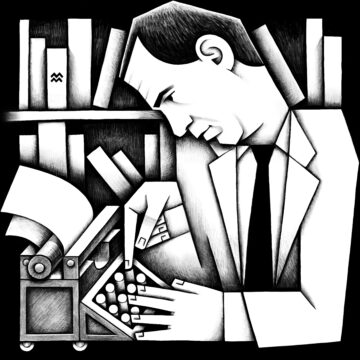
Another eight weeks have passed since I wrote about my Cousin Bernie—and how, posthumously, he adds to my understanding of him. To review: Earlier this year I wrote two chapters about Cousin Bernie completely from memory. Then his widow, Joan Hamilton Morris, sent me more material—pages she’d found of an incomplete memoir her late husband pecked out on a vintage typewriter in an adult education class he took after retiring as a university professor of psychology and mathematics.

If Cousin Bernie were alive today he would be 102, 32 years older than I am now. Each time I take a deeper dive into the pages Joan sent me, I realize I have only skimmed the surface.  And so, here is my fifth take on my cousin, who fascinates me despite his evergreen persona as a nerdy, chubby, lost boy from Brooklyn. This, in part, is the saddest offering from my cousin’s own memoir. It may—or may not—be the final one. A chapter about his interest in radios, as a child—and in being a ham radio operator in his retirement— might appear one of these days.

Again, I will let Cousin Bernie tell most of his story, this time about how having a schizophrenic mother affected him, in ways both obvious and veiled. His memories also offer a look inside an earlier time when mental illness in a family was far more shameful and misunderstood than it is even today. To review more: When I was a child my mother told me that Cousin Bernie’s mother was dead. She was my father’s mysterious, absent sister, that is all I was told at first. I now wonder if my mother wanted to put as much distance between herself and this sister as she could. It was bad enough that they sort of shared the same name. Cousin Bernie’s mother’s maiden name was Ida Fishkin. My mother’s married name was Ida Fischkin. I believe my mother also wanted to protect me from fear. She apparently believed that a dead aunt was not as scary as a living ghost, locked up in an institution for years, as Bernie’s mother was at the time. Read more »

Wednesday, November 12, 2025

Enabling Story Universes: A Conversation with William K Gillespie

by Philip Graham

When William K Gillespie was a student in one of my fiction writing workshops at the University of Illinois in the late 1980s, he turned in a brilliant, 36-page (single spaced!) story. A story absolutely typical of his talent and ambition. In the following years William went on to study under and impress a stellar cast of mentors, among them David Foster Wallace, Robert Coover, Brian Evenson, and Carole Maso. He was granted one of the first MFAs in Electronic Writing (from Brown University), and he established his own cutting edge press, Spineless Books. Since then he has written in every imaginable form, and is now organizing his diverse and interwoven oeuvre into a vast digital warren on the Web. We spoke recently about this project’s past, present, and future.

Philip Graham: The home page of your new and expanded author’s website, Collected Writings of William K Gillespie and Friends, lists and features the daunting range of genres in which you’ve written, and some of which you’ve probably invented: besides fiction, journalism, songwriting, sound collage and radio theater, there’s also “the longest literary palindrome ever written,” and “newspoetry,” to name just a small portion of your various literary explorations. Yet your career, seen in this perspective, rather than seeming scattered instead seems like solid evidence of a unified, voracious imagination.
William K Gillespie: Thank you. I’m inspired by Harry Mathews, Julio Cortázar, and Italo Calvino, who produced books so singular that each seemed to be by a different author. Visual art, music, and literature have a lot to learn from one another, and transposing ideas from one to the other is great fun.

PG: This transposition of ideas from one art form to another is certainly a hallmark of your website, and yes, your spider-like orchestration of it all is impressive. Can you say more about its architecture?

WG: In addition to preserving old works from moldy word processor files and decrepit websites, the Webwork — my new site — has hidden tools to help me compose complicated fictions spread across multiple books, forms, and media. There’s only a hint of this functionality visible now: at the bottom of the site you see an incomplete list of characters in my work. Eventually this will allow the assiduous reader to track characters between works and learn secret backstories. Read more »

The Literature of Limits: The West (Part I)

by Muhammad Aurangzeb Ahmad

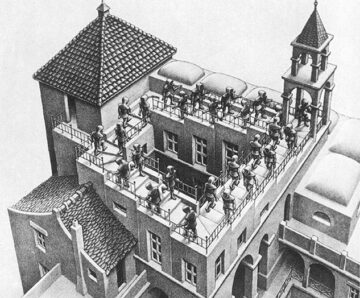
Upstairs and Downstairs by M C Escher

Every civilization eventually reaches the edge of its own understanding. The Enlightenment, which was basically a grand project of faith in reason, sought to replace the mysteries of revelation with the lucidity of thought. It promised that disciplined rationality could illuminate every corner of existence. It was thought that that through observation, experiment, and the methodical accumulation of knowledge, humanity could build a transparent world where nothing remained obscure. Knowledge would rise like light refracted through a cathedral of glass, cleansing superstition and disorder. Yet this grand confidence carried within it the seed of its undoing. The very tools of reason that once liberated humankind also revealed the boundaries of comprehension. The Enlightenment’s most profound legacy was perhaps not infinite clarity but the realization that even reason has horizons it cannot cross. By the twentieth century, the dream of total understanding had hardened into the austere project of formalized mathematics, symbolic logic, and mechanical computation. It finally fell crumbling down. It was a quest to capture truth in the language of machines, and in doing so, to continue the Enlightenment by other means.

Let us begin with Leibniz, who envisioned a future in which every disagreement could be settled through calculation. “Let us compute,” he declared, envisioning a characteristica universalis, a universal language in which thought itself could be reduced to algebraic precision. For him, reason was not merely a human faculty but an architecture of truth. It was a divine syntax underlying the cosmos. Through rational analysis, Leibniz believed, everything from theology to mechanics could be rendered transparent. This was the audacious spirit of the Enlightenment i.e., the conviction that the world, properly translated into the language of reason, would yield its secrets without remainder. Immanuel Kant inherited this dream and showed that reason, while vast, is not infinite, that it generates its own horizon. The limits of reason, Kant wrote, are not defects but conditions of possibility. He thought that we can never know the thing-in-itself (das Ding an sich). This is because knowledge is not a mirror but a creative act, shaping the appearances it seeks to understand. Where Leibniz saw the universe as a divine calculus, Kant saw it as a theater of understanding. The world was ordered by this understanding not by the world as it is, but by the mind that apprehends it. Rousseau afterwards even questioned whether the march of reason brought progress or alienation, warning that civilization’s rational order might enslave rather than liberate.

Enlightenment’s faith endured in science and in the dream that the human mind, through the right method, might still one day comprehend the whole. Read more »

Tuesday, November 11, 2025

History as Self-Healing Mechanism

by Malcolm Murray

The question of the day on everyone’s minds is whether AI is a boom or a bust. But if we lift our eyes ever so slightly from the question of the day and look at the bigger picture, two bigger questions come into view.

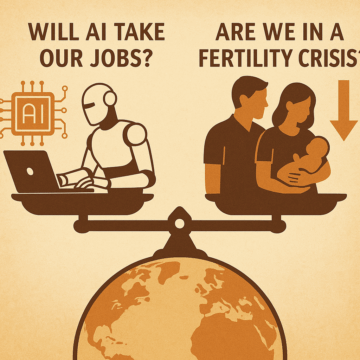
One: Will AI take our jobs? This debate seems to happen for all new technologies, but has been especially salient for AI. This makes sense. (Putting aside questions of per-unit economics and market distorting preferences), if you define AGI as something that can do anything humans can do, then by definition, you have also defined yourself out of any jobs remaining.

Two: Is dropping fertility a crisis? Fertility has been dropping precipitously in developed countries for years, first in East Asia, then Western Europe, and now in practically all countries. Immigration has been the solution, but sometime in this century, the global population as a whole will peak and start shrinking. Many economists, such as Robin Hanson, are deeply worried about this. This again makes sense. Innovation is closely linked to the number of people around to come up with innovations and shifting demographics will turn existing social security systems upside down.

However, a positive, bigger picture reading would be that these two effects might cancel each other out, or at least partly offset each other. The effects of both are of course highly uncertain, but from what we can best tell, these will largely overlap in timing, and could potentially have counteracting effects. By the middle of the century, one potential world is certainly one where AI has replaced humans in many jobs, but the number of working-age humans has gone down, so there are fewer humans that need employment. Or a world where a machine-to-machine economy fills government coffers with more than enough revenue to support the costs of the larger number of non-working age humans in need of pension and healthcare. It seems almost too good to be true that these two massive macro-level trends would coincide in time during the same century. Why is it that, just as the groundwork is laid for creating artificial intelligences that might be able to replace humans for many tasks, improvements in healthcare and economic pressures mean that families start having fewer children in most of the world? Read more »

Coffee In Cairo

by Eric Schenck

In Arabic, the word kahwa means coffee. At least that’s how I learned it. The Egyptian dialect doesn’t seem to care about the letter qoff, and will leave the sound off just about every word it appears in. The result? 

Ahwa.

It still means coffee, but the word takes on a much bigger meaning in Egyptian culture. That’s because the word also means “café.” And not a Western style café like Starbucks, where you sit inside with air conditioning and sip on fancy drinks. No – this is something much, much different. 

The ahwa, as I will come to find out, is the “café of the people.” 

And I love it.

*

Egyptian ahwas are a funny place. They start out intimidating. It’s 2015, I’ve just moved to Cairo, and I don’t quite know what to make of the thousands of outdoor cafés that seem to be everywhere.  They are almost constantly full of people. Loud, fast-paced, and covered in a slight haze of shisha smoke, ahwas are a shock to your senses. They give me a sort of anxiety I never knew I had. 

But they quickly become one of my favorite things about Egypt. Read more »

Monday, November 10, 2025

The Past is a Foreign Country: And the New Ian McEwen Novel

by Leanne Ogasawara

Which do you think is worse: a scenario in which every single email you ever wrote, (including all the drafts) and every last photo and video you ever took, are stored on the cloud for eternity. This is made publicly available, and is used to construct a book about your life.

OR

You destroy all trace of yourself in the digital record, and still a novelist uses your life as fodder for material, attributing thoughts and experiences to you, using your real name in the story, relating things that never happened.

1.

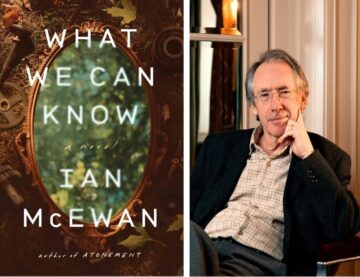
Set one hundred years in the future, the world depicted in Ian McEwen’s new novel, What We Can Know, is a very different one from our own. War and climate disaster have reshaped everything (surprise, surprise). The oceans have risen, and England is now an archipelago. Meanwhile, North America is ravaged by warlords and gangs, and China’s thirty-year experiment with democracy is collapsing amidst the people’s growing desire to wage war on Nigeria, a country which is now the sole remaining superpower and the only place which has managed to keep the lights on.

In England, people mainly eat protein bars and drink acorn coffee. The population has been halved. It’s not such a dire place when the story opens. It’s just harsher, with daily life more constrained. And not surprisingly people look back with longing—and also fury—to the people of our day.

We had so much. Oceans filled with fish and all those vineyards producing delectable wines. In the Age of Derangement, a term borrowed from Amitav Ghosh, why was our relentless avarice allowed to ravage the world unchecked?

One thing that has not changed over the hundred years separating our time with theirs is the human predilection for love and obsession.

Take the novel’s protagonist. Thomas Metcalfe is an academic in the Humanities—a field which has somehow survived to the year 2119, but only barely. Professors are sharing seven to a bathroom and there is no money. And yet, that does not stop Metcalfe from devoting himself to unraveling a certain poem by the poet Francis Blundy. Despite not having access to the work itself, he knows from the massive amounts of data that it did once exist and that it was read aloud by the poet at a legendary dinner party that occurred in 2014, when Blundy, one of the most renowned writers of the time, recited from memory what was a love poem for his wife.

McEwan says he was inspired to write this novel after his own reading of a John Fuller poem called “Marston Meadows: A Corona for Prue,” saying he knew he had to write a novel about it as soon as he read it. Read more »

Corn Mush Latke Pie

by Barry Goldman

It was more than 50 years ago that Mike and I invented Corn Mush Latke Pie. We were living in a flat on Margaret Street near 7 Mile and Woodward in Detroit. We paid 110 bucks a month for the place. It had white walls, white drapes, red carpeting and the kind of bathroom sink that has the hot water coming out of one faucet and the cold out of another. For furniture we had two lawn chairs and a big brass ashtray. We were “in school.”

One night it got to be time to eat and neither of us had any money so we had to look in the cupboard. Naturally, there was nothing in there you could just eat. Stuff you could just eat we had long since eaten. The stuff that was still in the cupboard you had to cook. It was left over from the first week we moved in when we said we would stop eating in restaurants all the time and save money.

What we came up with was some potatoes with giant tubers growing out of them and some Jiffy Corn Muffin Mix. We snapped off the tubers and grated the potatoes, mixed the corn muffin mix with some water and garlic powder and hot pepper flakes, and put the whole thing in a cast iron skillet and put it in the oven. We called it Corn Mush Latke Pie because we didn’t know what else to call it and because latke is Yiddish for potato pancake and potato pancakes are traditional on Hanukkah and it was roughly Hanukkah as near as we could figure.

It was awful, as you might have guessed. Read more »

Poem by Jim Culleny

Rear View

In reflection, the world’s not just a shifty place,
but odd really, the unexpectedness of it, it’s
sudden winds & wild humans shifting as I’ve aged,
sliding from simply familiar to things with
torn edges, never fully knowable, open-ended,
dangerous, yet held together tentatively by
threads of love and unexpected revelations
of beauty until, in entirety, it’s become
not just odd, but
odder still.

Jim Culleny, 11/9/25

Enjoying the content on 3QD? Help keep us going by donating now.

Sunday, November 9, 2025

Canali, Aristocrats, Ant-Men: David Baron on Mars

by David Kordahl

This article is a lightly edited transcript of a conversation with David Baron about his new book, The Martians: The True Story of an Alien Craze that Captured Turn-of-the-Century America. A video of this conversation is embedded below.

Intro and Percival Lowell Background (0:00)
Origins of the Canal Craze (6:39)
Gathering Evidence for the Canals (10:41)
Scientific Debate with Astronomers (14:02)
Thinking about “Outsider Scientists” (23:35)
Influence of Canals on Culture (27:45)
Reflections on Mars and the Future (32:33)

Intro and Percival Lowell Background

Today I’m speaking with David Baron, a seasoned science writer who has contributed to many major American journalism outlets, including the New York Times, the Washington Post, and the Wall Street Journal. He was a longtime science correspondent for NPR, and his TED Talk on the experience of solar eclipses has been viewed millions of times. His last book, American Eclipse, won the American Institute of Physics Science Writing Award in 2018. Today we’ll be discussing his new book, The Martians: The True Story of an Alien Craze that Captured Turn-of-the-Century America.

The “alien craze” in the subtitle of your book is the story of how, for about a decade at the beginning of the twentieth century, many people came to believe that the planet Mars held not only life, but a complex civilization. The person most responsible for popularizing this view as an established scientific fact was Percival Lowell. Lowell functions as a main character in your book.

I want to thank you for joining me today. At what point in your reporting for this book did it become clear that Lowell would function as a central figure in your story?

Oh, pretty much I knew that from the start. I first learned about the so-called “canals on Mars” from Carl Sagan, when I was in high school and watched the Cosmos series on PBS. On an episode about Mars, Sagan talked about this astronomer, Percival Lowell, who at the turn of the last century saw these weird lines on Mars that he believed were irrigation canals. It’s remembered as one of the great blunders in science, because it was an idea that really took off.

What actually surprised me was not that Lowell was my main character, but just how many other people got swept up in this craze—some of them quite prominent, famous scientists and inventors who totally believed that in fact there was the civilization on Mars. It was not just Percival Lowell. It was quite a collection of interesting characters. Read more »

Lessons From Singapore: Always Building

by Eric Feigenbaum

From a corner room in Singapore’s Peninsula hotel, I spent many nights staring out the windows, watch sparks fly silently from the nearby construction sites. Up on the 18th or 14th or 20th floors, Singapore looked still and calm at midnight or 1am. Unlike many big metropolitans, Singapore streets – even in the city center – become quiet at night, especially a weeknight. There was an other-worldly quality watching Singapore’s downtown sleep at night.

My very first visit to Singapore was in February 2004. As business had it, by the end of the year, I was going frequently and for increasingly long stretches – sometimes for seven to ten days at a time, until I rented a condo in March 2025.

But 2004 was filled with nights looking out at the big, fast-moving clouds, giant sky, ships anchored offshore and ever-growing skyline. And sparks. Always sparks coming from below.

It took me a visit or two to realize the new National Library building being built just a couple of blocks away was under construction seemingly 24 hours a day. Which meant from visit to visit – even if it was just a few weeks between – the building grew rapidly. In fact, the 16-story, 338 foot tall, 121,675 square foot site with a gross floor area of 632,918 square feet was completed in less than 18 months. An amazing accomplishment.

As a comparison point, a recently very similar sized project in San Francisco – the 5M Office Tower at 415 Natoma Street took began in mid-2019, taking two years and nine months. Its cost – $158 million – is only $3 million more than the National Library’s – and ironically, the building received a development loan of $393 million from Singapore’s United Overseas Bank.

In a similar time-period as the construction of the Singapore National Library, my alma mater, the University of Washington, built a new Business School building – PACCAR Hall – on nice flat land in exactly two years from 2008 to 2010. Despite it being five stories and 133,000 square feet of total floor area – almost one fifth of the National Library’s – it still took six months longer to construct.

Obviously, 24-hour a day construction gives Singapore an advantage in construction time. But doesn’t that create around-the-clock noise that disturbs the city? Isn’t it inordinately expensive? Aren’t labor unions protesting? Read more »